Expanding to Traffic-Disadvantaged and Outlying Areas... Lowering Production Costs and Increasing Efficiency by Reducing LED Standards
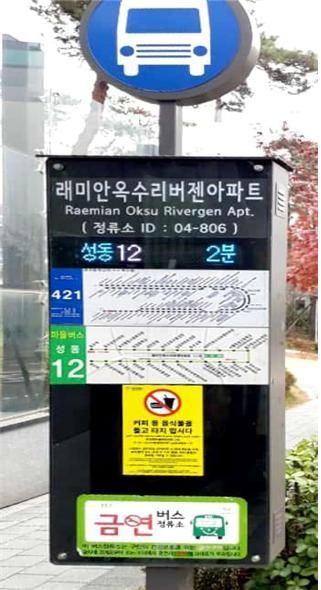
[Asia Economy Reporter Jo In-kyung] The Seoul Metropolitan Government announced on the 3rd that it will install an additional 540 'Bus Information Terminals (BIT)' that provide bus arrival times at bus stops this year. In outlying areas with fewer bus routes, 'high-efficiency mini BITs' recycled from mobile phones will also be installed.
According to Seoul City, starting with a pilot installation of 6 BITs in 2007, a total of 4,930 BITs have been operated at 4,878 bus stops throughout the city as of last year, achieving an installation rate of 78.2%.
This year, BITs will be installed at major bus stops with a large number of routes and daily passengers, such as City Hall (5 routes, 607 daily boardings), Hongdaeipgu Station (5 routes, 1,184 boardings), Sinnonhyeon Station (11 routes, 5,098 boardings), and Cheongnyangni Hyundai Coa (18 routes, 1,869 boardings).
In particular, for 270 metropolitan bus stops within Seoul, the city plans to invest in 120 BITs this year and secure national funding to supply an additional 150 units next year, expanding BIT installation across all areas.
For outlying areas where BIT installation has been difficult and underserved, as well as bus stops with only one route, high-efficiency mini BITs recycled from old mobile phones will be installed.
The high-efficiency mini BIT reduces LED specifications compared to existing budget BITs and lowers power consumption and production costs by recycling old mobile phones instead of using internal control boards, thereby saving budget. Last year, 11 stops were pilot-installed to conduct winter performance tests and effect analysis.
While the production and installation cost of existing budget BITs is about 5 million KRW per unit, the mini BIT costs 3.5 million KRW, according to Seoul City.
The city also plans to gradually replace BITs installed before 2010, which are outdated and frequently malfunction. This year, 200 units will be prioritized for replacement with improved designs on major roads such as Hangang-daero and Mangu-ro central lanes.
Ma Chae-sook, Seoul City’s Walkability Planning Officer, said, "We will further expand BIT construction using resource upcycling such as mobile phones and eco-friendly facilities. We will also expand distribution to underserved bus stops in areas with fewer bus routes and lower service frequency, as well as metropolitan bus stops frequently used by citizens in the Seoul metropolitan area, to eliminate blind spots in transportation welfare."
© The Asia Business Daily(www.asiae.co.kr). All rights reserved.

















