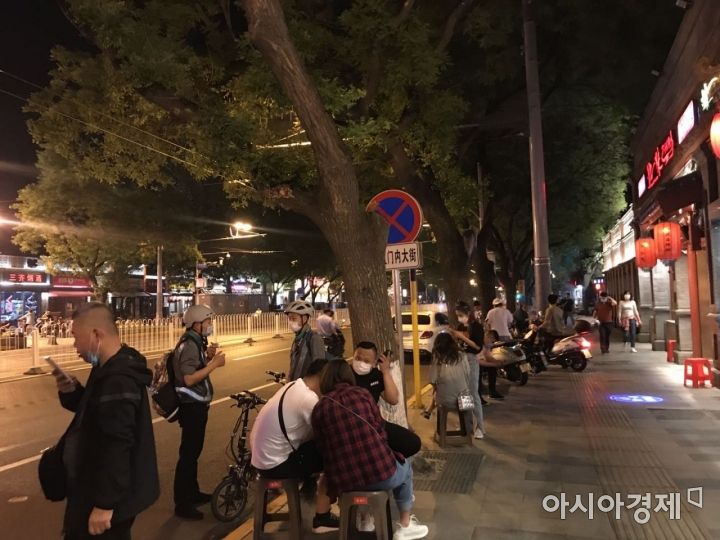
 Guijie, a famous night food street in Beijing, China, was bustling with people enjoying late-night snacks on the night of the 1st during the Labor Day holiday. Due to COVID-19, restaurant tables were arranged with a 1-meter distancing rule, and most eateries were either fully occupied or had sold out their prepared menus. The photo shows customers waiting in front of a fully occupied restaurant. Photo by XXX
[Asia Economy Beijing=Special Correspondent Park Sun-mi] On the first day of the Labor Day Golden Week holiday (May 1-5), major tourist attractions across China were bustling with tourists as the risk of spreading the novel coronavirus infection (COVID-19) decreased. While maintaining COVID-19 prevention measures, the Chinese government, aiming for economic normalization, has taken steps to allow more Chinese citizens to travel freely between regions by establishing a nationwide unified COVID-19 health QR code system.
On May 2, China’s state-run Xinhua News Agency cited statistics from the Ministry of Culture and Tourism, reporting that the tourism market showed overall stability on the first day of the Labor Day holiday. A total of 8,498 nationwide A-level tourist attractions were open during the holiday, accounting for 70% of all tourist sites.
To reduce the risk of COVID-19 infection, daily visitor numbers at open tourist sites were controlled to within 30% of their maximum capacity. Despite these restrictions, the number of tourists within China on the first day of the Labor Day holiday reached 23.197 million. The tourism revenue generated by these visitors amounted to 9.77 billion yuan. The Chinese government expects the total number of tourists during the five-day Labor Day holiday to reach 117 million.
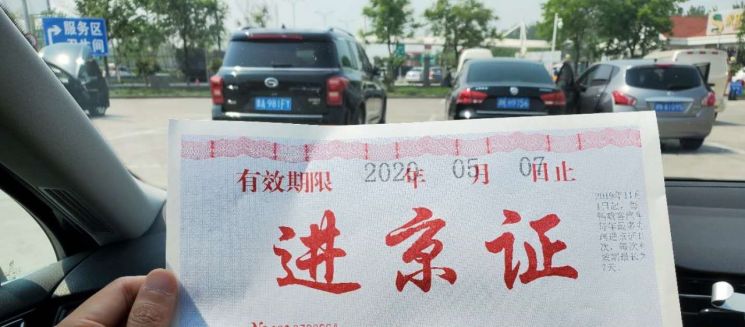 On the 1st, when the Labor Day holiday began, the Beijing highway checkpoint experienced traffic congestion due to vehicles from outside areas seeking entry permits to Beijing. As more people went out for the Labor Day holiday, travel time between Tianjin and Beijing doubled compared to usual.
Among Beijing’s major tourist attractions, the Forbidden City reopened for visits starting May 1. This came after a suspension of operations for over three months since January 25 due to concerns over COVID-19 spread. However, to prevent overcrowding, entry was limited to 5,000 visitors per day by reservation only. The National Museum of China also reopened on May 1, operating under a reservation system allowing only 3,000 visitors per day. On the first day of the Labor Day holiday, the "2020 Beijing World Horticultural Expo Health Run" event was held at the Beijing World Horticultural Expo Park.
The health QR code, which has served as a travel permit in China since the COVID-19 outbreak, has now established a nationwide unified system, laying the groundwork to stimulate more domestic tourism demand.
The Chinese government announced the national standard COVID-19 health QR code the day before, unifying approximately 100 different health codes that had been operated across the country. Authorities explained that with the application of the national standard COVID-19 health QR code, local governments will recognize health codes through a single system, allowing more people to be free from quarantine and travel restrictions.
Previously, different regions applied different health QR codes, causing discord between regions where even people with a "green" code?indicating safe passage?were not permitted to travel in other areas. For example, residents of Hubei Province, severely affected by COVID-19, often faced 14-day quarantine measures in other cities despite having received green codes from their local authorities.
The e-commerce industry and local governments are also viewing the Labor Day holiday as an opportunity to boost consumption, holding various May 1st commemorative discount events. Shanghai is hosting large-scale discount events during the holiday period involving nearly all online sales platforms and stores in the region to stimulate the economy. The e-commerce platform JD.com has not only offered discounts on home appliances for the May 1st holiday but also created a special section focusing on brands from Hubei Province, reflecting the unique circumstances of COVID-19 this year.
Luo Sugang, Director of the Ministry of Culture and Tourism, stated that many Chinese people are expected to engage in tourism and consumption that had been suppressed due to the COVID-19 crisis during the Labor Day holiday. He urged that vigilance against COVID-19 should not be relaxed during the holiday period. Director Luo emphasized, "Visitors should make reservations before visiting tourist sites, honestly report their health information, and maintain social distancing from others," while also recommending mask-wearing, hand washing, and avoiding group meals.
© The Asia Business Daily(www.asiae.co.kr). All rights reserved.
![Clutching a Stolen Dior Bag, Saying "I Hate Being Poor but Real"... The Grotesque Con of a "Human Knockoff" [Slate]](https://cwcontent.asiae.co.kr/asiaresize/183/2026021902243444107_1771435474.jpg)

















