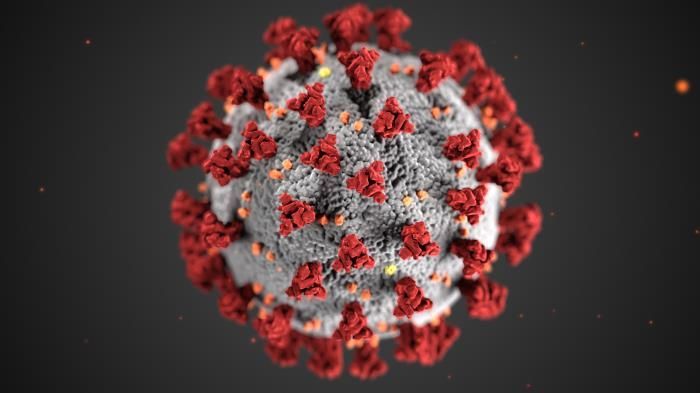
[Asia Economy Reporter Junho Hwang] A U.S. research team has released findings predicting a second wave of the novel coronavirus infection (COVID-19) this fall, which could escalate into a more severe situation than the first wave. This spread of COVID-19 is expected to continue for at least 18 to 24 months, infecting more than half of the world's population. Given that deaths are expected to continue during the spread of COVID-19, there are calls for strict government measures worldwide.
COVID-19 to last 18-24 months... Infecting more than half the population
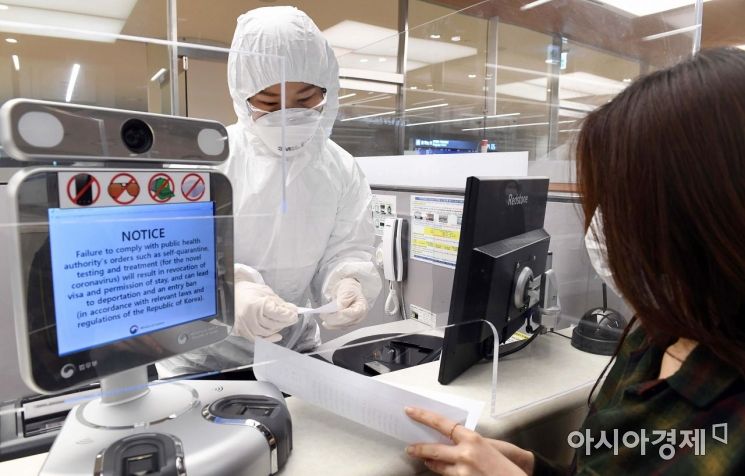 An immigration officer from the Ministry of Justice's Incheon Airport Immigration Foreigners Office is explaining self-quarantine guidelines at the dedicated symptomatic arrivals inspection counter at Terminal 2 of Incheon International Airport on the 8th. Photo by Moon Honam munonam@
The Center for Infectious Disease Research and Policy (CIDRAP) at the University of Minnesota stated in a COVID-19 report released on the 30th of last month, "U.S. health authorities must prepare for the worst-case scenario," adding, "Even in the best-case scenario, deaths from COVID-19 will continue to occur."
The research team predicted that the spread of COVID-19 will not stop. Mike Osterholm, director of the research center, said, "The idea that the coronavirus crisis will end soon goes against microbiology," and "This situation will not stop until 60-70% of people are infected." Osterholm is an expert who has studied infectious diseases for 20 years.
According to the research report, since the pandemic began with no immunity to COVID-19, it is expected to continue for the next 18 to 24 months until 60-70% of the entire population is infected. COVID-19 is characterized by a long incubation period, asymptomatic transmission, and a high reproduction number (R0). Analyzing these factors, more people need to be infected and develop immunity to stop COVID-19.
Three scenarios for the COVID-19 pandemic
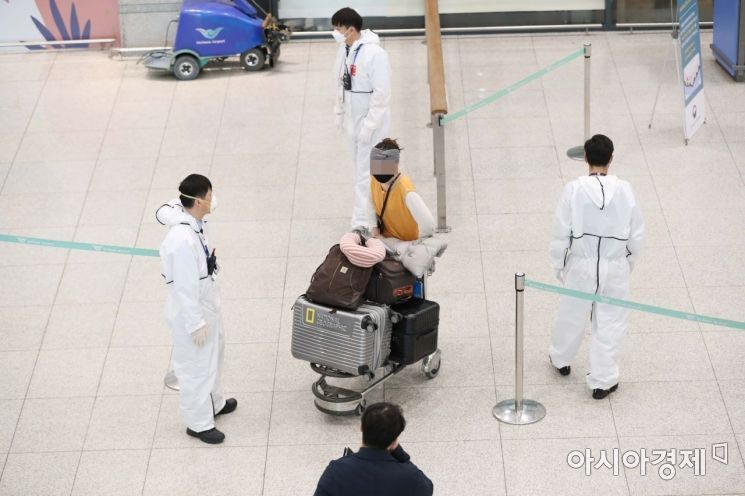 On the 1st, when the mandatory 2-week self-quarantine for all incoming travelers from abroad began, arrivals at Terminal 1 of Incheon International Airport received transportation-related guidance. Photo by Moon Honam munonam@
The report presented three pandemic scenarios based on these assumptions.
First, following the ongoing first pandemic wave, second and third waves will occur from this summer, after which the spread will gradually decrease starting next year. Another scenario is that after this pandemic, a larger and more severe outbreak will occur this fall or winter, followed by a lull starting next year. The last scenario is a gradual decline amid continuous cases and deaths without a major outbreak.
The research team emphasized the need to prepare for the second scenario. They argued that instead of governments assuring citizens that COVID-19 will end soon, preparations should be made for a prolonged COVID-19 crisis.
In addition to Osterholm, the study involved Mark Lipsitch, an epidemiologist at Harvard University School of Public Health; Christine Moore, formerly of the Centers for Disease Control and Prevention (CDC); and historian John Barry, author of the book "The Great Influenza" about the 1918 Spanish flu pandemic.
© The Asia Business Daily(www.asiae.co.kr). All rights reserved.
![Clutching a Stolen Dior Bag, Saying "I Hate Being Poor but Real"... The Grotesque Con of a "Human Knockoff" [Slate]](https://cwcontent.asiae.co.kr/asiaresize/183/2026021902243444107_1771435474.jpg)


















