[Asia Economy Reporter Park Hyungsoo] As the number of confirmed cases of the novel coronavirus infection (COVID-19) worldwide surpassed 3 million, society is rapidly transitioning to a contactless (untact) environment. With the spread of untact culture, internet data traffic has surged, and demand for server DRAM has also increased. This is why semiconductor-related companies are expected to improve their performance amid growing concerns about a global economic recession. The semiconductor industry, a representative export item of Korea, is one of the key indicators to gauge the domestic economic recovery. We take a closer look at materials, parts, and equipment companies within the semiconductor value chain showing signs of performance improvement.
As demand for server semiconductors increased, Hansol Chemical also performed well in the first quarter of this year. With increased shipments of hydrogen peroxide for semiconductors, the profit scale remained at the previous year's level. Going forward, with additional sales of new materials, Hansol Chemical's profit scale is expected to steadily grow despite concerns about an economic downturn caused by the COVID-19 pandemic.
According to the Financial Supervisory Service, the National Pension Service increased its stake in Hansol Chemical to 14.35% (1,620,862 shares) this year. During the period when Hansol Chemical's stock price sharply dropped last month, it net purchased about 12,000 shares on the market. This appears to be a low-price purchase based on the judgment that performance stability is high this year.
Founded in 1980, Hansol Chemical produces precision chemical materials and electronic materials such as hydrogen peroxide (H2O2), precursors, and quantum dot (QD) materials. Hydrogen peroxide is mainly used for newspaper paper bleaching, semiconductor cleaning, liquid crystal display (LCD) etching, wastewater treatment, and soil restoration. As Samsung Electronics and SK Hynix expand their semiconductor lines, demand for ultra-high purity hydrogen peroxide is increasing.
Precursors are thin film materials used in the semiconductor manufacturing process to form thin films. They are consumable materials used in semiconductor deposition processes, and their usage increases as semiconductor processes become finer. Demand is rising with the advancement of fine process technology.
Due to the impact of COVID-19, data traffic is steadily increasing. More companies have adopted remote work, and general consumers' online shopping has also increased. This has acted as a factor promoting facility investment by data center companies. The investment scale of global internet companies such as Google, Facebook, Amazon, and Microsoft is expected to increase by 15% compared to the previous year. This is why demand for memory semiconductors such as server DRAM and solid-state drives (SSD) is increasing due to data center expansion.
DB Financial Investment researcher Eo Gyu-jin explained, "Annual demand for server DRAM and SSD is expected to increase by 29.0% and 45.0%, respectively, this year," attributing this to "the increase in remote work, online lectures, and video content viewing time."
Hansol Chemical increased its production capacity of hydrogen peroxide for semiconductors by about 30% compared to the previous year. It is ready to respond to new demand arising from increased shipments of high-capacity memory modules for data centers by Samsung Electronics and SK Hynix this year. Hansol Chemical supplies hydrogen peroxide to Samsung Electronics' Pyeongtaek 2 plant.
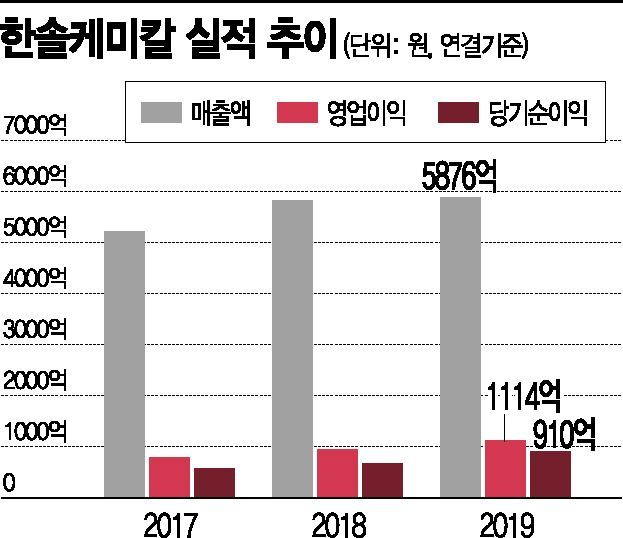
DB Financial Investment estimated that Hansol Chemical will achieve sales of 617.4 billion KRW and operating profit of 130.2 billion KRW this year. These are expected to increase by 5.1% and 16.9%, respectively, compared to the previous year. The current stock price is below a price-earnings ratio (PER) of 10 times and a price-to-book ratio (PBR) of 2 times based on this year's expected performance.
Until 2018, Hansol Chemical increased its borrowings through investments related to electronic materials, expansion of ultra-high purity hydrogen peroxide, and acquisition of Taepax. As the investment effects appeared, operating profit increased by about 18% compared to the previous year last year and is expected to continue to grow steadily from this year onward. The debt ratio stood at 80.4% as of the end of last year.
© The Asia Business Daily(www.asiae.co.kr). All rights reserved.
![Clutching a Stolen Dior Bag, Saying "I Hate Being Poor but Real"... The Grotesque Con of a "Human Knockoff" [Slate]](https://cwcontent.asiae.co.kr/asiaresize/183/2026021902243444107_1771435474.jpg)










