Prioritizing 'Work-Life Balance' but 'Customer Abuse' Persists
9 out of 10 Part-Time Workers "Hurt by Customers' Rude Behavior"
Emotional Labor Protection Law Faces Effectiveness Doubts
Experts "Societal Effort Needed"
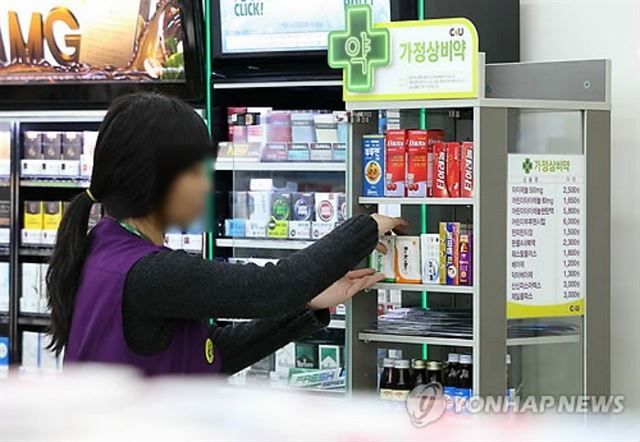
[Asia Economy Reporter Heo Midam] "Miss, I'll have an Americano," "Don't you even know your regular customer's menu preference?"
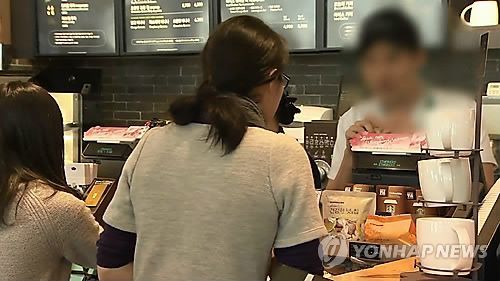
Kim (25), a university student working part-time at a cafe in Mapo-gu, Seoul, recently had an unpleasant experience. A customer abruptly spoke to Kim in an informal tone while ordering coffee. Kim sighed, saying, "It's common for customers to speak informally," and added, "Even if I feel upset, I can't show it. If I get angry, they might just raise their voice even more."
She continued, "Part-time workers are still considered 'subordinates.' Isn't the reason I get disrespected because I'm a part-timer?" and said, "I hope everyone could at least observe basic manners."
As the issue of abusive behavior by black consumers (malicious customers) has emerged as a social problem, the number of customers aiming for 'manner consumption' has increased. 'Manner consumption' refers to consuming while respecting and considering the other party rather than demanding unconditional kindness from workers. However, many emotional laborers still suffer from so-called 'abusive customers' in the field. Experts suggest that social attention is needed to improve the human rights of part-time workers.
Unlike the past when "the customer is king," there is a growing awareness that employees and customers should respect and consider each other. Professor Kim Nando of Seoul National University's Department of Consumer Studies also identified 'worker-customer-balance (worker-customer-balance)' as one of the top ten consumer trends in 2019 through 'Trend Korea 2019.' 'Worker-customer-balance' means a balance between employees and customers, implying that employees should be kind to customers, but customers should also show courtesy to employees.
Despite this trend, part-time workers still suffer from rude behavior by customers. According to a survey conducted by the part-time job portal Albamon last year targeting 952 part-time workers, 90.2% responded that they had been hurt by customers' bad manners during their part-time work.
They cited moments when they were hurt during work as △ dealing with customers who speak informally (51.5%) △ requests beyond the part-timer's authority such as "give me a discount" or "give me free service" (27.5%) △ customers throwing or slapping money or cards (26.9%) △ customers demanding unconditional apologies from part-timers even when the customer made a mistake (24.8%) △ venting by nitpicking such as "It tastes bad," "The service is terrible" (16.3%) and so on.
Other bad manners included △ ignoring part-timers' greetings (12.1%) △ repeatedly calling part-timers for even minor issues including self-service (9.3%) △ demanding the boss come out unconditionally (7.7%).
Previously, in October 2018, the 'Emotional Laborer Protection Act' (an amendment to the Industrial Safety and Health Act) was enacted to prevent workers from suffering verbal abuse and assault from customers. However, since it lacks enforceability, opinions say it is practically insufficient to protect workers.
According to the amendment, employers must prepare customer service manuals and take measures such as posting phrases to prevent verbal abuse by customers at the workplace. However, there are no regulations to punish employers for failing to comply. Employer punishment is only possible if unfair personnel measures are taken against workers who requested 'work suspension' due to customer service damage.
As a result, there are criticisms that the law revision is ineffective. According to a survey conducted last year by the Emotional Labor National Network targeting 2,765 emotional laborers, 70% of respondents said they were not protected by the Emotional Laborer Protection Act. In particular, 62% of female respondents and 42% of male respondents were in need of psychological healing due to emotional labor-related distress.

Lee (25), who has been working part-time at a convenience store for six months, also did not take any special action against verbal abuse from customers. Lee said, "While working at the convenience store, a customer stood in front of the register and ordered me to bring alcohol. When I said they should get the items themselves, they got furious," adding, "I didn't want to make a big deal out of it, so I brought it, but I wondered if I really had to do this kind of work."
She added, "Even if I report it, nothing will change. Troublemaker customers exist everywhere, and reporting one or two won't solve the problem."
Experts emphasize the need for social attention to improve the human rights of part-time workers. The Korea Occupational Safety and Health Agency stated in the occupational health guideline 'Emotional Labor Workers' that "The excessive customer-first principle, customers' unreasonable demands, and irrational behavior can cause unhealthiness among emotional labor workers, and the entire nation should recognize this and make a societal effort to manage the health of emotional labor workers."
They added, "It is necessary to establish a desirable consumer-worker relationship through campaigns where consumers voluntarily gather to raise consumer awareness or by publishing promotional booklets."
© The Asia Business Daily(www.asiae.co.kr). All rights reserved.



















