Middle and High Schools in China, European Elementary Schools Start
Singapore Shaken by Spread Just 2 Weeks After School Opens
South Korea to Decide School Reopening Timing and Method Next Month
Following Living Quarantine System
"Staggered Reopening" Sparks Debate on Timing
Two-Track System of In-Person and Remote Classes Maintained
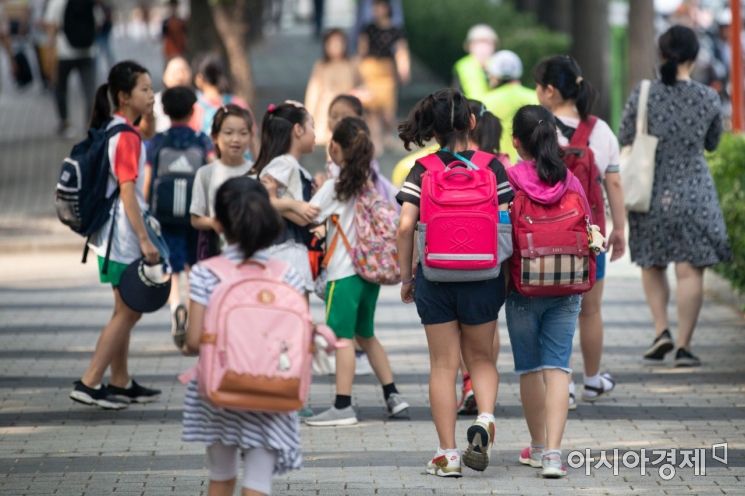
[Asia Economy Reporters Hyunju Lee and Hyunjin Jung] "If a student tests positive after the school reopens for in-person classes, the entire grade will be prohibited from attending school. Then, who will be blamed? Will my child be able to attend school without stigma even after full recovery?" (Elementary school teacher A)
"Whether it's e-learning platforms or YouTube... I don't think grandparents can continue to supervise remote classes. The kids don't concentrate well either. Since both my spouse and I work, we're considering emergency childcare." (Parent of a lower elementary student B)
Since the implementation of online school openings due to the COVID-19 pandemic, there has been intense debate over whether to resume in-person classes. Opinions are divided between those who believe reopening schools is still too risky due to infection concerns and those who argue that phased reopening is possible as emergency childcare expands. There are also claims that reopening schools is necessary so parents can return to work and resume economic activities. Although the number of new confirmed cases in Korea has recently dropped to single digits, signaling a positive trend, asymptomatic infections still exist and vaccines have not yet been developed, so many feel it is too early to relax. The Ministry of Education plans to decide on the timing and method of reopening schools in early May, in coordination with the Central Disaster and Safety Countermeasures Headquarters' transition to a daily quarantine system. Even if schools reopen, the current experience with remote learning is expected to serve as a cornerstone for establishing blended learning (a method that integrates online learning into regular education programs).
◆Europe starts with elementary schools, China with middle and high schools= The debate over reopening schools is not unique to Korea. Countries worldwide, from China to Singapore, the United States, and European nations, are grappling with when and how to reopen schools.
China, the epicenter of COVID-19, has been gradually reopening schools since last month, depending on the region. Some areas like Qinghai have already started in-person classes for third-year middle and high school students, while all regions except Hubei Province plan to resume classes by the end of this month. Hubei Province, where Wuhan is located, will begin reopening for third-year middle and high school students starting June 6. Although the spread of the virus has somewhat subsided since early last month, China delayed reopening due to a surge in imported cases from overseas.
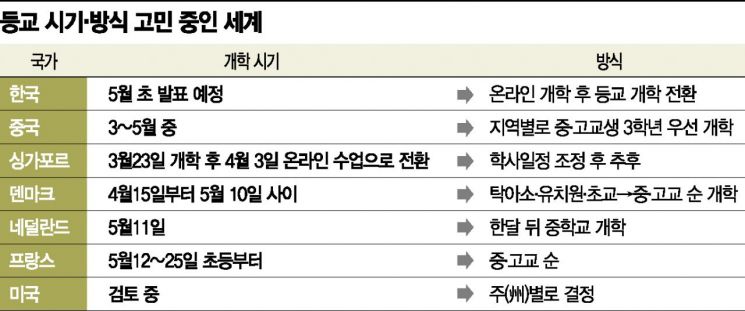
Most European countries are moving forward with reopening schools. Denmark was the first European country under lockdown to reopen daycare centers, kindergartens, and elementary schools on the 15th. Despite some parental opposition before and after reopening, the Danish government divided students into small groups and arranged desks to maintain at least 2 meters of distance between students. They are also actively implementing measures to prevent spread, such as conducting classes outdoors whenever possible. Norway reopened schools on the 20th.
The Netherlands plans to reopen elementary schools on June 11 and middle schools a month later. France will first allow elementary students to return on June 12, followed by a gradual reopening of middle and high schools, aiming for all schools to be open by June 25.
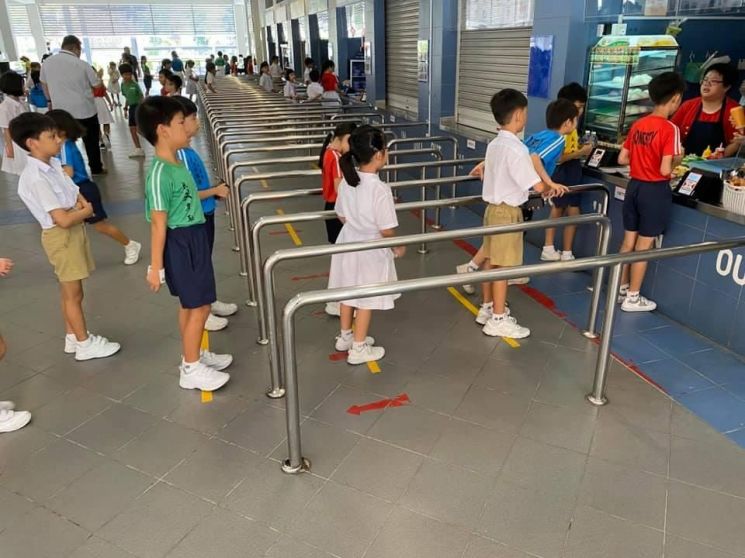
Singapore, which operates on a three-term system and was once a model for quarantine, reopened after a short spring break on April 23 but quickly switched back to online classes after two weeks due to a surge in cases. In the United States, states are reviewing lifting lockdown measures on a state-by-state basis, with school reopening timing a primary concern. According to CNN, as of April 22, governors in 39 states, including Washington D.C., have instructed or recommended schools remain closed through the end of the spring semester in June. Andrew Cuomo, governor of New York State, which has the highest number of COVID-19 cases in the U.S., emphasized that "economic activities and public transportation must resume closely alongside school reopening," adding that "schools must not become sites of infection and must have pre-established protocols for disinfection and social distancing."
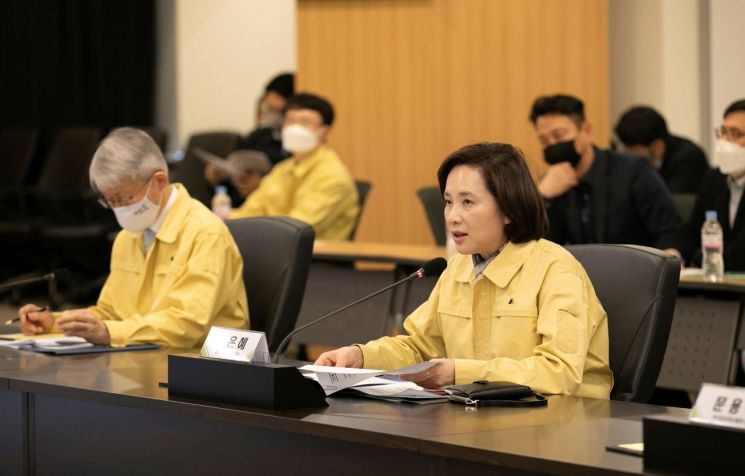
◆Ministry of Education to follow a three-step process before announcing results= The Ministry of Education is currently consulting with infectious disease experts, the Korea Disease Control and Prevention Agency, and other related ministries on school quarantine measures and preparations for reopening. Starting April 27, they will collect opinions from teachers and parents through surveys and consult with provincial education superintendents. The final decision on reopening will be made between May 2 and 5, linked to the Central Disaster and Safety Countermeasures Headquarters' announcement on the readiness for daily quarantine and system transition. The Ministry plans to carefully consider the current infection status, controllability, and infection risk among students, as well as phased reopening by grade level.
Learning management systems (LMS) such as EBS Online Class and e-Hakseupter previously experienced frequent outages but have stabilized since a joint public-private task force was established on April 14. The servers have maintained stability even with peak simultaneous users exceeding 500,000. Teachers on the ground are gradually gaining momentum. Since the school opening, teachers have continuously created content, with cumulative content on e-Hakseupter, mainly for elementary students, reaching approximately 1.76 million items, and about 540,000 items on EBS Online Class. Measures against improper attendance are also being strengthened. If cheating such as code manipulation or opening multiple lectures simultaneously is detected, teachers can question students about their attendance, and if confirmed that they did not properly attend, the absence can be recorded.
Even if in-person classes resume, remote learning is expected to continue in a two-track system. If a confirmed case occurs after reopening, the affected school will need to close classes or grades or switch to remote learning. Park Baek-beom, Deputy Minister of Education, stated, "In some schools, the COVID-19 situation may not be resolved quickly, and there may be another crisis in the fall or winter, so we must prepare in advance."
© The Asia Business Daily(www.asiae.co.kr). All rights reserved.



















