[Asia Economy Reporter Donghyun Choi] The Seoul Metropolitan Government announced on the 24th that it will improve the criteria for changing land use zones for transit station area youth housing.
Transit station area youth housing is a housing policy in which the Seoul Metropolitan Government provides benefits such as land use zone upgrades, floor area ratio relaxation, simplified procedures, and construction fund support, allowing private developers to build 100% residential rental housing (public and private) in transit station areas with convenient public transportation, prioritizing supply to university students, youth, and newlyweds.
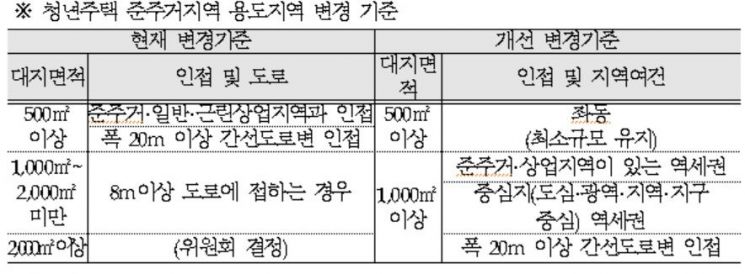
The transit station area youth housing project has been limited to participation only in quasi-residential and commercial zones within transit station areas. However, there have been criticisms that the requirements for changing land use from residential zones type 2 and 3 to quasi-residential zones were too stringent, lowering accessibility for project participation. In response, Seoul has improved the criteria to encourage active land use zone upgrades and to enable more private developers to participate.
According to the improved criteria, when changing the land use of sites with a land area of 1,000㎡ or more to quasi-residential zones, it is possible if the site meets at least one of the following conditions: ▲ located in a transit station area with quasi-residential or commercial zones ▲ located in a transit station area designated as a center (downtown, metropolitan, regional district, or district center) under the 2030 Seoul Urban Basic Plan ▲ adjacent to a main road with a width of 20m or more. In particular, sites with a land area of 1,000㎡ or more can be designated as public-supported private rental housing promotion districts. This enables a one-stop service for both building permits and land use zone changes through the Seoul Metropolitan Government, accelerating the project.
Additionally, the road width standards related to different land area sizes have been rationalized by applying individual legal frontage conditions according to the "Special Act on Private Rental Housing," which refers to the "Housing Act" and the "Building Act." The city expects that by reflecting the already disclosed urban planning center system, private developers wishing to participate in transit station area youth housing will be able to predict project site selection criteria more transparently and accurately, lowering the barriers to participation. Furthermore, through land use zones and urban management linked to the center system, it is expected to complement the consistency of the land use zone change criteria for transit station area youth housing and expand the discovery of project sites.
Kim Seong-bo, Director of Housing Planning at the Seoul Metropolitan Government, said, "With the improved criteria, youth housing supply has become possible even in transit station areas that are central but could not be changed to quasi-residential zones." He added, "We will continue to discover reasonable and diverse measures to revitalize projects and expand the supply of youth housing."
© The Asia Business Daily(www.asiae.co.kr). All rights reserved.

![User Who Sold Erroneously Deposited Bitcoins to Repay Debt and Fund Entertainment... What Did the Supreme Court Decide in 2021? [Legal Issue Check]](https://cwcontent.asiae.co.kr/asiaresize/183/2026020910431234020_1770601391.png)