Asia Economy & Seoul City Joint Project [Work-Life Balance 2.0 Era]
'Work-Life Balance Strong Small Business' How Work and Life Have Changed
Database Security Company 'Shinsihey'
No fixed start time
Commute according to own work schedule
Not required to complete 40 hours per week
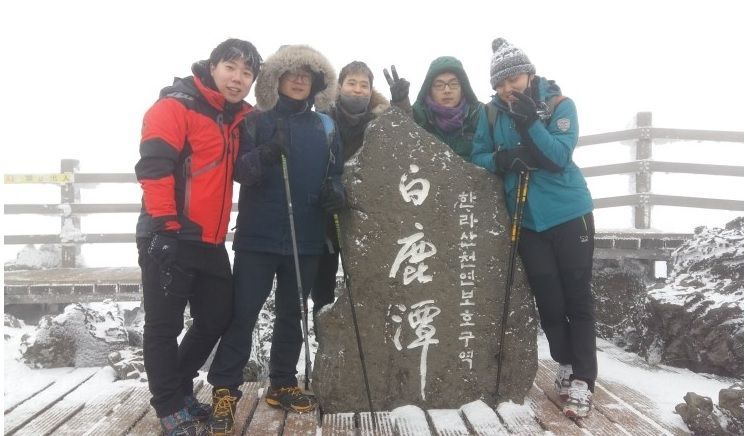 All employees of Shinseway hold a 'kick off' event at the beginning of the year. It is a gathering where all employees share their goals together with the spirit of 'Songguyeongsin (seeing off the old and welcoming the new)' before the start of the year. It was mainly held in Jeju, where the R&D center is located. In January 2017, employees who climbed to the summit of Hallasan are taking a commemorative photo. (Provided by Shinseway)
[Asia Economy Reporter Hyunju Lee] Fixed-rate housing loan support at 1%, in-house clubs, corporate cards with a personal limit of 1 million KRW, payment of communication expenses, employee-only caf?, provision of education and book purchase expenses...
These are the work-life balance (WLB) policies implemented at Shinseway, a DB security company located in Munjeong-dong, Songpa-gu, Seoul. From a long-term perspective, these policies are formalized to help employees adjust their personal lives and work environments without getting exhausted by work. The support for clubs and self-development expenses reflects the high proportion of unmarried employees.
At the entrance of Shinseway’s headquarters, which is about 660㎡ (approximately 200 pyeong) in size, the aroma of coffee fills the air as if entering a caf?. The employee-only caf?, equipped with soft lighting, also hosts birthday parties once a month for employees celebrating their birthdays. Every morning, employees gather here in small groups to drink coffee.
Founded in 2005, Shinseway’s homepage introduces the company as a DB security specialist “created by people who respect each other.” The company prides itself on people and technology being its greatest assets. The average length of service is five years, which is relatively high compared to other small and medium-sized enterprises. There are also 11 employees who have worked for more than 10 years. Last year, the company achieved sales of about 7 billion KRW.
The company name “Shinsi” is the name of a city that Hwanung established under the Sindansu tree on Mount Taebaek, and “Way” is derived from “way.” CEO Jaehoon Jung said, “The creation of new technology ultimately starts with people,” adding, “Rather than subordination based on a single decision by management, providing an environment and foundation where employees can work with respect can increase productivity.”
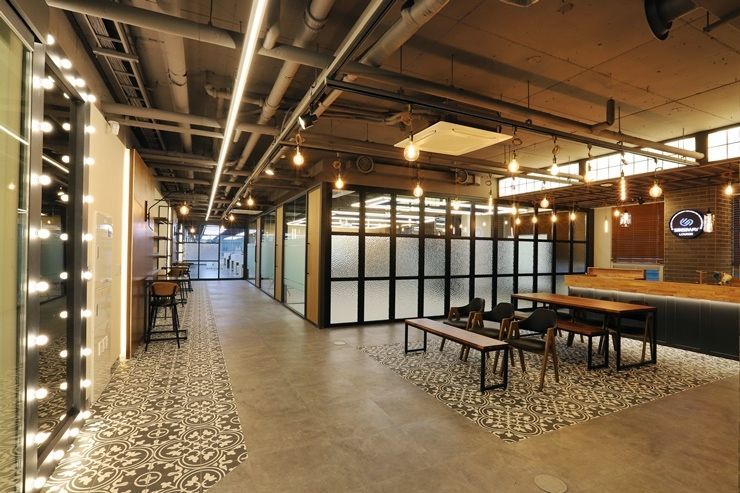 In November 2017, Shinseway relocated to its current headquarters located in Munjeong-dong, Songpa-gu. To create a comfortable space where employees can take a brief rest, the main entrance was designed in the style of a caf?. Right next to the entrance, an ondol lounge was set up where both male and female employees can relax. (Provided by Shinseway)
There is no fixed start time for work. The basic principle is not to evaluate work performance based on time restrictions. Employees only need to arrive at work when collaboration with other teams is required. Even then, the time is not enforced but decided through mutual agreement. The legal working hours of 40 hours per week may or may not be fulfilled. If an employee works overtime one week, they can reduce their working hours the following week on their own. Since 80% of employees are engineers (developers), many do not come to the headquarters but go directly to client sites. The same applies to leaving work; employees can leave the site once their tasks are completed regardless of the time. However, each team has assigned tasks, and work division and responsibility follow accordingly. Song Jonghoon, head of the Management Support Division, explained, “The corporate culture is generally oriented toward granting a lot of autonomy and authority.”
Kim Mina, who has been with the company for over two years after changing jobs from her first workplace, expressed high satisfaction in various aspects. She said, “My previous workplace had a so-called military-style culture where we were pressured from above to increase sales, so all employees were tense together,” adding, “I was always scared of what noise might come next and wondered whether I should keep working or quit, but here it’s the complete opposite.” She emphasized, “Since I can work autonomously within the given time, work efficiency has significantly improved.”
Employee birthday parties at the in-house caf?
Support for housing loans at 1%
Corporate cards with 1 million KRW per person also provided
Due to the COVID-19 pandemic, since late February, except for about 10 essential personnel, most employees have been working from home. Masks were provided to engineers who need to frequently visit sites. The company has a total of 66 employees, with 3 and 5 employees working at the Jeju R&D Center and Daejeon Technical Support Center, respectively, in addition to the headquarters. Meetings are mainly conducted via video conferencing.
Employees who have worked for one year receive low-interest housing loans supported by the company’s reserve funds. About 6 to 7 employees apply each year. Regardless of rank, most employees participate in clubs. The activities range from cultural ones like cooking and movie watching to sports such as futsal, fitness/marathon, and fishing. The company supports 40,000 KRW per person for these activities. Shinseway employees enjoy gathering together.
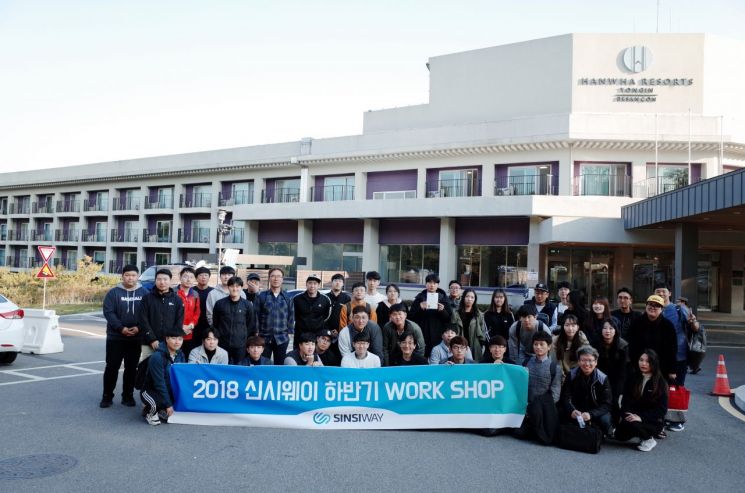 Shinsihei holds quarterly workshops in the suburbs not far from the company. The focus is on sharing experiences related to self-development and relieving stress from daily work through various recreational activities. In the second half of 2018, all Shinsihei employees went on a workshop to Yangpyeong, Gyeonggi Province, and took a group photo. (Provided by Shinsihei)
In addition to communication expense support, corporate cards with a limit of up to 1 million KRW per employee are provided, reflecting the CEO’s intention to grant autonomy and responsibility to employees. Deputy Manager Ji-young Hwang said, “You can claim all amounts if used for work purposes, and I think the limit is quite high,” adding, “When you think the company has given you this much authority, your sense of responsibility also grows.”
Unlike most companies that only have women’s lounges, this company has ondol-style lounges for both men and women so employees can rest during lunch or free time. Go Minjung, who recently returned from parental leave, said, “Using leave and commuting are flexible, and especially the team leader creates a good atmosphere first, so my mind feels much lighter.” Lee Yuri, a consultant from the Seoul Work-Life Balance Support Center, which conducted on-site consulting six times, said, “The consulting proceeded smoothly thanks to the active cooperation of the CEO and the person in charge,” and evaluated, “As an excellent company included in the top 10% in corporate welfare evaluations among IT development companies, its future growth potential is expected to be very high.”

© The Asia Business Daily(www.asiae.co.kr). All rights reserved.



















