 Citizens visiting Hangang Citizen's Park in Yeongdeungpo-gu, Seoul, on the 3rd, enduring the worst heatwave and tropical nights, are cooling off in the river breeze. Photo by Hyunmin Kim kimhyun81@
[Asia Economy Reporter Junho Hwang] The principle behind tropical night insomnia, where it is difficult to overcome drowsiness during the hot summer daytime and sleepless at night, has been identified. It was found that temperature affects the activity of sleep center neurons, causing sleepless nights during tropical nights. The domestic research team that uncovered this principle evaluated that it could provide a clue to resolving sleep disorders.
According to Ulsan National Institute of Science and Technology (UNIST) on the 21st, Professor Jeonghoon Lim's team from the Department of Life Sciences at UNIST revealed the 'principle of how sleep patterns change according to temperature' using a fruit fly model.
The research team explained that the inhibitory neurotransmitter 'GABA' is regulated according to temperature, causing the synapses between sleep-regulating neurons to disappear, which affects sleep patterns.
Temperature Influences Activity of Sleep Center Neurons
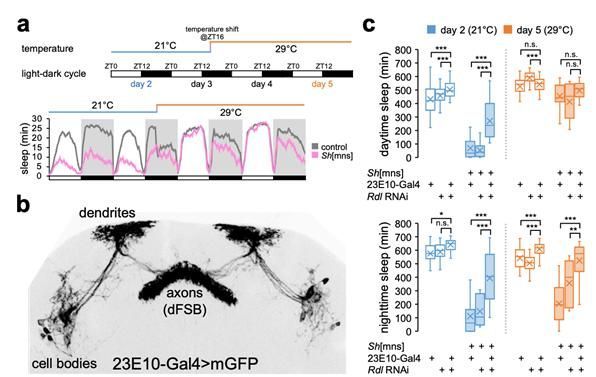 A diagram illustrating the phenomenon where sleep behavior changes according to temperature are regulated through the GABA receptor (Rdl) of the sleep-promoting neurons (dFSB).
The research team used fruit flies with a mutation in the 'Shaker gene' to identify this fact.
The protein produced by the Shaker gene forms a channel for potassium ions in the brain. When this protein is deficient, it excessively activates neurons, suppressing sleep. The research team reported that these mutant fruit flies did not show sleep suppression when raised in a high-temperature environment.
As a result of studying these mutant fruit flies, the team found that as the temperature rises, the synapses between GABA-producing neurons and dFSB disappear, allowing for better sleep.
In particular, they discovered that the signals regulating dFSB change depending on temperature. At low temperatures (21℃), GABA controls dFSB activity, while at high temperatures (29℃), another neurotransmitter, dopamine, regulates dFSB activity.
Temperature Also Affects Dopamine Action
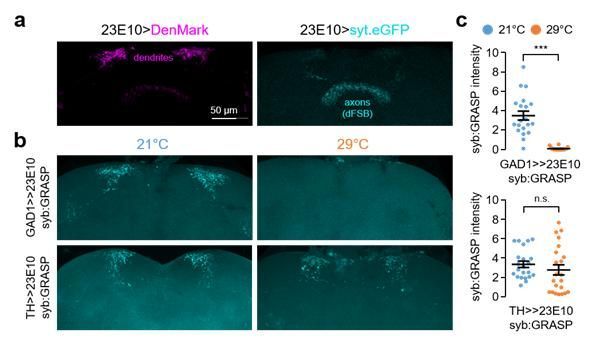 A diagram showing synaptic plasticity between GABA-producing neurons affected by temperature changes and sleep-promoting neurons (dFSB).
Ji-hyung Kim, a doctoral researcher in the Department of Life Sciences at UNIST, explained, "At high temperatures where GABA synapses disappear, the dopamine responsiveness of sleep-promoting dFSB becomes more active. This phenomenon is a very important discovery showing that the plasticity of the GABA signaling system due to temperature changes also influences the action of another neurotransmitter, dopamine."
Professor Jeonghoon Lim said, "This study neurogenetically explains how the environmental factor 'temperature' leads to the plasticity of sleep-promoting neurons (dFSB) and how this is implemented as the complex behavior of sleep. It can help understand changes in sleep patterns caused by conditions such as spring fatigue or tropical nights in summer and provide clues to resolving resulting sleep disorders."
The research results were published in the June 15 issue of the international journal Communications Biology.
© The Asia Business Daily(www.asiae.co.kr). All rights reserved.



















