Narasallim Research Institute, Analysis of Public Officials' Personnel Expenses in the 2nd Supplementary Budget
"Morale Decline Among Frontline Public Officials" Also Pointed Out
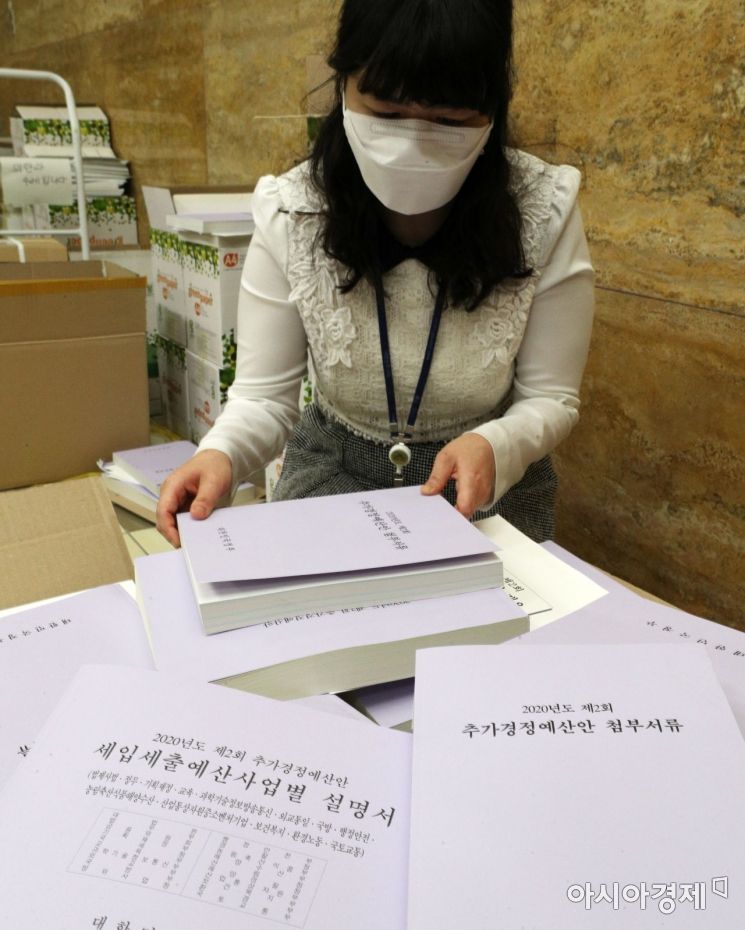 On the 20th, when the second supplementary budget bill for the COVID-19 emergency disaster relief fund payment was submitted to the plenary session, documents related to the supplementary budget bill were placed in the corridor in front of the National Assembly's bill office. Photo by Yoon Dong-joo doso7@
[Asia Economy Reporter Kim Hyunjung] It has been confirmed that the government cut even the annual leave compensation expenses of the Korea Disease Control and Prevention Agency (KDCA) as part of expenditure restructuring to provide emergency disaster relief funds in response to the novel coronavirus infection (COVID-19). There are concerns that the morale of public officials on the front lines of the COVID-19 crisis could be lowered.
According to the "Second Supplementary Budget Public Officials' Personnel Expenses Analysis" report published on the 21st by Lee Sangmin, senior research fellow at the National Fiscal Research Institute, the government carried out expenditure restructuring to secure 7.6 trillion won for the emergency disaster relief fund, cutting the KDCA's personnel expenses (annual leave compensation) from 56.3 billion won to 55.6 billion won, a reduction of about 700 million won. Along with this, annual leave expenses for public officials at local national hospitals were also targeted for restructuring: 133 million won cut from National Naju Hospital, 62 million won from National Mokpo Hospital, 80 million won from National Masan Hospital, and 22 million won from Osong Life Science Complex Support Center personnel expenses.
Earlier, the government announced plans to reduce related expenditures by encouraging maximum use of leave in accordance with social distancing policies. Through this method, it intends to allocate 395.7 billion won of annual leave compensation from public officials' personnel expenses as funds for disaster relief.
However, not all ministries had their annual leave expenses fully cut. The government reduced related costs in 19 large-scale organizations including the National Police Agency, Ministry of Science and ICT, Ministry of Education, Ministry of National Defense, National Tax Service, Ministry of Land, Infrastructure and Transport, Financial Services Commission, Ministry of Economy and Finance, Ministry of Agriculture, Food and Rural Affairs, Supreme Court, Ministry of Justice, Ministry of Health and Welfare, Korea Forest Service, Ministry of Trade, Industry and Energy, Ministry of Foreign Affairs, Korea Coast Guard, Ministry of Oceans and Fisheries, Ministry of the Interior and Safety, and Ministry of Environment. Meanwhile, the Board of Audit and Inspection, Ministry of Employment and Labor, Fair Trade Commission, Ministry of Patriots and Veterans Affairs, National Human Rights Commission, National Intelligence Service, Office for Government Policy Coordination, Anti-Corruption and Civil Rights Commission, National Assembly, Korea Meteorological Administration, Rural Development Administration, Presidential Security Service, Presidential Secretariat, Cultural Heritage Administration, Ministry of Culture, Sports and Tourism, National Unification Advisory Council, Korea Communications Commission, Ministry of Government Legislation, Military Manpower Administration, Saemangeum Development Authority, Ministry of Food and Drug Safety, Ministry of Gender Equality and Family, Nuclear Safety and Security Commission, Ministry of Personnel Management, Public Procurement Service, Ministry of SMEs and Startups, National Election Commission, Statistics Korea, Ministry of Unification, Korean Intellectual Property Office, Administrative City Construction Agency, Constitutional Court, etc., were not included in the cut list.
Regarding this, a Ministry of Economy and Finance official explained, "While the principle was to fully cut annual leave expenses for all ministries, the restructuring was mainly focused on ministries with large-scale organizations where the related budget was significant in expenditure restructuring." However, the KDCA's related budget is about 700 million won, which is less than the Ministry of Culture, Sports and Tourism (2.7 billion won), which was excluded from cuts. It appears that since KDCA is affiliated with the Ministry of Health and Welfare (3.8 billion won), it was naturally cut.
The ministry with the largest personnel expense cuts was the Ministry of National Defense, which was reduced by 175.8 billion won from 4.2127 trillion won to 4.0369 trillion won. Other cuts include 97.9 billion won from the National Police Agency, 27.5 billion won from the Ministry of Justice, 26.1 billion won from the Ministry of Science and ICT, and 15.5 billion won from the Supreme Court. Among ministries, the Ministry of the Interior and Safety had the highest cut rate in the second supplementary budget compared to the first, with a 6.8% reduction from 227.3 billion won to 211.9 billion won, and the Ministry of Economy and Finance was reduced by 6.6% from 75.3 billion won to 70.3 billion won.
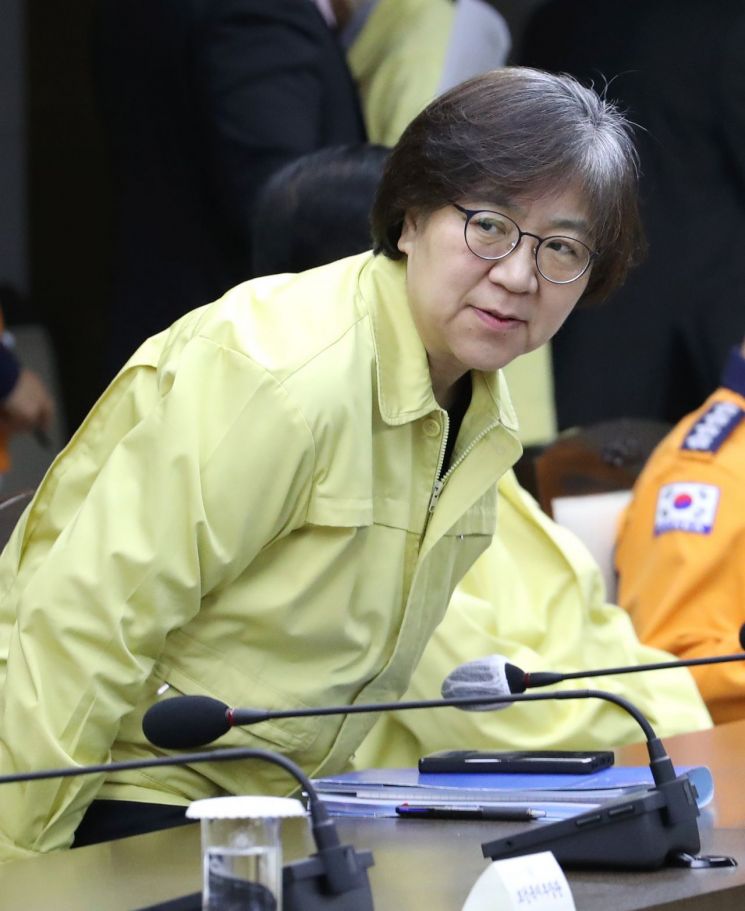
Senior Researcher Lee Sangmin pointed out, "When the government formulated the second supplementary budget, it secured about 700 billion won through personnel expenses of public officials, which is an easy way to save expenditures rather than fundamental fiscal reform-type expenditure restructuring." He added, "However, fully cutting the annual leave compensation of the KDCA and local national hospitals, which are burdened with heavy workloads, is not desirable from the perspective of boosting the morale of public officials responding to COVID-19." He further criticized, "Not providing even the annual leave compensation that expires unused despite overtime and holiday work is a violation of labor rights."
He also criticized, "The fact that no government bonds are issued in the second supplementary budget is merely a political goal that does not align with fiscal realities and economic substance," adding, "It is not about cutting unnecessary budgets or reorganizing inefficient expenditures but simply adjusting the timing of expenditures or engaging in fund transactions unrelated to fiscal soundness." He emphasized, "It is appropriate to use items expected to be unused due to COVID-19 as resources for the second supplementary budget," and added, "Public officials' overseas business travel expenses and overseas education expenses can be utilized." The researcher advised, "Marketing support funds for attracting foreign tourists and overseas advertising expenses could be reduced."
© The Asia Business Daily(www.asiae.co.kr). All rights reserved.


















