Seoul and Gyeonggi Province Provide Disaster Relief Funds to Some Migrants
Civilians Debate "Support for Migrants Too" vs "Limits to Support for Foreigners"
Migrant Solidarity Calls for Disaster Basic Income for All Migrants Including Undocumented Residents
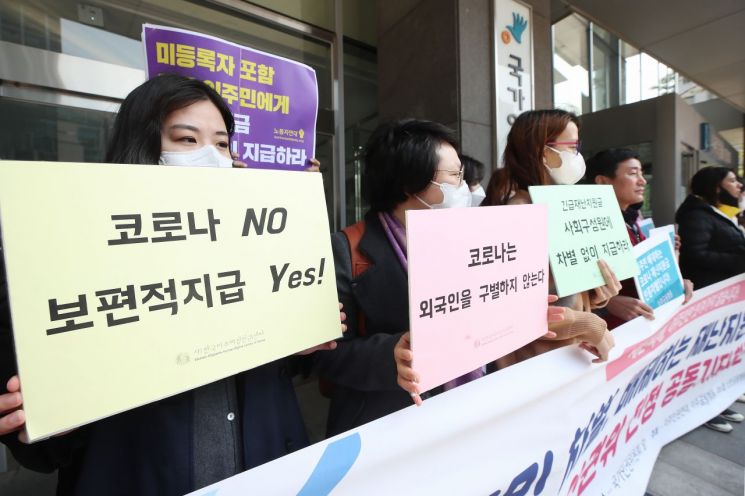 On the afternoon of the 2nd, a joint press conference was held in front of the National Human Rights Commission in Jung-gu, Seoul, titled "Joint Press Conference on the National Human Rights Commission Petition Against Disaster Relief Fund Policies Discriminating and Excluding Migrants." Photo by Yonhap News
[Asia Economy Reporter Kim Ga-yeon] As the novel coronavirus disease (COVID-19) crisis prolongs, local governments have announced plans to provide disaster relief funds to residents. Among them, controversy has arisen as immigrants are excluded from the disaster relief fund recipients.
Regarding this, citizens argue that since the funds are paid with taxpayers' money, there must be limits to the support recipients, while others insist that payments should also be made to migrants to revitalize the economy, leading to ongoing debates. There are quite a few foreign residents facing economic difficulties due to the COVID-19 impact, and excluding them from the payment targets is being criticized as discrimination.
Seoul City has been accepting applications for emergency disaster living expenses since the 30th of last month, targeting about 1.17 million households with median income below 100% who are not receiving existing government support. Initially, only foreigners married to or related to Korean nationals were included in the support targets, while overseas Koreans and others were excluded.
However, when Mr. K, a third-generation Korean resident in Japan who acquired Korean nationality and lives in Seoul, filed a complaint claiming discrimination over the exclusion of overseas Koreans from the application targets, the city announced on the 18th that even overseas Koreans with resident registration would be included.
Gyeonggi Province also announced on the 19th that among foreigners initially excluded from the disaster basic income payment, marriage immigrants and permanent residents would receive the disaster basic income. Governor Lee Jae-myung posted on his Facebook that "It is unreasonable to pay all foreigners such as illegal residents or short-term entrants," and added, "Marriage immigrants, although not having acquired nationality, are effectively nationals as they are married to Koreans, and permanent residents are treated without discrimination against nationals, which is a global trend."
Nevertheless, criticism continues that these measures are still discriminatory administration, as migrants and refugees not married to nationals remain excluded from the disaster relief fund recipients.
On the 2nd, 62 migrant human rights organizations including the Migrant Joint Action filed a complaint with the National Human Rights Commission, claiming that Seoul City and Gyeonggi Province's exclusion of refugees, humanitarian stayers, and Chinese Koreans from the disaster relief fund recipients constitutes human rights violations.
On the same day, the organizations held a press conference in front of the Human Rights Commission in Jung-gu, Seoul, stating, "The disaster relief funds of Seoul City and Gyeonggi Province aim to support those in the blind spots of existing welfare systems," and "However, these local governments have marginalized migrant groups in their policies, violating their right to live with dignity."
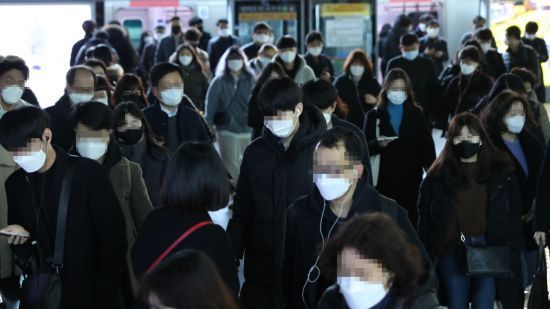 On the morning of the 11th of last month, citizens wearing masks are commuting to work through Sindorim Station in Guro-gu, Seoul. Photo by Yonhap News
Mr. A, a worker in his 50s living in Goyang, Gyeonggi Province, said, "Isn't the disaster basic income paid with taxpayers' money?" and added, "I think it is only right to provide support to foreigners who reside, engage in economic activities, and pay taxes. However, I believe the state has no obligation to provide support funds to refugees or illegal residents."
He further said, "It is just a waste of taxpayers' money," and "It seems more appropriate to provide greater support to citizens in need."
Meanwhile, Mr. B (28), an office worker living in Seocho-gu, Seoul, argued, "Since this is a national disaster situation, even temporarily, people should be able to receive medical insurance and disaster relief funds."
Mr. B emphasized, "It is not only our country facing a disaster but a pandemic. If we do not provide welfare such as medical support or disaster relief funds just because we think taxes are wasted, we do not know when or where the quarantine net might be breached," and "Including foreigners in Korea, we must raise the quarantine level together to overcome COVID-19 quickly."
Some overseas countries are reportedly rushing to prepare measures for foreign residents such as illegal immigrants.
The Portuguese government announced on the 31st of last month (local time) that it would grant temporary citizenship to migrants and refugees until the COVID-19 crisis is resolved. The government explained that the purpose is to provide medical insurance benefits to all migrants and refugee applicants, aiming to reduce the number of foreigners in medical welfare blind spots and close quarantine gaps.
California, USA, also announced on the 15th of last month that it would provide $500 (about 610,000 KRW) in cash to 150,000 illegal immigrants. Governor Gavin Newsom said that 10% of the local workforce are illegal immigrants who paid $2.5 billion in taxes last year, and expressed "infinite gratitude to those who continue to provide necessary services to Californians while living with the fear of deportation."
Meanwhile, Migrant Joint Action urged that disaster basic income be provided not only to marriage immigrants and permanent residents but to all migrants living in Gyeonggi Province.
On the 17th, Migrant Joint Action issued a statement condemning, "Gyeonggi Province distinguishes among residents and even among migrants during the COVID-19 disaster, yet calls all of them 'all Gyeonggi residents' while ignoring the existence of migrants."
They continued, "Do not divide and separate local residents living together in this difficult disaster situation," and emphasized, "All Gyeonggi residents include migrants. The human rights of migrant workers, including undocumented residents, are human rights. Provide disaster basic income without discrimination to all migrants living in Gyeonggi Province, including undocumented residents."
© The Asia Business Daily(www.asiae.co.kr). All rights reserved.


















