Politicians Who Deliberately Choose 'Difficult Districts' to Run
Running in Busan, Gyeongnam, Jeonnam Regardless of Progressive or Conservative Affiliation
Even Defeat Can Be a Valuable Political Asset If Justified
Running for Election as Political Engineering Can Backfire
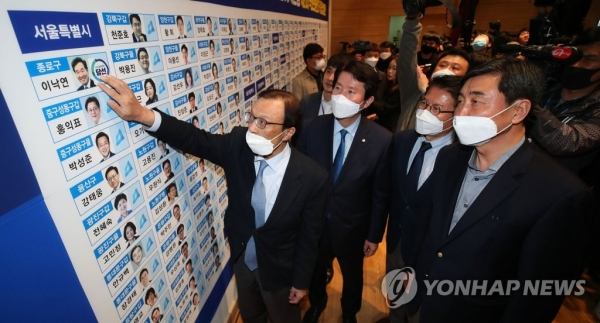 Lee Hae-chan, leader of the Democratic Party of Korea, is placing a winning sticker on the comprehensive status board for the 21st National Assembly election at the party's election situation room set up in the National Assembly Members' Office Building on the afternoon of the 15th.
 [Photo by Yonhap News]
[Asia Economy Reporter Han Seung-gon] In the 21st general election, public sentiment overwhelmingly favored the ruling party, resulting in the creation of a 'dinosaur ruling party' holding 180 seats, equivalent to three-fifths of the total 300 seats in the National Assembly. The elected candidates began preparing for full-fledged legislative activities by expressing their gratitude to the voters who supported them through various media interviews.
On the other hand, the defeated candidates posted concession messages on personal blogs or Facebook. Unless there are by-elections, it will be difficult for them to officially enter politics for the time being. However, some political circles evaluate that even defeat can be a valuable political asset if the justification is sufficient.
Although defeated, it is analyzed that what is equally important as winning is the political path shown after the defeat. The public is watching closely how much effort candidates put into fulfilling the pledges they made and serving the constituencies they ran for.
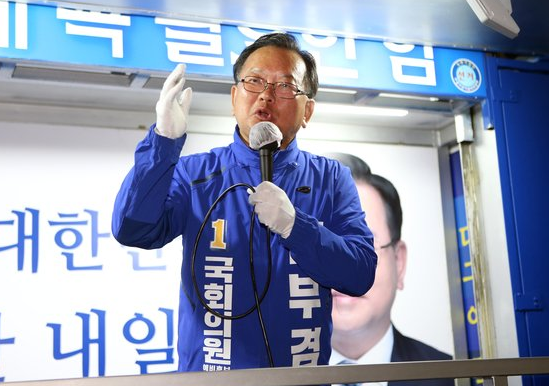 On the afternoon of the 14th, one day before the April 15 general election, Kim Bu-gyeom, the Democratic Party candidate running in Suseong-gap, appealed for support at Sinmae Square in Suseong-gu, Daegu. [Yonhap News]
◆ "I will till the soil of Korean politics more deeply." Politician heading to Daegu, the heart of conservatism
Kim Boo-kyum, a Democratic Party candidate who ran and lost in Daegu Suseong-gap, first ran in this area during the 19th general election in 2012.
He was a senior lawmaker who had consecutively won three terms in Gunpo, Gyeonggi Province since the 16th general election, but he ran in Daegu, a Democratic Party barren land, aiming to eliminate regionalism in Korean politics.
As political observers predicted at the time, Kim lost to Lee Han-gu, a Saenuri Party (predecessor of the United Future Party) candidate and senior alumnus of Gyeongbuk High School. The vote difference was about 14,000 votes.
Later, on June 4, 2014, during the 6th simultaneous local elections, he prepared region-specific pledges such as the 'Park Chung-hee Convention Center construction' and challenged the Daegu mayoral race but failed to overcome the conservative stronghold, losing to Saenuri Party candidate Kwon Young-jin. He secured 40.3% of the vote in the mayoral election.
Even after two consecutive election defeats, Kim did not leave the region but met residents to explain and persuade them about his reasons for running in Daegu.
He then challenged again in the 20th general election in 2016 and was finally elected. It was the result of his third attempt in Daegu. With Kim's election, the Democratic Party and its predecessors produced a National Assembly member from Daegu for the first time in 31 years.
However, in this general election, public sentiment did not favor him. On the 16th, right after his defeat, Kim posted on his Facebook, stating, "My steps toward overcoming regionalism and politics of integration will not stop," expressing his intention to run again in Daegu. He added, "I will rise again. Although I am a failed farmer today, I will till the soil of Korean politics more deeply. I will sweat more so that Yeongnam becomes a fertile field."
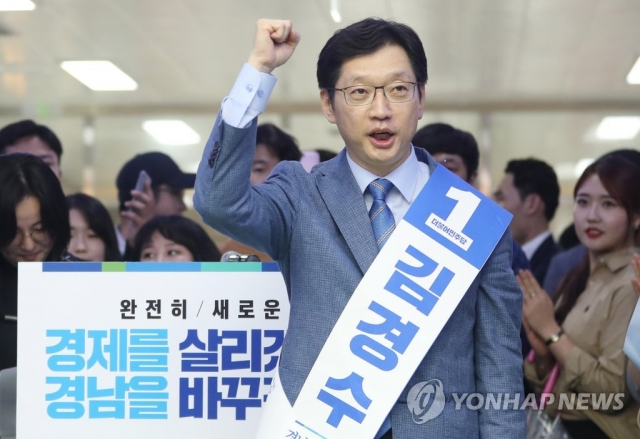 Candidate Kim Kyung-soo, who ran as the Democratic Party of Korea's candidate for Governor of Gyeongsangnam-do in the 2018 local elections and was elected, is cheering after his victory.
 [Image source=Yonhap News]
◆ Kim Boo-kyum, Kim Kyung-soo, Lee Jung-hyun, etc. ran in 'hostile territories'... After the bitterness of defeat, victory
Kim is not the first politician to choose a hostile territory and taste the bitterness of defeat. Kim Kyung-soo, Governor of Gyeongnam, lost consecutively in the 19th general election in 2012 and the 2014 Gyeongnam gubernatorial election but was elected as the first Democratic Party-affiliated governor of Gyeongnam in the 2018 local elections.
After his defeat in 2012, he said, "I thank the citizens of Gimhae who gave me overwhelming support and encouragement during the short campaign period," and strongly expressed his will to start politics again by saying, "I will work with the citizens of Gimhae to fill in the lacking parts."
In particular, he stated, "During the election period, regardless of the outcome, I am destined to protect Bongha Village," clearly explaining why he had to challenge Gyeongnam.
Lee Jung-hyun, a key figure of the former Park Geun-hye administration who lost in Seoul Yeongdeungpo-eul in this general election, solidified his political position by winning the National Assembly by-election on July 30, 2014, in Suncheon-Gokseong, Jeonnam, a conservative barren land, and later became party leader.
He won with 49.43% of the vote, decisively defeating Seo Gap-won of the New Politics Alliance for Democracy (predecessor of the Democratic Party), who garnered 40.32%. It was the first time since 1988 (13th National Assembly) that a conservative candidate was elected in Gwangju and Jeonnam, and the third time in 18 years in the entire Honam region, following former lawmakers Yang Chang-sik (Namwon, Jeonbuk) in 1992 and Kang Hyun-wook (Gunsan, Jeonbuk) in 1996.
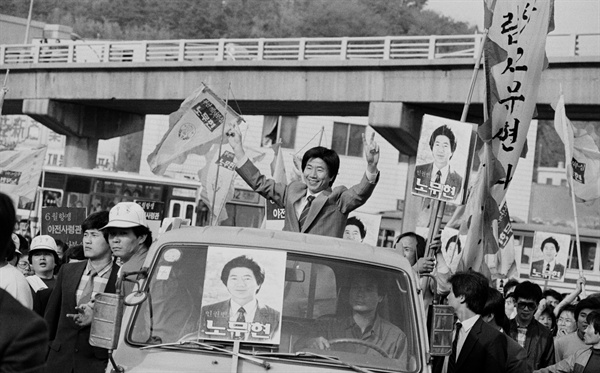 After concluding the joint election rally for the 13th National Assembly member election in Dong-gu, Busan, then candidate Roh Moo-hyun of the Unification Democratic Party climbed onto a car and toured his constituency to appeal for support. At that time, candidate Roh won the contest against Heo Sam-soo of the Democratic Justice Party and was elected as a National Assembly member.
 [Image source=Yonhap News]
◆ Abandoning 'political prime spot' Jongno for Busan, the emergence of 'Fool Roh Moo-hyun'
There are cases where politicians solidified their political position after defeat, rose as presidential candidates, and eventually were elected president.
The late former President Roh Moo-hyun ran in Busan Dong-gu in the 13th general election in 1988, defeating Heo Sam-soo, a former military regime figure, and was elected, but lost in the 1992 election in Busan Dong-gu to Heo Sam-soo, who had switched party affiliation from the Democratic Justice Party to the Democratic Liberal Party.
Some analyze that his defeat was due to his opposition to the so-called 'Three-Party Merger' launched on January 22, 1990. At that time, Roh declared he would remain in the party and not join the Democratic Liberal Party.
The Three-Party Merger refers to the merger of the ruling Democratic Justice Party, the second opposition Unified Democratic Party, and the third opposition New Democratic Republican Party, which formed the Democratic Liberal Party. This merger created a 'dinosaur ruling party' that far exceeded the constitutional amendment blocking line. Critics of this integration sometimes call it the 'Three-Party Collusion.'
Regarding this, Roh said, "If I had followed the ruling party during the 1990 Three-Party Merger, I might have been a member of the National Assembly three or four times, served as a minister early, and held positions such as governor or mayor. However, it would not have been honorable. At least, my great pride and happiness lie in not compromising with the wrong political atmosphere."
Later, in 1998, he was elected in the by-election in Jongno, Seoul, known as the 'political prime spot,' but in the 2000 16th general election, he declined the nomination for Jongno and ran as a candidate of the Millennium Democratic Party (predecessor of the Democratic Party) in Gangseo, Busan.
Roh loudly appealed for support by shouting 'Overcome regionalism.' However, his opponent blatantly stirred regional sentiments.
At that time, Heo Tae-yeol, a candidate of the Grand National Party (predecessor of the United Future Party), said, "If anyone thinks their living conditions have improved, please raise your hand," and when someone raised their hand, he asked, "Are you from Jeolla Province?" Early in the election, Roh, who was leading, lost by a large margin of 17.5 percentage points. It was his third defeat in Busan alone.
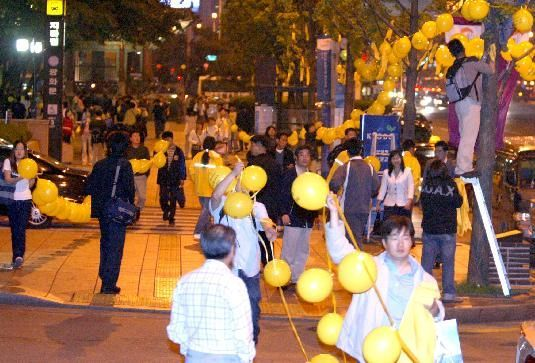 In March 2004, during the impeachment, 'Nosamo' was conducting an anti-impeachment movement. Photo by Yonhap News
After his defeat, he said, "Do not blame the people of Busan. Regionalism is not only Busan's problem." People called him 'Fool Roh Moo-hyun' because of his actions. This was the birth of a powerful support base that propelled him to become a presidential candidate and eventually president.
Roh's supporters also gathered from all over the country, regardless of region, including Seoul, Busan, Gyeongnam, and Jeonju. In the 16th general election, the biggest star was the defeated Roh Moo-hyun.
After retiring from the presidency, he said in his memoir, "The two big fights I faced during my political career were the fight against regionalism and the fight against opportunism. That is why I kept talking about 'principle and integration' during the presidential election. I am very particular about principles, but I have practiced politics that can sacrifice any other value for integration."
Experts pointed out that politicians showing clear convictions by running in hostile territories is good, but political moves based solely on political calculations can be harmful.
One political commentator said, "It is good for politicians to voluntarily jump into hostile territories with great intentions that can ultimately benefit Korean politics and the people, such as overcoming regionalism. However, running in hostile territories purely for political engineering, ignoring local voters and public sentiment, and losing is meaningless."
© The Asia Business Daily(www.asiae.co.kr). All rights reserved.
![User Who Sold Erroneously Deposited Bitcoins to Repay Debt and Fund Entertainment... What Did the Supreme Court Decide in 2021? [Legal Issue Check]](https://cwcontent.asiae.co.kr/asiaresize/183/2026020910431234020_1770601391.png)


















