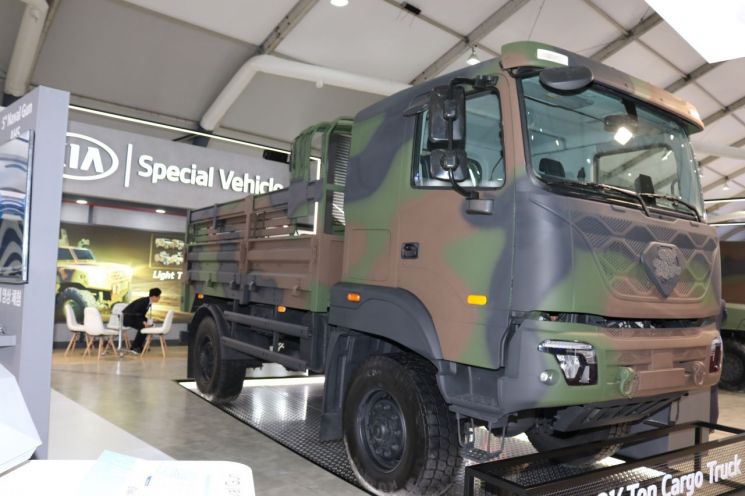
[Monthly Defense Times Editor-in-Chief An Seung-beom] The Medium Tactical Vehicle (MTV) project began in March 2006 following an urgent requirement request from the Army Headquarters, but feasibility reviews repeatedly delayed preliminary research and the project itself. Initially, the Army pursued separate developments for tactical vehicles with armored bodies and next-generation standard vehicles. However, citing budget and parts compatibility issues, in August 2015, the Army decided to integrate the Medium Tactical Vehicle and the next-generation standard vehicle (2½-ton/5-ton class) development. They proceeded with requirement analysis by the Korea Institute for Defense Analyses (KIDA), requirement verification by the Ministry of National Defense, and preliminary research, but the project faced cancellation risks due to the absence of allocated R&D funding.
Subsequently, as the Army pushed forward the Baekdusan Tiger 4.0 project aiming to motorize marching infantry units, the Medium Tactical Vehicle project also gained momentum. The military authorities increased the development initiation budget by 1.46 billion KRW in the 2019 defense budget and officially commenced the project in June.
The Medium Tactical Vehicle project was merged with the next-generation standard vehicle project and promoted as the Medium Standard Vehicle R&D project. It focuses on developing the basic platform for a 5-ton class armored standard vehicle by advancing the next-generation 2½-ton/5-ton standard vehicles and the initially proposed Medium Tactical Vehicle. The currently operated 2½-ton/5-ton standard vehicles are based on designs dating back to the 1950s with only minor upgrades, and during the stagnation of the next-generation standard vehicle project, the gap widened significantly compared to the rapid development of military vehicles in advanced countries.
The U.S. military, operating similar bonnet-type platform vehicles, has been fielding the Family of Medium Tactical Vehicles (FMTV) series with cab-over platforms similar to commercial trucks since 1996, aligning with modern battlefield requirements and improving vehicle operational efficiency. Currently, 30% of the standard vehicles in service are aging and require rapid replacement. Moreover, to motorize infantry units as planned by the Army, more standard vehicles than the existing replacement demand are needed.
The Army plans to invest approximately 17.7 billion KRW to develop the standard platform starting in 2019 and to allocate about 1.7 trillion KRW from 2024 to sequentially deploy between 11,000 and 14,000 medium standard vehicles to units.
▲ Operational Requirement Capabilities (ROC) of the Standard Vehicle = Since the standard vehicle is operated in the field, durability and off-road mobility are critical. Therefore, it must be designed with a frame body using thicker steel plates (1.4mm or more) than commercial vehicles (0.8mm or less), have a longitudinal slope climbing ability of 60% (31˚) for forward and reverse, and a certain depth for fording capability (1m for the next-generation 5-ton prototype vehicle). To achieve this, full-wheel drive, waterproof design for components along the fording line (axles, engine, transmission, etc.) and electronic equipment, higher minimum ground clearance than commercial vehicles (300mm for the next-generation 5-ton prototype), and large approach and departure angles are essential.
Additionally, to facilitate escape from rough terrain, a limited-slip or locking differential must be applied to the rear axle. Since vehicles produced currently use electronically controlled engines and automatic transmissions, EMI shielding design capable of electronic warfare protection must be applied to vehicle electronics. The engine must start reliably in extreme cold and heat (-32℃ to 43℃), lighting for blackout conditions must be installed, and the vehicle must be capable of towing trailers or other towed vehicles off-road.
Given the longer lifecycle compared to commercial vehicles and the military operational characteristics requiring readiness for emergencies, the structure should be simple enough for soldiers learning maintenance for the first time to perform repairs, and major parts should be compatible with other standard vehicles to ensure no issues in subsequent logistics support.
▲ Key Features of the Medium Standard Vehicle = The medium standard vehicle, i.e., the next-generation 2½-ton/5-ton/5-ton armored version, is being developed by applying advanced vehicle technologies and elements that meet modern battlefield requirements to the basic military vehicle ROC.
The next-generation 2½-ton/5-ton standard vehicles use an engine tuned to military specifications based on Hyundai’s independently developed and widely used commercial G engine (inline 6-cylinder CRDi turbo intercooler diesel). For the 5-ton class vehicle, the engine displacement is about half that of the current K711A1 5-ton truck, with a 10% increase in power output, and it meets Euro V emission standards.
They are equipped with an electronic 6-speed automatic transmission and full-time all-wheel drive system, full air brakes with ABS, electrically controlled air differential lock (DL), anti-spin regulator (ASR), air conditioning, rear cameras, and many other features common in commercial trucks to address various complaints from the user units regarding existing standard vehicles.
Additionally, a Central Tire Inflation System (CTIS) is installed to improve driving capability on soft ground and rough terrain. Like existing standard vehicles, blackout lights, rear towing hooks, air valves for trailer brakes, and receptacle connectors are applied.
The 5-ton armored standard vehicle, initially developed as a precursor under the Medium Tactical Vehicle project, features an armored cab and cargo bed designed to protect against rifle bullets and anti-personnel mines. Considering the increased weight due to armor, a more powerful H engine is adopted as the base engine, capable of producing approximately 1.6 times the power of the current K711A1 5-ton truck based on the precursor prototype. Basic specifications are being developed similarly to the next-generation 5-ton standard vehicle, and run-flat tactical tires capable of maintaining a speed of 48 km/h over a certain distance even when damaged will be installed.
The initial precursor prototype was designed to carry a squad-sized force, but with the Army’s Baekdusan Tiger 4.0 initiative, there is discussion about changing the ROC to accommodate fireteam-sized loads. To address the outdated design and aging of the standard vehicles, the Ministry of National Defense has been replacing standard vehicles with commercial vehicles since 2005 and has implemented a policy to replace 60% of current standard vehicles with civilian vehicles by 2020.
The next-generation standard vehicle is developed based on commercial vehicles from the engine and powertrain to the basic platform, while actively reflecting military ROC to produce a vehicle suitable for deployment in modern battlefields. The key points in standard vehicle development are off-road mobility, safety, operational convenience, and modularity.
In terms of off-road mobility, the vehicle will deliver improved performance compared to current standard vehicles by utilizing proven engine and powertrain performance from commercial vehicles, CTIS, DL, and other modern automotive technologies. Full air brakes with ABS, tactical tires, and cargo bed seat belts will ensure basic safety for personnel onboard.
Moreover, the cab-over platform, commercial vehicle-based driving instruments, air conditioning, and many parts compatible with commercial vehicles will provide improved operational convenience compared to the outdated design of existing standard vehicles. Modular design based on the basic platform will enable the production of various variant vehicles.
Since variant vehicles require separate testing, evaluation, and standardization, it is difficult to field all variants simultaneously with the base vehicle. However, developing and fielding as many variants as possible alongside the base vehicle is the way to reduce inefficiencies in logistics support caused by concurrent production of old vehicle models.
© The Asia Business Daily(www.asiae.co.kr). All rights reserved.

















