Demand for Ddareungi Increased by 66.8% in Feb-Mar This Year Compared to Last Year
Usage Up but Management Lax...Empty Racks and Lack of Hand Sanitizers Reported
Seoul City "Plans to Gradually Expand Available Units"
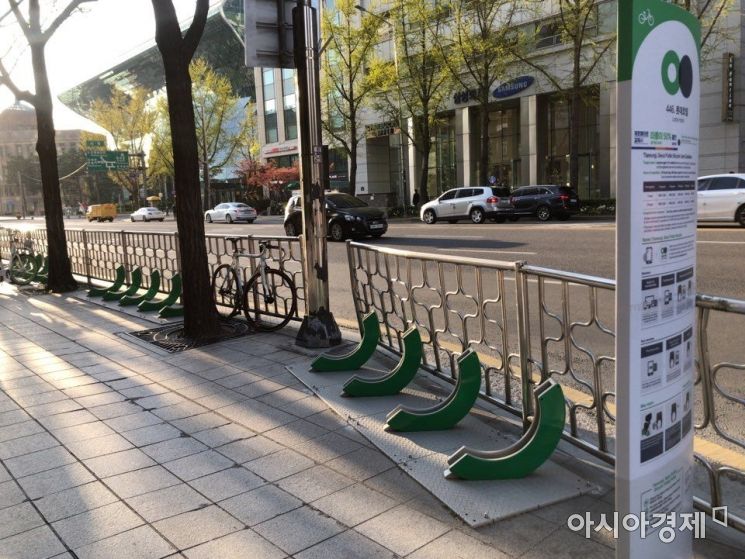 On the 13th, a Ddareungi rental station in Myeongdong, Jung-gu, Seoul. The station is completely empty.
 Photo by Kang Juhee, intern reporter kjh818@aisae.co.kr
[Asia Economy Reporter Han Seung-gon, Intern Reporter Kang Joo-hee] As the novel coronavirus disease (COVID-19) spreads, more citizens are avoiding public transportation and commuting by bicycle, leading to a surge in the use of the public bicycle service "Ddareungi." However, management has not kept pace with the increased demand, causing inconvenience for some users. The Seoul Facilities Corporation's Public Bicycle Operations Department stated that they will focus on strengthening maintenance, including continuous hygiene management and expanding the number of bicycles.
Seoul City announced on the 8th that the usage rate of the public bicycle "Ddareungi" in February and March this year increased by 66.8% compared to the same period last year. The total number of rides in February and March was 2,295,809, which is 919,479 more than last year's 1,376,330 rides.
In contrast, public transportation such as subways and buses saw a decrease in usage during commuting hours, with a 23.02% drop in the morning and a 26.42% drop in the evening compared to usual. This is analyzed as people preferring bicycles, which allow solo travel, over buses or subways due to avoiding enclosed spaces amid the COVID-19 spread.
However, some citizens have expressed discomfort with using Ddareungi. Although public bicycle usage has increased due to the COVID-19 situation, management has not been adequately maintained.
On the Seoul Bicycle Citizen Feedback Board, one netizen wrote, "The handlebars, display terminals, and other frequently touched areas are not clean, which feels uncomfortable," adding, "With the spread of COVID-19, personal hygiene must be thorough, but since many people use the bicycles, regular maintenance is necessary."
In response, Seoul City stated that the 25,000 Ddareungi bicycles and approximately 1,540 rental stations across the city are regularly disinfected. They especially focus on disinfecting frequently touched areas such as front wheel racks and handlebars, and hand sanitizers are provided at all rental stations.
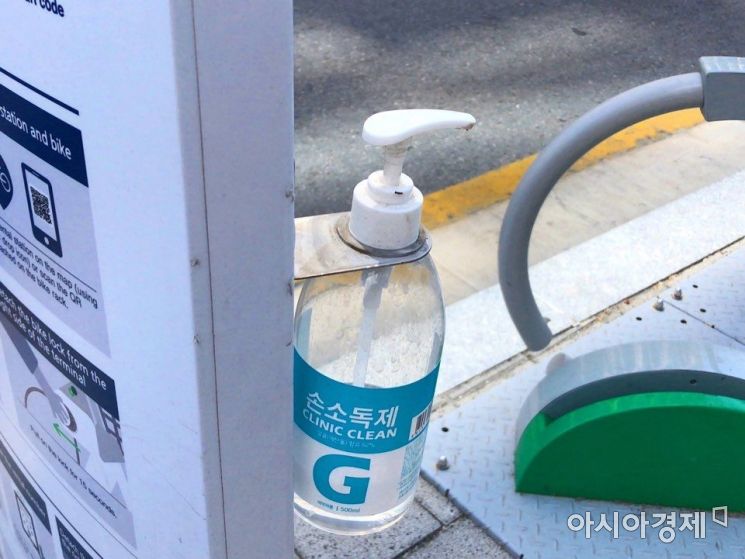 On the 14th, the hand sanitizer at a Ddareungi station in Chungmuro, Jung-gu, Seoul, was empty. Photo by Joohee Kang, Intern Reporter kjh818@asiae.co.kr
However, it was confirmed that at some stations, the hand sanitizers provided were empty, indicating inadequate management.
B (29), an office worker who commutes using a subscription for Ddareungi, said, "I frequently use Ddareungi for commuting, but the hand sanitizers provided are often empty because passersby also use them."
He added, "Some stations don't have hand sanitizers at all, and I have seen some left missing for over a week. It would be better if hand sanitizers were only for Ddareungi users or if there was a system to replenish them regularly."
Some citizens also experienced inconvenience due to a lack of bicycles at rental stations. B (31), another office worker, said, "The rental station near my home is always empty," and added, "Even when I check the surrounding area on the Ddareungi app map, there are no bicycles at any station or only one available. I wonder if bicycle redistribution is being done properly."
Regarding this, the Seoul Facilities Corporation's Public Bicycle Operations Department said they are continuously working on facility management and plan to significantly increase the number of Ddareungi bicycles to meet the growing demand.
The corporation explained, "With warmer weather, the number of users has surged, causing a shortage of bicycles. We continuously collect and dock bicycles at rental stations for smooth operation, but inconvenience may occur depending on the time and regional characteristics."
They added, "We are gradually adjusting the appropriate docking quantities and inspection frequencies to ensure no inconvenience at the rental stations. Our goal is to expand the number of bicycles to around 40,000 by the end of this year."
Regarding COVID-19 prevention measures, they stated, "All facilities at rental stations are disinfected once daily. Additionally, at the maintenance center, handlebars, saddles, and terminals are further sterilized and disinfected before dispatch."
On hand sanitizer management, they said, "When citizens use up the hand sanitizers, we check and replace them during bicycle deliveries. The hand sanitizers at rental stations are installed for use by all citizens, not just Ddareungi users. Also, to prevent theft, silicone work has been done to make it difficult to forcibly remove sanitizer containers at stations where theft occurred."
They continued, "At the national level, behavioral guidelines are being disseminated, and our corporation is promoting the same content. Besides this, when calling the Ddareungi information center, a COVID-19 related voice message is played, and when renting a Ddareungi bicycle, a prompt encourages the use of hand sanitizer."
Furthermore, Seoul City announced plans to introduce an additional 5,000 units of the 'QR-type New Ddareungi' by the first half of this year and 15,000 more by the second half.
© The Asia Business Daily(www.asiae.co.kr). All rights reserved.


















