Seoul Metro Establishes 23 Measures in 4 Key Areas for Fine Dust Management
Prioritizing Air Purification in Passenger Cars with Longest Dwell Time
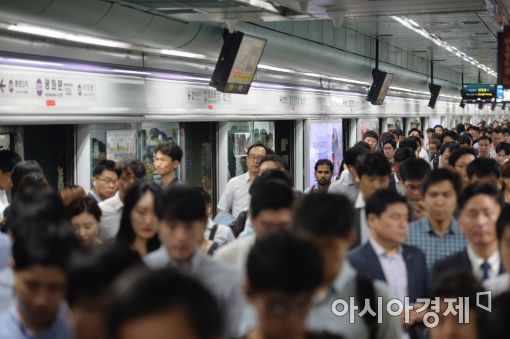
[Asia Economy Reporter Jo In-kyung] The Seoul Metropolitan Government plans to reduce subway dust (PM10) concentrations in tunnels, trains, and underground stations by up to 50% compared to 2018 levels, and fine dust (PM 2.5) concentrations by 45%. A budget of 795.8 billion KRW will be invested by 2022.
Seoul Metro announced the "2020 Comprehensive Fine Dust Management Plan" on the 12th, which includes 23 measures across four major areas to create a comfortable subway environment.
This plan aligns with the revised Ministry of Environment's "Indoor Air Quality Management Act Standards" amended this month, setting ambitious goals that far exceed the legal standards, such as lowering fine dust concentrations in underground stations to 50 μg/㎥ by 2022, well below the legal limit of 100 μg/㎥. Additionally, the plan aims to reduce fine dust (PM2.5) concentrations in trains and underground stations to 35 μg/㎥ or less, strengthening the legal standard of 50 μg/㎥.
First, air purification inside trains, where passengers spend the most time, will be promoted. Analysis of average passenger dwell time by movement within the subway showed 11 minutes in the concourse, 6 minutes on the platform, and 35 minutes inside the train. Accordingly, air quality improvement devices will be installed in train cars progressively: 140 cars in 2019, 1,076 cars in 2020, and 344 cars in 2021. For 1,914 aging train cars scheduled for replacement, air quality improvement devices will be incorporated into the design of new trains.
Air curtains, which use airflow to prevent fine dust from tunnels or platforms from entering the train cars through both sides of the train doors, will also be installed inside train cars. After a pilot installation on 10 train cars this year and subsequent effectiveness analysis, the plan is to expand installation to 1,020 cars by 2022.
High-performance air purifiers equipped with HEPA filters capable of filtering fine dust, including ultrafine particles, are being installed on platforms. Sixteen units will be installed per station across 254 underground stations. Of the 2,040 units contracted last year, installations are underway at 127 stations, with the remaining 2,024 units to be installed at other stations this year. Additionally, station ventilation systems will be upgraded to purify both fine and ultrafine dust.
To manage wheel and rail wear, which are major sources of dust in subway tunnels, rail milling vehicles will be introduced. This will shift from the existing method of grinding damaged rail cross-sections to a method that also collects cutting chips. Furthermore, bi-directional electrostatic precipitators that adsorb and remove dust from incoming and outgoing air will be expanded at ventilation openings, and the capacity of aging tunnel ventilation facilities will be improved by 15% over current levels.
Fine dust removal vehicles capable of eliminating metal powder and dust inside tunnels will also be introduced. Diesel motorcars using fossil fuels will be replaced with eco-friendly electric or hybrid motorcars, starting with 11 units this year and completing the replacement of a total of 35 units by 2022.
Information and communication technologies such as the Internet of Things (IoT), big data, and artificial intelligence (AI) will be actively utilized to quickly and accurately measure and effectively manage underground station air quality. Following the installation of 840 fine dust measuring devices in concourses and trains at all 277 stations on Seoul Subway Lines 1 through 8 in June last year, a real-time smart air quality management system will be established at 100 stations starting this year to optimally manage various air quality reduction devices.
Kim Sang-beom, President of Seoul Metro, explained, "Until now, subway fine dust has been managed within legal limits, but this plan aims to improve air quality to a revolutionary level that citizens can feel."
© The Asia Business Daily(www.asiae.co.kr). All rights reserved.
















