Financial Burden Impact Assessment from Acquisition Financing Divides
Prudential Life's Utilization of Workforce, Products, and Assets Key to Group Synergy Creation

[Asia Economy Reporter Kangwook Cho] KB Financial Group has succeeded in acquiring Prudential Life Insurance and is beginning to strengthen its business capabilities in the non-banking sector. Now, KB Financial faces the challenge of how to utilize Prudential Life Insurance's workforce, products, and managed assets to create group synergy in the future.
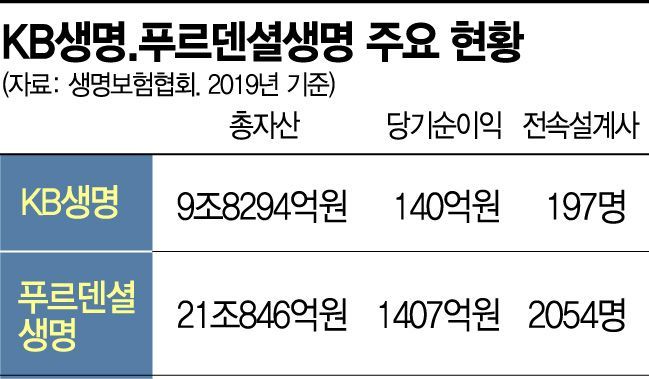
According to financial circles on the 11th, KB Financial announced the acquisition of Prudential Life Insurance the day before. The expected acquisition timing is the third quarter of this year, with an acquisition amount of 2.265 trillion KRW and a purchase price-to-book ratio (PBR) of 0.78 times.
Considering Prudential Life Insurance's return on equity (ROE) of 6.5% last year and the control premium, the market views the acquisition price as reasonable. Since Prudential Life Insurance's net profit in 2019 was 140.8 billion KRW, even after considering financing costs, an annual increase of over 100 billion KRW or about 4% in consolidated net profit for the group is expected. Additionally, given that Prudential Life Insurance's fair value and acquisition price are below book value, it is positively evaluated that bargain purchase gains and amortization of fair value differences under purchase price allocation (PPA) are expected to be recognized significantly in 2020-2021.
However, evaluations of the financial burden caused by acquisition financing are mixed.
Korea Investment & Securities sees the capital adequacy burden as limited. It forecasts that the common equity tier 1 (CET1) ratio will only decline by 0.7 percentage points due to the acquisition of Prudential Life Insurance. Applying the acquisition effect of -0.7 percentage points to the 13.6% CET1 ratio in Q4 2019, the CET1 ratio would still be 12.9%. Considering the introduction schedule of the Basel III final rules in Q2 this year, despite recent active credit supply and potential deterioration in soundness, there is still a considerable buffer in the capital ratio.
Baek Doosan, a researcher at Korea Investment & Securities, explained, "The double leverage ratio is currently 124% considering the issuance of 300 billion KRW in new capital securities, and it will rise to 136% upon acquiring Prudential Life Insurance," but added, "It can be sufficiently managed below the benchmark of 130% through intermediate dividends from subsidiaries."
On the other hand, concerns have been raised that this acquisition could increase risk by imposing financial burdens such as a decline in the CET1 ratio. Lee Byung-geon, a researcher at DB Financial Investment, said, "KB Financial's acquisition of Prudential Life Insurance is unlikely to contribute to shareholder value and has a strong burden that could increase risk."
KB Financial intends to maintain the double leverage ratio at 130%, but funding through new capital securities issuance and subsidiary dividends is expected, and the CET1 ratio, which was 13.58%, is estimated to decline by about 88 basis points.
The researcher assessed, "There are no attractive assets to buy immediately, and aside from small-scale overseas M&A pursued at the subsidiary level, the capacity for large-scale M&A by the holding company is considered exhausted for now," adding, "The bargain purchase gain after fair value evaluation of liabilities is about 200 billion KRW, and the negative goodwill is expected to be reversed quarterly at about 40 billion KRW until the implementation of IFRS 17."
KB Financial is expected to begin strengthening business competitiveness in the non-banking sector through this acquisition of Prudential Life Insurance. Financial holding companies have various ways to utilize life insurers' assets, typically selling life insurance products through bank channels, enabling banks to offer diverse investment product portfolios. Also, by leveraging life insurers' managed assets, collaboration among securities, banks, and capital companies can secure mega-deals, which is positive from a group synergy perspective.
However, Prudential Life Insurance holds significantly superior capital capacity but has a high-interest debt ratio exceeding 40%, with a burden interest rate in the 5% range. There are particular concerns about the future profitability of life insurers. Accordingly, Daishin Securities expects that due to index and interest rate declines this year, the burden of variable annuity reserves for life insurers will be substantial, and the negative spread will widen. Therefore, Prudential Life Insurance's profits this year are projected to inevitably decrease compared to last year. The key future challenge is synergy creation.
Park Hyejin, a researcher at Daishin Securities, emphasized, "Prudential Life Insurance is the last decent asset available, but its ROE was only 4.8% last year and averaged 6.1% over three years," adding, "It is necessary to consider how to utilize Prudential Life Insurance's workforce, products, and managed assets to create group synergy going forward."
© The Asia Business Daily(www.asiae.co.kr). All rights reserved.


















