February Unemployment Benefits Paid 808.3 Billion Won... Record High
Majority of New Recipients in Their 50s and 60s... Manufacturing and Construction Lead
Employment Insurance Fund Deficit Concerns Amid COVID-19 Uncertainties
"Need for System to Address Blind Spots Beyond Crisis Response Measures"
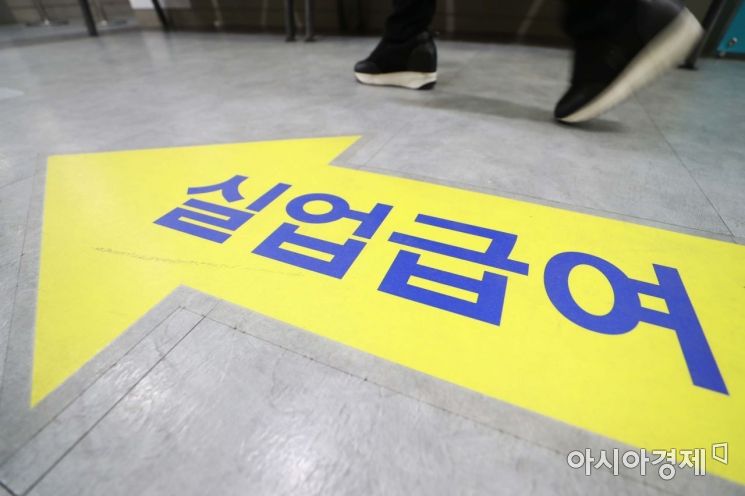
[Asia Economy Reporter Kim Bo-kyung] In February, unemployment benefit payments surpassed 800 billion won for the first time ever. This indicated that an unemployment crisis was already anticipated in February, the early stage of the COVID-19 outbreak. However, the government is only now hastily devising additional unemployment measures. Due to budget constraints and legal and institutional shortcomings, the pain in the employment sector is growing increasingly severe.
According to employment insurance statistics on the 11th, the amount paid in unemployment benefits in February reached a record high of 808.3 billion won. This is the first time monthly unemployment benefit payments have exceeded 800 billion won. It increased by 28% compared to the same month last year (632.4 billion won). Unemployment benefits are a broader concept than job-seeking benefits. Specifically, the total includes job-seeking benefits of 780.9 billion won, early reemployment allowances of 25.8 billion won, sickness benefits of 100 million won, and various other allowances and benefits supporting the unemployed.
The Employment Crisis Began in February... 'Unemployment Tsunami' Expected in March
Analyzing the 107,000 people who newly received unemployment benefits in February, the hardest hit were middle-aged and older adults. By age group, those in their 50s were the largest at 27,000. Next were those aged 60 and above (22,000), 40s (20,000), 30s (19,000), and 20s (18,000). The main reason for unemployment was resignation due to company recession and restructuring, which surged by 7,100 to 42,300 compared to 35,200 in the same month last year. Resignations due to contract expiration or project completion numbered 35,400, an increase of 12,600 from the previous year. Those who lost jobs due to business closures or bankruptcies also reached about 4,400, up by 1,200 from last year.
By industry, manufacturing had the highest number at 18,500, followed by construction at 16,500, business facility management and services at 12,400, wholesale and retail at 12,000, and accommodation and food services at 7,500. By workplace size, the most were in businesses with fewer than five employees, which are financially vulnerable, at 24,800, but even large corporations with over 1,000 employees had 13,200 unemployed. In fact, mass unemployment began to surge from February.
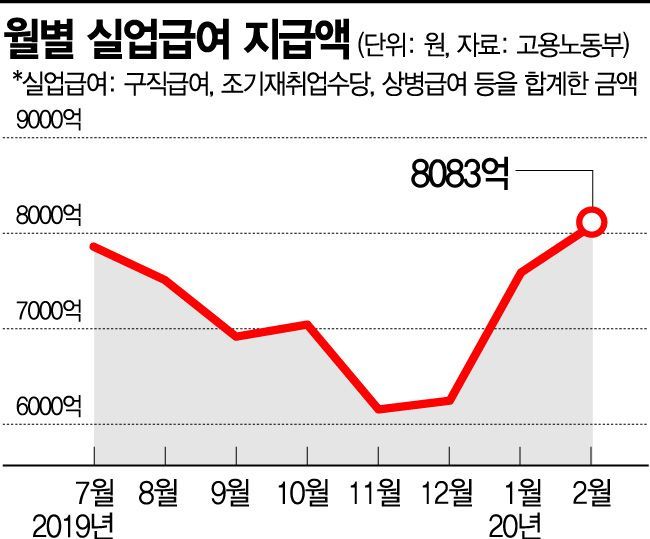
February statistics are only a precursor. Next week, employment indicators for March, when the impact of COVID-19 on the labor market became full-scale, will be released. On the 13th, the Ministry of Employment and Labor will release March unemployment benefit statistics, and on the 17th, Statistics Korea will publish employment trends (economically active population survey). The number of job-seeking benefit applicants last month is estimated to be around 150,000 to 160,000. However, so far, the government has not presented any clear unemployment response measures other than expanding employment retention subsidies paid to workplaces implementing paid leave or furloughs.
One reason it is difficult to introduce bold unemployment measures is budget issues. The employment insurance fund, which finances unemployment benefits and various employment stabilization projects, has been in deficit for two consecutive years following 2018. The government did not anticipate the unexpected situation of COVID-19 and heavily invested the budget in job creation projects. The Youth Additional Employment Incentive, which pays up to 27 million won per person over three years to small and medium-sized enterprises hiring young people as regular employees, spent 127.1 billion won in February alone, a 110% increase compared to the same month last year. The Youth Tomorrow Filling Deduction Support Fund also spent 32.5 billion won, an 87% increase year-on-year.
Support Measures Needed for Blind Spots... Legislation for the National Employment Support System Planned for May
The safety net for groups outside the employment insurance system, such as special-type workers, platform workers, and small self-employed business owners, remains insufficient. The government secured a budget of 277.1 billion won this year to implement the National Employment Support System, known as the Korean-style unemployment assistance, but it became ineffective as related legislation was not passed in the National Assembly. The government intends to seek an opportunity during the last extraordinary session of the 20th National Assembly next month after the general election. Once the 21st National Assembly is formed, existing bills will be discarded, and rapid passage of bills will be difficult due to committee reassignments. The National Employment Support System provides a monthly job-seeking allowance of 500,000 won to low-income job seekers and offers customized employment support services. It can serve as an employment safety net for workers who do not receive unemployment benefits.
The government plans to announce additional unemployment measures around the release of March employment indicators. The Ministry of Employment and Labor, the relevant department, held its first meeting with employment and labor experts on the 9th to share ideas. Facing an unprecedented employment crisis, the timing of the announcement has not yet been decided. A ministry official said, "Additional measures require budget negotiations with the Ministry of Economy and Finance," and added, "We are reviewing various measures, including employment stabilization and employment measures for young people whose new hires have decreased."
Professor Kim Sung-hee of Korea University’s Labor Issues Research Institute said, "The government is focusing on measures centered on workplaces covered by employment insurance, but only 56% of workers are insured under employment insurance," adding, "It is necessary to consider institutionalizing continuous response measures, such as resolving blind spots in employment insurance, rather than stopping at COVID-19 crisis response measures."
© The Asia Business Daily(www.asiae.co.kr). All rights reserved.
![Clutching a Stolen Dior Bag, Saying "I Hate Being Poor but Real"... The Grotesque Con of a "Human Knockoff" [Slate]](https://cwcontent.asiae.co.kr/asiaresize/183/2026021902243444107_1771435474.jpg)

















