Seoul General Apartments Decline for the First Time in 41 Weeks Since Mid-June Last Year
Increase in Declining Areas Including Gangnam, Yongsan, Dongjak, and Gwacheon in Gyeonggi
[Asia Economy Reporter Yuri Kim] Seoul apartment prices have turned downward, extending from reconstruction apartments to general apartments. While the reconstruction market has been fluctuating between declines and slight decreases since January, general apartments are also entering a downward trend with about a three-month lag. Amid growing concerns over an economic recession due to loan regulations, holding tax burdens, and the impact of COVID-19, the price increases in Seoul’s non-Gangnam areas and Gyeonggi regions, which had previously experienced some balloon effects, have narrowed, and the number of areas with falling apartment prices has increased, including Seoul’s Gangnam 4 districts (Gangnam, Seocho, Songpa, Gangdong), Yongsan and Dongjak districts, and Gwacheon city in Gyeonggi.
According to Real Estate 114 on the 10th, the weekly change rate of apartment sale prices in Seoul was -0.04%, marking a decline for three consecutive weeks. Reconstruction apartments fell by 0.22%, and general apartments also decreased by 0.01%. General apartments dropped for the first time in 41 weeks since mid-June last year (June 14, -0.02%). Meanwhile, new towns showed a stable trend (0.00%), and Gyeonggi and Incheon rose by 0.05%.
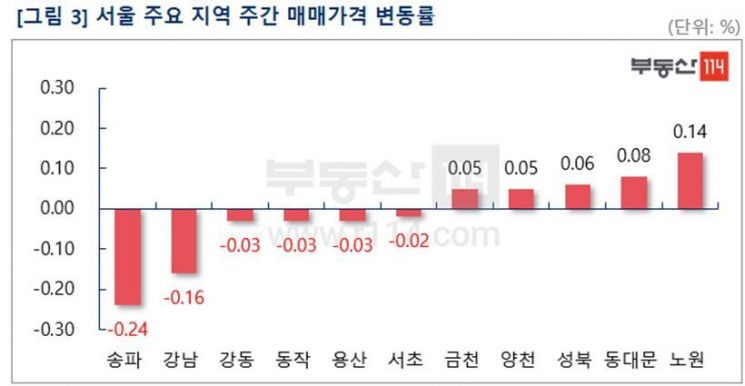
In Seoul, as signs of a prolonged economic downturn due to COVID-19 appear, buying demand is further shrinking. Both reconstruction complexes and general apartments in the Gangnam area showed weakness, and Yongsan and Dongjak were also adjusted downward this week. Along with this, the rate of increase significantly slowed in most areas, including outer Seoul regions such as Gangbuk, Gangseo, and Guro. By region, the declines were in the order of Songpa (-0.24%), Gangnam (-0.16%), Gangdong (-0.03%), Dongjak (-0.03%), Yongsan (-0.03%), and Seocho (-0.02%). In Songpa, prices dropped by 10 to 50 million KRW in areas including Lake Palace and Jugong Complex 5 in Jamsil-dong, Jamsil Els, as well as Jamsil Parkrio in Sincheon-dong and Olympic Family Town in Munjeong-dong. In Gangnam, prices fell by 30 to 75 million KRW in Gaepo-dong’s The H Honor Hills and Jugong Complex 1, Daechi-dong’s Seonkyung 1 and 2, and Dogok-dong’s Dogok Rexle. In Dongjak, Heukseok Han River Centreville Complex 2 in Heukseok-dong was adjusted downward by 25 million KRW. Conversely, areas such as Nowon (0.14%), Dongdaemun (0.08%), Seongbuk (0.06%), and Yangcheon (0.05%) saw price increases.
In new towns, Ilsan (-0.02%) and Wirye (-0.02%) declined, while Sanbon (0.04%), Jungdong (0.03%), and Bundang (0.01%) rose. In Ilsan, prices dropped by 2.5 to 10 million KRW in Moonchon Complex 8 Donga and Moonchon Complex 13 Daewoo in Juyeop-dong, and Hugok Complex 2 Dongyang and Daechang in Ilsandong. In Wirye, the large-scale Songpa Jangji-dong Wirye 22 Complex Vivaldi fell by about 6.5 million KRW. On the other hand, in Sanbon, small-sized units in Sinan Moran, Jumong Complex 2, and Jugong Complex 11 in Sanbon-dong rose by 1.5 to 5 million KRW.
In Gyeonggi and Incheon, the southern Gyeonggi area still leads price increases, but the rate of increase is steadily slowing in most regions. By region, prices rose in Guri (0.11%), Seongnam (0.11%), Gunpo (0.09%), Hanam (0.09%), Hwaseong (0.09%), Bucheon (0.08%), Uiwang (0.08%), Gwangmyeong (0.07%), and Suwon (0.07%). Conversely, Gwacheon (-0.06%), Gwangju (-0.03%), and Icheon (-0.01%) declined. In Gwacheon, the buying demand contraction caused Remian Sure Complex 3 in Wonmun-dong and Remian Sure in Byeolyang-dong to fall by about 10 million KRW, halting the previous upward trend.
The jeonse (long-term lease) market continued to rise as the supply of jeonse properties became scarce due to lease renewals, despite demand not increasing significantly amid the impact of COVID-19. However, the market remained stable despite the spring moving season. Jeonse prices rose by 0.02% in Seoul and 0.01% in Gyeonggi and Incheon. New towns showed a stable trend this week (0.00%).
In Seoul’s jeonse market, prices increased in Seongbuk (0.10%), Nowon (0.08%), Dongdaemun (0.07%), Songpa (0.07%), Gangdong (0.06%), Geumcheon (0.06%), and Jungnang (0.06%). In Seongbuk, prices rose by 5 to 25 million KRW in Jongam Complex 2 IPARK in Jongam-dong, Remian Anam in Anam-dong, and Remian Wolgok Complex 1 in Hawolgok-dong. In Nowon, Hanshin Complex 3 in Sanggye-dong, Sanggye Complex 2 Central Heights, and Deer Complex 3 in Wolgye-dong increased by 5 to 25 million KRW. In Dongdaemun, Hanshin in Jegi-dong, Remian Elpine in Dapsimni-dong, and Cheonggyecheon Daeseong Skyrex II in Yongdu-dong rose by 5 to 10 million KRW.
In new towns, Wirye (-0.06%) and Gimpo Hangang (-0.03%) declined, while Bundang (0.02%), Jungdong (0.01%), and Ilsan (0.01%) rose. Other new towns remained stable with little change (0.00%). In Wirye, the large-scale Seongnam Changgok-dong Wirye Jayeon & Remian e-Pyeonhan Sesang fell by about 5 million KRW, and in Gimpo Hangang, Gimpo Hangang IPARK in Gurae-dong dropped by about 5 million KRW. Conversely, in Bundang, Hyoja Donga in Seohyeon-dong and Jangmi Dongbu in Yatap-dong rose by 5 to 10 million KRW, and in Jungdong, Sangdong Sarang Byuksan, Jungdong Yeonhwa Ssangyong, and We’ve The State Complex 6 increased by about 5 million KRW.
In Gyeonggi and Incheon, prices rose in Incheon (0.04%), Seongnam (0.04%), Uiwang (0.03%), Uijeongbu (0.03%), Goyang (0.02%), Yongin (0.02%), and Guri (0.01%). Conversely, Gwacheon (-0.05%) and Namyangju (-0.01%) declined. The large number of about 3,400 households moving in from last year to early this year had a significant impact on Gwacheon.
Lim Byung-chul, senior researcher at Real Estate 114, said, "The contraction in buying demand is spreading beyond the Gangnam area to surrounding regions, and the rate of increase is shrinking in Seoul’s outer areas and southern Gyeonggi, which had led price rises. If the contraction in buying demand due to COVID-19 prolongs, a downward turn in the outskirts of the metropolitan area is inevitable."
Regarding the jeonse market, he added, "Although there is a localized shortage of jeonse properties due to increased lease renewals amid COVID-19 infection concerns, demand is not moving significantly, so prices remain relatively stable. This situation is expected to continue for the time being. Due to holding tax burdens, landlords may increase contract types such as half-jeonse and monthly rent to pass taxes on to tenants, which could become a burden for tenants."
© The Asia Business Daily(www.asiae.co.kr). All rights reserved.
![Clutching a Stolen Dior Bag, Saying "I Hate Being Poor but Real"... The Grotesque Con of a "Human Knockoff" [Slate]](https://cwcontent.asiae.co.kr/asiaresize/183/2026021902243444107_1771435474.jpg)
















