COVID-19 Issue Black Hole Effect, Economic Keywords Disappearing Like Ghosts... Opposition's Economic Judgment Election Momentum Weakens, COVID-19 Response Capability as Voter Evaluation Criterion
[Asia Economy Reporter Ryu Jeong-min] The usual 'economic keywords' of general elections have disappeared. The 21st general election on the 15th is expected to be recorded as an election of 'economic issue indifference' held amid an 'economic crisis (亂國)'.
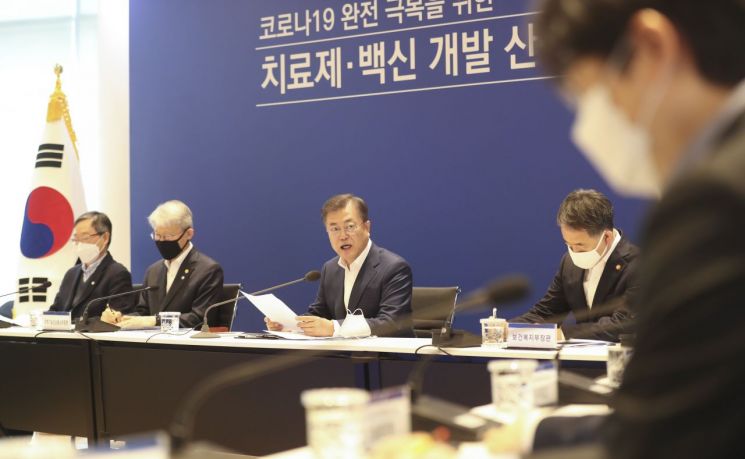
This paradoxical situation is closely related to the 'Novel Coronavirus Infection (COVID-19)' crisis, which has become an issue black hole. It has led to the effect of pushing not only economic keywords but also most economic pledges that the public should pay attention to into the background. It is not that the ruling and opposition parties did not present economic pledges.
The Democratic Party of Korea declared through its general election policy pledge book, based on '5 core values and 10 policy tasks,' the enactment of a special law (tentative name) for innovative growth and competitiveness of manufacturing, and fostering three new industries: system semiconductors, future cars, and bio. Cho Jeong-sik, chairman of the Democratic Party's Policy Committee, said, "We will improve the lives of the people with life-oriented pledges that contain vivid concerns from the field of people's livelihoods and sow the seeds of change and reform." However, the ruling party's major economic pledges failed to capture voters' attention.
The opposition party is no different. The United Future Party presented through its policy pledge book, based on 'Economic Redesign, Future Leap,' ▲expansion of corporate management freedom ▲corporate tax reduction ▲bold deregulation ▲prevention of tax bombs on future generations ▲strengthening of short selling regulations, among others.
Kim Jae-won, head of the United Future Party's '2020 Hope Pledge Development Group with the People,' expressed his ambition, saying, "We will transform the despair economy of the Moon Jae-in administration into a hopeful economy and open the hopeful tomorrow of the Republic of Korea." However, most voters are unaware of what economic pledges the ruling and opposition parties have presented.
COVID-19 threatens the survival of self-employed and small business owners, and job insecurity is deepening. General elections held in the middle of a president's term are mostly judged elections where 'economic mismanagement' emerges as a key issue. If the opposition had focused on highlighting the problems of income-led growth, a weak link of the Moon Jae-in government, it could have put the ruling party in a difficult position amid the tough economic situation.
However, having practically failed to discover economic keywords that would run through the general election, the election is approaching with no clear direction. It means they failed to find topics that could sway voters' hearts, such as the core keywords of past elections like 'tax bomb,' 'new town,' and 'free school meals.'
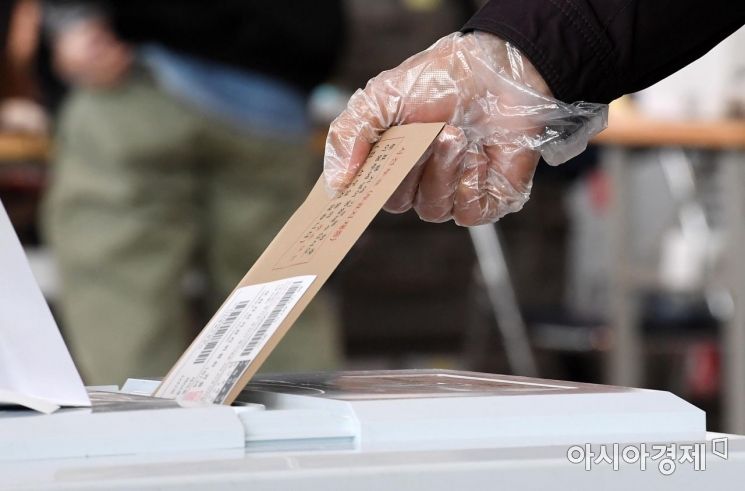 On the first day of early voting for the 21st National Assembly election on the 10th, citizens are casting their precious votes at the Namyeong-dong early voting station set up at Seoul Station. Photo by Hyunmin Kim kimhyun81@
Experts believe that the opposition party's frustrating reality is also related to internal problems. Professor Lee Jun-han of the Department of Political Science and Diplomacy at Incheon National University pointed out, "Kim Jong-in, the United Future Party's general election campaign committee chairman, should be the person leading the pledges (in the election), but he is cleaning up after reckless remarks," adding, "Instead of doing that, he should be leading the election issues by saying what the economic issues are and what the alternatives are, but he is running around trying to prevent controversies."
With early voting for the 21st general election having already started on the 10th and the official election campaign entering its final stage after this weekend, it is not easy to attempt a turnaround. Furthermore, the fact that voters are showing interest in early voting, which has lower turnout due to COVID-19 issues, is also an embarrassing point for the opposition party. It means there is not much time left for the opposition.
Um Kyung-young, director of the Era Spirit Research Institute, diagnosed, "It does not seem that economic keywords will emerge as the core issue of the election during the remaining campaign period," adding, "Rather than an evaluation of the economic situation, the ability to respond to COVID-19 is influencing voters' judgments."
© The Asia Business Daily(www.asiae.co.kr). All rights reserved.


















