Ministry of SMEs and Startups to Support About 8,400 Companies This Year
Minister Park Young-sun: "We Will Ease the Cash Flow Shortage"
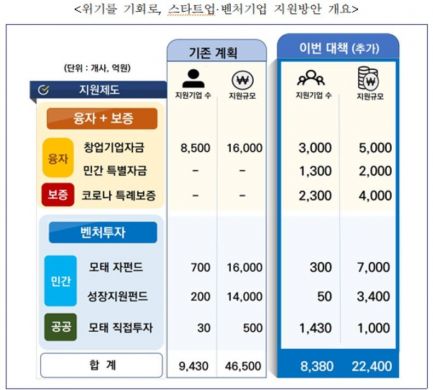
[Asia Economy Reporter Kim Daeseop] The Ministry of SMEs and Startups will provide an additional 2.2 trillion KRW in funding to startups and venture companies struggling with management difficulties due to the novel coronavirus disease (COVID-19). The ministry plans to take measures to ensure that the effects of this policy can be quickly felt on the ground through the fastest possible evaluation and execution.
On the 8th, at the 4th Emergency Economic Meeting on COVID-19 response held at the Blue House, the Ministry of SMEs and Startups reported the "Turning Crisis into Opportunity: Support Measures for Startups and Venture Companies." Additional funding support measures will be promoted to help startups and venture companies overcome the COVID-19 crisis and maintain their operations.
This policy was prepared based on the necessity to provide startups and venture companies with opportunities to prepare for a new leap as key players in the "digital new economy," which will accelerate after COVID-19. Although emergency financial support measures are currently being implemented mainly for small and medium enterprises and small business owners, startups and venture companies have also expressed difficulties, leading to the judgment that separate support measures are necessary.
In particular, the policy focuses on supplying additional dedicated funds and investment capital for startups. An additional 1.1 trillion KRW of dedicated startup funds will be supplied, and institutional incentive measures have been established to induce an additional 1.1 trillion KRW scale of venture investment in the market.
Looking at the detailed implementation of this policy, the scale of dedicated funds for startup companies has been increased by 500 billion KRW to alleviate funding difficulties for startups. Accordingly, the scale of dedicated funds for startup companies has expanded from the existing 1.6 trillion KRW to 2.1 trillion KRW. Dedicated funds for startup companies are provided only to startups less than seven years after establishment or prospective entrepreneurs.
The increased funds will be executed swiftly through faster review and evaluation to ensure timely use on the startup front. For funds under 150 million KRW, a fast track (from 29 to 15 evaluation items) will be applied during the technology business feasibility evaluation.
The Ministry of SMEs and Startups plans to cooperate with Shinhan Bank to prepare and supply 200 billion KRW in low-interest special funds, focusing on promising startups with experience participating in government support projects. The limit is 200 million KRW per startup, with interest rates as low as 1.87%.
The Korea Technology Finance Corporation, a public institution under the Ministry of SMEs and Startups, will newly supply 400 billion KRW in "Startup and Venture Company COVID-19 Special Guarantees," which provide additional new support regardless of existing guarantees, considering the financial vulnerability of startups. For simplified guarantees of 50 million KRW each, support will be provided quickly through simplified evaluation (evaluation items reduced from 33 to 10) and an online one-stop system. Additionally, startups and venture companies that promise to maintain employment for the next year will receive guarantee support of up to 300 million KRW.
The Ministry of SMEs and Startups also prepared measures for venture investment, an important funding source for startups and venture companies, as there are signs of cooling private sentiment due to COVID-19. Maintaining the momentum of venture investment, which recorded record-breaking performance last year, is also a very important task. Higher investment targets will be set for venture capital, and investment companies that achieve these targets will receive full incentives such as priority loss coverage.
For the mother fund sub-funds (funds formed in 2018?2019), funds formed up to the previous year typically invest 23% of the fund amount in the current year, but this year the target will be raised to invest up to 35% of each fund's size. Also, while newly formed funds usually invest 16% of the fund amount in the year of formation, funds formed this year will be targeted to invest up to 20% within the year.
Growth support fund sub-funds (funds formed in 2018?2019) also typically invest 24% in the current year for funds formed up to the previous year, but this will be raised to 30% within this year.
If venture capital achieves the proposed investment targets, the Ministry of SMEs and Startups plans to provide an incentive package including ▲up to 10% priority loss coverage on investments made after April ▲an additional 10% of policy fund profits to the management company ▲1% payment on excess investment achievement ▲increased contribution ratio next year (up to +10 percentage points) ▲extra points when applying for policy fund contributions next year.
Through these measures, the ministry expects that the investment scale of funds injected with government money this year will expand from the existing 3 trillion KRW to 4 trillion KRW, an increase of 1 trillion KRW within the year. In particular, the mother fund will directly invest 150 billion KRW in startups that have demonstrated competitiveness during the COVID-19 recovery process to help them seize new opportunities in the changed market environment after COVID-19.
To promote the rapid formation and investment execution of venture funds, a fast closing system will be introduced temporarily this year, allowing funds to be formed and investments to start once more than 70% of the funds are raised. Normally, venture funds must recruit 100% of the committed funds before starting investments. The ministry also plans to select venture funds for investment early, including the industrial accident compensation insurance fund (60 billion KRW), and encourage early contributions from pension funds and banks through investment briefings.
The Ministry of SMEs and Startups will also actively promote the "K-Unicorn Project" to secure future growth engines. It will discover "baby unicorns" with growth potential in employment and sales and provide package support including market development, loans, and guarantees. The plan is to support 200 companies by 2022.
Additionally, "pre-unicorns" (companies valued at over 100 billion KRW) with potential to become unicorns will be offered special guarantees (up to 10 billion KRW) and opportunities for large-scale investment attraction. The plan is to support 100 companies by 2022. Along with this, a new leverage guarantee (about 200 billion KRW) will be established, where the Korea Technology Finance Corporation matches venture capital investments up to 5 billion KRW one-to-one, and a Jump-up Fund of 1 trillion KRW will be supplied.
Park Young-sun, Minister of SMEs and Startups, said, "Through this policy, we will supply an additional 2.2 trillion KRW in funding to about 8,400 startups and venture companies this year," adding, "We will ease the funding shortage and act as a stepping stone so that startups and venture companies can become key players in the digital new economy, which will accelerate after COVID-19."
© The Asia Business Daily(www.asiae.co.kr). All rights reserved.
![Clutching a Stolen Dior Bag, Saying "I Hate Being Poor but Real"... The Grotesque Con of a "Human Knockoff" [Slate]](https://cwcontent.asiae.co.kr/asiaresize/183/2026021902243444107_1771435474.jpg)
















