COVID Shock and Oil Price Drop Direct Hit
Rating Downgrades Expected Mainly in April-May
Operating Profit of 141 Listed Companies Forecasted to Fall 17%
Hanwha Solutions, Doosan Heavy Industries, Hanjin Kal, etc.
Under Review for Credit Rating Outlook Downgrade by Rating Agencies
[Asia Economy Reporter Minji Lee] As the impact of the novel coronavirus infection (COVID-19) and the decline in oil prices is expected to result in a gloomy performance report for domestic listed companies in the first quarter, concerns are growing that corporate credit ratings may be downgraded one after another. Downgrades in corporate credit ratings not only increase financing costs but also negatively affect the national credit rating, potentially acting as a weak link in our economy.
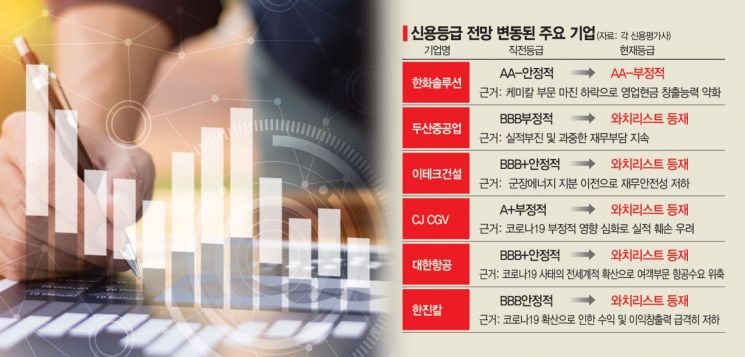
According to related industries on the 8th, domestic credit rating agencies have started their regular evaluations this month. Regular evaluations are usually conducted within six months from the company's fiscal year-end, and credit rating agencies plan to rate companies' credit ratings by considering last year's and this year's first-quarter performance as well as the company's future value. If this year's first-quarter performance worsens following last year's results and future prospects are also poor, it leads to credit rating downgrades. In particular, as the performance and outlook of most domestic companies have significantly deteriorated, it is expected that mass credit rating downgrades will be inevitable.
According to financial information provider FnGuide, the consolidated operating profit forecast for 141 listed companies in the first quarter is estimated at 16.7942 trillion won, about 17% lower than the first quarter operating profit of last year (20.2154 trillion won). The spread of COVID-19 worldwide, including the U.S. and Europe, greatly impacted the production and export of major companies. Especially, the refining and chemical industries were hit hard by the sharp drop in international oil prices.
The securities industry expects that as the COVID-19 situation prolongs, a decrease in corporate profits in the second quarter will also be inevitable. The second-quarter operating profit estimated by FnGuide for 117 companies is expected to be 21.85 trillion won, lower than the market's earlier expectation of 24.5 trillion won.
Companies such as Emart (AA+→AA), OCI (A+→A), and LG Display (AA+→A-), whose business outlooks had already turned negative before COVID-19, have had their credit ratings adjusted. Kim Eun-gi, senior researcher at Samsung Securities, said, "Since the specific impact of COVID-19 on corporate performance has not yet been revealed, rating downgrades will be concentrated from mid-April to May, when the first-quarter preliminary results are released," adding, "At this point, it is difficult to even estimate the scale of credit rating downgrades for companies."
Credit rating agencies are expected to prioritize downgrading the credit ratings of companies whose rating outlooks have been lowered or are under review. Companies with lowered credit rating outlooks by credit rating agencies include Hanwha Solutions, Doosan Heavy Industries & Construction, E-Tech Construction, CJ CGV, Korean Air, and Hanjin KAL.
Kim Sang-hoon, a researcher at Shinhan Investment Corp., explained, "From experience, companies that experienced credit rating downgrades in regular evaluations were greatly influenced by changes in first-quarter performance," and added, "It should be noted that companies receiving negative downgrade reviews with confirmed first-quarter performance declines may face credit rating downgrades."
The market expects that if rating downgrades materialize, uncertainty regarding individual companies' financing will inevitably increase. For example, in the case of Korean Air (BBB+), a downgrade is expected to further increase liquidity burdens. Due to operational sluggishness caused by COVID-19, profit-generating capacity has sharply declined, and concerns are growing that a large portion of operating cash flow may go toward repaying principal and interest on securitized borrowings (ABS) due to additional trust recovery performance deterioration. Already, corporate bond spreads (credit spreads) have sharply risen amid concerns over credit tightening. The spread of BBB+ rated bonds compared to 3-year government bonds recorded 2.18% on the 7th, a sharp increase of 0.23 percentage points from a month ago (1.95%).
Ultimately, from the perspective of overseas investors, negative investment sentiment toward Korea may spread. Professor Sung Tae-yoon of Yonsei University's Department of Economics said, "At a time like this, except for companies that can withstand performance, credit ratings are likely to be downgraded mainly for companies with high labor and personnel costs," and forecasted, "If mass corporate credit rating downgrades occur, individual companies' financing issues could lead to national credit rating problems."
© The Asia Business Daily(www.asiae.co.kr). All rights reserved.
![User Who Sold Erroneously Deposited Bitcoins to Repay Debt and Fund Entertainment... What Did the Supreme Court Decide in 2021? [Legal Issue Check]](https://cwcontent.asiae.co.kr/asiaresize/183/2026020910431234020_1770601391.png)
















