Negotiations on Production Cuts Held Consecutively on the 9th and 10th
Key Issue: Whether the World's Largest Oil Producer, the US, Will Join
US Department of Energy Claims "Production Cuts Already Achieved"
Effectiveness of Production Cuts Questioned
Oversupply Persists Despite Record Production Cuts
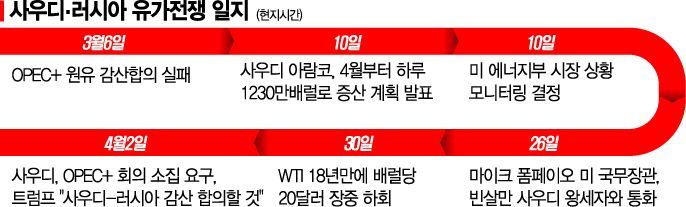
[Asia Economy Reporter Naju-seok] Although discussions among oil-producing countries on production cuts to stabilize oil prices are underway in earnest, market stabilization remains difficult to be optimistic about. It is hard to confirm the willingness of the United States, the world's largest oil producer, to cut production, and the demand has drastically decreased as the global economy and social activities have come to a halt due to the novel coronavirus infection (COVID-19).
On the 7th (local time) at the New York Mercantile Exchange (NYMEX), May delivery West Texas Intermediate (WTI) crude oil closed down 9.39% ($2.45) at $23.63 per barrel. June delivery Brent crude on the London ICE Futures Exchange fell 3.57% ($1.18) to $31.87. Despite the Organization of the Petroleum Exporting Countries (OPEC) and the OPEC+ group, which includes non-oil-producing countries such as Russia, planning to hold a meeting on the 9th to discuss a historic scale of production cuts, the market still shows signs of instability.
Experts explain that this is because doubts have grown not only about the possibility of reaching a production cut agreement but also about the effectiveness of such an agreement.
The biggest concern in the market regarding production cut negotiations is whether the United States will participate. According to foreign media, Saudi Arabia and Russia, who are expected to lead the OPEC+ talks, have set the participation of the United States as a condition for production cuts. On the other hand, the United States appears hesitant to join the production cut negotiations with them.
On the 6th, U.S. President Donald Trump stated, "We have not yet received a request regarding production cuts," but also mentioned that U.S. oil production has already decreased. The U.S. Department of Energy, citing a report from the Energy Information Administration (EIA), expressed skepticism about government-level production cut orders.
The U.S. Department of Energy explained, "Regarding media reports that OPEC+ requested production cuts from the United States, according to the EIA report, U.S. crude oil production has already decreased by 2 million barrels," adding, "This was achieved without government intervention." It means that the U.S. has already reduced production due to market supply and demand dynamics caused by low oil prices. The U.S. government claims it has already taken production cuts through so-called market-driven reductions. However, experts believe that for the U.S. to implement specific production cuts, orders from state or federal governments are necessary. This is because if oil producers reduce output to prevent price drops (to raise prices), it could violate antitrust laws.
Some expect that the atmosphere demanding production cuts from the United States might change after the upcoming Group of Twenty (G20) summit scheduled for the 10th. Experts from the global consulting research firm Eurasia Group anticipate that pressure on the U.S. to join production cut negotiations may ease after the G20. There is a possibility that the reduction in oil production due to low prices will be repackaged as the U.S.'s production cut efforts.
While the U.S.'s participation is questionable, doubts about the effectiveness of a production cut agreement are also significant. Fatih Birol, Executive Director of the International Energy Agency (IEA), said, "Even if Saudi Arabia and Russia reach an agreement, if the scale is to reduce production by 10 million barrels per day, it may be insufficient to solve the current problem." This means that despite production cuts, there could be a situation where 15 million barrels per day need to be stored.
Bjorn Schieldrop, an analyst at Sweden's SEB Markets, predicted, "Even if production is reduced by 10 million barrels per day compared to the first quarter of this year, the market will still be in an oversupply situation."
Schieldrop also raised doubts about whether Saudi Arabia will be proactive in production cut negotiations. Saudi Arabia might use this low oil price situation as an opportunity to eliminate competitors. It remains to be seen whether Saudi Arabia will actively engage in production cut negotiations.
© The Asia Business Daily(www.asiae.co.kr). All rights reserved.
![Clutching a Stolen Dior Bag, Saying "I Hate Being Poor but Real"... The Grotesque Con of a "Human Knockoff" [Slate]](https://cwcontent.asiae.co.kr/asiaresize/183/2026021902243444107_1771435474.jpg)












