Ministry of Land and Local Governments Survey Relocation Demand of Non-Residential Residents
72% of 8,875 Households Wish to Relocate...Many in Gosiwon
Ministry Expands Public Rental Housing to 5,500 Units This Year
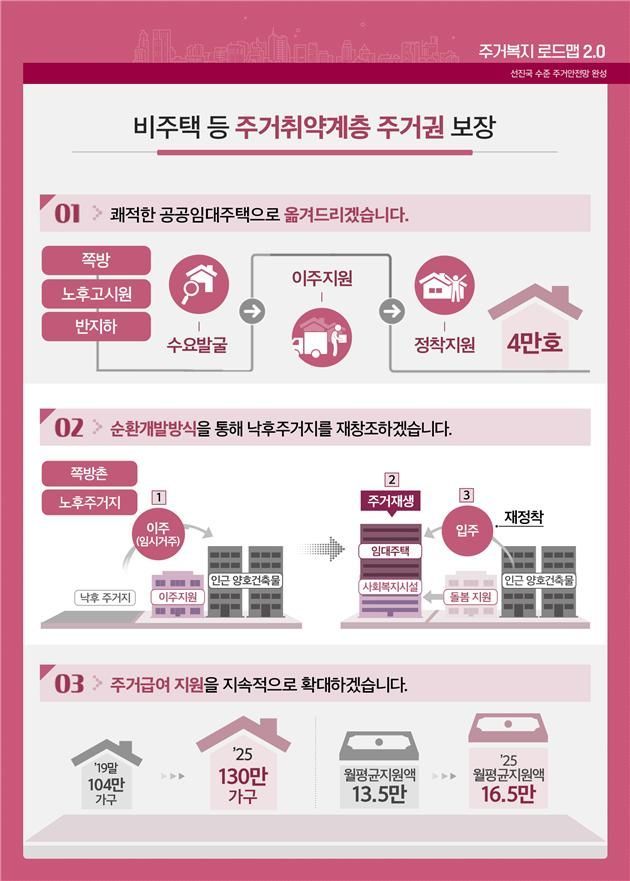
[Asia Economy Reporter Moon Jiwon] The Ministry of Land, Infrastructure and Transport (MOLIT) is set to fully implement a housing upgrade support project targeting non-residential dwellers such as those living in jjokbang (tiny rooms) and gosiwon (small, affordable rooms) who wish to relocate to public rental housing.
According to MOLIT on the 8th, a survey conducted by MOLIT and local governments from December last year to February this year, visiting gosiwon, jjokbang, vinyl greenhouses, and other non-residential dwellings to assess demand for relocation to public rental housing, revealed that 72% of non-residential residents expressed a desire to move.
Among the 8,875 households that responded to the survey, middle-aged groups (45?64 years old) accounted for the largest portion at 48.1%, followed by elderly households aged 65 and above at 42.8%. The relocation desire rate was highest at over 80% among residents of gosiwon, motels, and inns, while the rate was relatively lower among households living in vinyl greenhouses and containers.
MOLIT explained that based on these survey results, it will actively carry out the housing upgrade support project for households wishing to relocate to public rental housing.
Public rental housing will be equipped with built-in essential appliances such as refrigerators and washing machines, and in cooperation with the Housing Welfare Foundation and the Korea Inclusive Finance Agency, full deposit coverage, moving expenses of 200,000 KRW, and living supplies costs of 200,000 KRW will be provided. To prevent cases of giving up on moving into public rental housing, on-site close support will be offered through housing search assistance and moving helpers.
Additionally, various support programs tailored to local conditions will be implemented, such as meetings with 'jjokbang seniors' who have settled in public rental housing (Yongsan-gu), move-in gifts (Gwangmyeong City), side dish sharing (Michuhol-gu, Incheon), and housewarming programs (Jung-gu).
MOLIT plans to expand the priority supply of public rental housing from about 2,000 units annually to 5,500 units this year, supporting a total of 40,000 households by 2025.
For those who find it difficult to relocate immediately to public rental housing or do not wish to move, support will be provided to alleviate housing cost burdens through housing benefits.
For middle-aged single-person households living in deteriorated gosiwon with poor housing conditions, a dedicated loan product for jeonse (key money deposit) has been newly introduced. Alongside the housing upgrade project, redevelopment and urban regeneration projects aimed at transforming deteriorated residential areas into quality public rental housing will also be promoted.
The number of leading local governments for housing welfare will increase from the current 11 to 30 by 2025, and an 'Relocation Support 119 Center' will be established within the Korea Land and Housing Corporation (LH), the operator of public rental housing, to provide counseling on rental housing move-in, relocation support, and overall settlement assistance.
Kim Jeonghee, Director of Housing Welfare Policy at MOLIT, emphasized, "We will actively support housing upgrades by expanding the supply of public rental housing for vulnerable groups, combining comprehensive support such as moving expenses, deposit assistance, and care services."
She added, "Above all, since the housing welfare delivery system must operate tightly on the ground, we will support various specialized projects of leading local governments and strengthen incentives to enhance regional housing welfare capabilities."
© The Asia Business Daily(www.asiae.co.kr). All rights reserved.

















