Operating profit fell below 1 trillion last year
Direct hit from COVID-19 this year, oil prices plummet
Billions in inventory valuation losses inevitable
Borrowings increased by 1 trillion last year, nearing 5 trillion
Demand for aviation and others sharply declined, gloomy outlook for second half
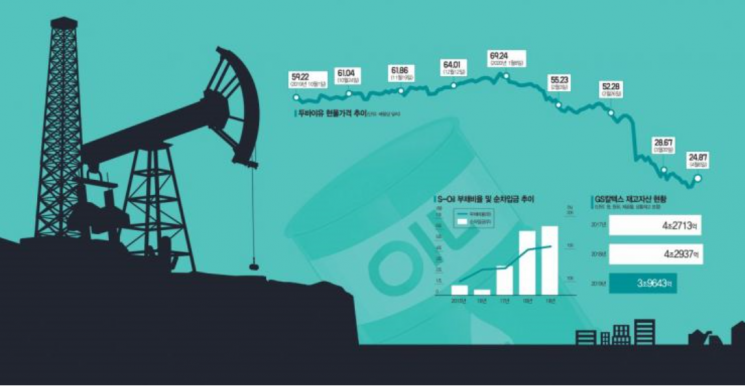
Refining companies have also been hit hard by the novel coronavirus disease (COVID-19) crisis. The price of West Texas Intermediate (WTI), which was around $60 per barrel at the beginning of the year, fell to about $20 last month as COVID-19 rapidly spread to the United States, Europe, and other regions. Refiners' refining margins remain in negative territory, and inventory valuation losses are substantial. Even if COVID-19 subsides, if the global demand slowdown prolongs, companies could fall into a performance slump. We examine the performance and financial status of refiners through GS Caltex and S-Oil.
[Asia Economy Reporter Lim Jeong-su] GS Caltex is struggling with continuous performance deterioration. Due to the drop in oil prices, operating profit fell below 1 trillion won last year, and this year, with the COVID-19 crisis causing a sharp plunge in oil prices, a large-scale loss in the first quarter has become inevitable. Despite worsening performance, investments continue, causing the financial structure to deteriorate again.
◆ First quarter loss forecast up to 800 billion won = The financial investment industry expects GS Caltex to record an operating loss close to 700 billion to 800 billion won on a consolidated basis in the first quarter of this year. This is due to the negative margin structure where the loss increases as petroleum product sales increase because of the decline in refining margins caused by the plunge in oil prices. The Singapore complex refining margin, representing figures for the Asia region, turned negative from February and fell to as low as -$15 last month. Although it has shown gradual improvement, it remained negative until early April. It is far below the breakeven refining margin known to be around $4 to $5.
Inventory valuation losses amounting to several hundred billion won due to the oil price plunge are also unavoidable. GS Caltex recently held inventory assets averaging over 4.1 trillion won over the past three years. Due to the drop in oil prices, inventory assets slightly decreased to about 3.963 trillion won last year. When oil prices plunge, inventory valuation losses increase accordingly. However, inventory assets include not only crude oil but also feedstock in the production process and product inventory before sales. Also, the size of valuation losses varies depending on accounting inventory valuation methods such as FIFO (First-In, First-Out) and weighted average cost. The securities industry estimates GS Caltex's first-quarter inventory valuation loss at 150 billion to 200 billion won.
An accounting firm official said, "Inventory valuation losses due to the drop in oil prices are reflected in operating results," adding, "While inventory valuation gains or losses for the quarter may vary depending on the accounting inventory valuation method, the overall impact on operating profit is minimal."
◆ Demand gap makes the second half uncertain = The bigger problem is the demand gap for petroleum products caused by COVID-19. According to related industries, the transportation sector, including aviation, shipping, and automobiles, accounts for 60% of petroleum product demand. However, petroleum product demand in the transportation sectors of major global consumer countries has sharply declined due to COVID-19. Accordingly, domestic refiners such as SK Innovation and Hyundai Oilbank have decided to reduce operating rates. Concerns are emerging that it will be difficult to expect a recovery in refiners' performance unless supply and demand conditions improve in the second half. Global credit rating agency Standard & Poor's (S&P) forecasts that "demand slowdown will continue for the next six months."
Among domestic refiners, GS Caltex, which has an export ratio of up to 70%, is expected to be significantly affected by the demand gap. Furthermore, as China has gradually started to increase operating rates, it has poured cold water on the supply and demand situation. A refiner official said, "Since crude oil was imported at very low prices in February and March, if refining margins improve in April and May, some of the first-quarter losses will be recovered," but added, "Demand is at rock bottom, so it is uncertain whether annual losses can be avoided this year."
◆ Financial structure hit... Decline in debt repayment ability = The financial situation has also turned to a worsening trend again. Borrowings, which had fallen below 4 trillion won in 2018 due to improved performance, increased by 1 trillion won in one year due to changes in International Financial Reporting Standards (IFRS) related to lease liabilities recognition, reaching nearly 5 trillion won at the end of last year. Net borrowings excluding cash equivalents also increased from 2.61 trillion won to 3.62 trillion won during the same period.
GS Caltex is expected to execute investments exceeding 1 trillion won this year despite the sharp deterioration in performance. This is because it is constructing an olefin production facility (MFC) capable of producing 700,000 tons of ethylene annually, scheduled for completion in the first half of next year. Last year, capital expenditures (Capex), including the MFC, amounted to between 1.2 trillion and 1.4 trillion won.
S&P forecasts, "GS Caltex will increase Capex to between 1.5 trillion and 1.8 trillion won this year," adding, "Adjusted borrowings increased from 3.1 trillion won in 2018 to about 4 trillion won last year and will exceed 4.5 trillion won this year."
◆ Test of overcoming the crisis = CEO Heo Se-hong is in a situation where he must prove his management ability by overcoming the crisis. He took office as GS Caltex CEO in 2019 and has been plagued by external adversities for two consecutive years. Last year, performance deteriorated due to sluggish business conditions caused by the US-China trade dispute, and this year, COVID-19 has been a stumbling block. GS Caltex's operating profit, which exceeded 2 trillion won for two consecutive years in 2016 and 2017, decreased to about 1.23 trillion won in 2018 and fell to 880 billion won last year. It has dropped to less than half in two years. It is difficult to expect performance improvement this year as well.
Whether GS Caltex overcomes this crisis could also affect GS Group's direction and future strategy. Caltex is a core affiliate of the group and leads Chairman Heo Tae-soo's digital innovation strategy. CEO Heo is the eldest son of Heo Dong-soo, chairman of GS Caltex, and leads the fourth-generation management of GS Group.
A refiner official said, "CEO Heo Se-hong led the Singapore branch, which handled the company's crude oil transactions, during the 2008 financial crisis and overcame the crisis," adding, "Although the situation is quite difficult, he is expected to navigate through it well by leveraging his experience."
© The Asia Business Daily(www.asiae.co.kr). All rights reserved.
![Clutching a Stolen Dior Bag, Saying "I Hate Being Poor but Real"... The Grotesque Con of a "Human Knockoff" [Slate]](https://cwcontent.asiae.co.kr/asiaresize/183/2026021902243444107_1771435474.jpg)
















