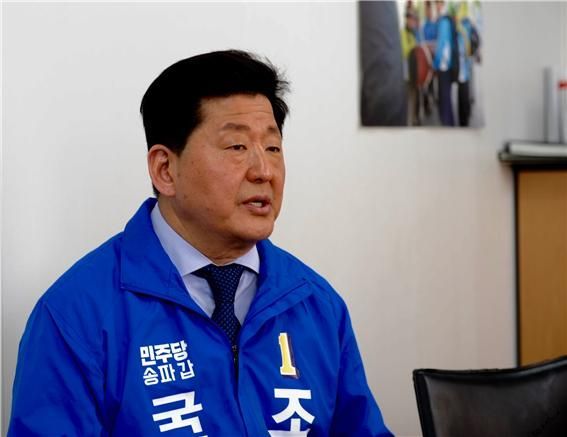
[Asia Economy Reporter Park Jong-il] Jo Jae-hee, the Democratic Party candidate for Songpa-gap, issued a statement on COVID-19 prevention on the 7th, saying, "Observing the responses of various governments to infectious diseases such as SARS, H1N1, MERS, and COVID-19, Director Jeong Eun-kyung of the Korea Disease Control and Prevention Agency deserves the Nobel Prize in Medicine for her dedication to successful disease control." The following is the full text of the statement.
Jo added, "Director Jeong Eun-kyung prioritized infectious disease response as her primary goal and promised a swift control tower, and now she is succeeding in COVID-19 prevention," emphasizing, "Based on these objective and fair grounds, I would call Director Jeong Eun-kyung Korea's Schweitzer. Comparing her first briefing photo with a recent one, you can see the fatigue accumulated from her dedication to public health. She has clearly earned the qualification for the Nobel Prize in Medicine simply by setting an exemplary model in COVID-19 prevention."
---------------------------------------
Full Statement by Jo Jae-hee, Songpa-gap Candidate
I express my respect for the Korea Disease Control and Prevention Agency's response to COVID-19 and declare that Director Jeong Eun-kyung, praised worldwide, is qualified for the Nobel Prize in Medicine. Analyzing the establishment of the Disease Control and Prevention Agency under the Roh Moo-hyun administration and the infectious disease responses of the Lee Myung-bak, Park Geun-hye, and Moon Jae-in administrations, I examine how the government should protect its people.
The Roh Moo-hyun administration responded through a 'system.' The president did not make policies impulsively but systematized the nation to maintain consistent standards. In response to SARS, they created response systems and manuals and ensured transparency of information. Ultimately, with only 4 infected and zero deaths, Korea was recognized by the WHO as a model country for infectious disease prevention.
After SARS emerged in China at the end of 2002, Korea issued an infection alert in 2003 and maintained proactive prevention until the situation ended in July. The Disease Control and Prevention Agency was launched in December 2003 and has played a decisive role during the COVID-19 crisis. Korea’s infectious disease response system has been in place since then.
In early 2009, during the Lee Myung-bak administration, H1N1 occurred in the U.S. and appeared in Korea in May. The Disease Control and Prevention Agency’s establishment shone during this time. Within a month of the U.S. outbreak, the Influenza Countermeasures Headquarters was formed, and rapid isolation measures were taken. However, due to difficulties securing antiviral drugs like Tamiflu, the system eventually collapsed.
The Lee Myung-bak administration cut the antiviral drug purchase budget from 6 billion won under the Roh Moo-hyun administration to 1.37 billion won in 2009. Prioritizing the wealthy upper class, it opposed raising taxes on them to cover overall costs. Ultimately, there were 760,000 infected and 270 deaths.
In 2015, the second year of the Park Geun-hye administration, the first MERS patient appeared, but the countermeasures headquarters was formed nine days later. The response center was disorganized without a control tower. The names of problematic hospitals were concealed and later forcibly disclosed but inaccurately. Despite the spread of infection, only the caution stage was maintained.
Concealing information to avoid disadvantages to large hospitals showed the conservative government’s authoritarian mindset of placing itself above the people. Especially problematic was the lack of transparency. The Park Geun-hye administration’s information transparency was completely zero. Ultimately, there were 186 infected and 38 deaths, and Korea was criticized as the world’s second-largest outbreak country.
At the end of last year, COVID-19 emerged in China, and Korea’s outbreak began in January this year. The government raised the response level from caution to alert and responded proactively. Infection routes were disclosed in real time, and close contacts were traced. Although confirmed cases surged due to Shincheonji, regional lockdowns were not imposed, and prevention was maintained.
?
The president and prime minister took the lead as control towers, and the Disease Control and Prevention Agency led prevention with a comprehensive system. The initial response was successful, earning Korea envy as a model prevention country from nations with rapidly increasing confirmed cases. The world envies our medical system and follows our prevention methods.
On March 28, Hwang Kyo-ahn, leader of the United Future Party, posted on Facebook a fallacy claiming, "The medical insurance introduced by President Park Chung-hee is the foundation for overcoming COVID-19." In response, I held a press conference on the 30th, clarifying that the current medical insurance was completed during the Kim Dae-jung administration. Isn’t it the integrated medical insurance admired worldwide?
During the Kim Dae-jung administration, I served as the head of the Blue House 'Quality of Life Improvement Planning Group' and created the current integrated medical insurance, which became the cornerstone for overcoming the COVID-19 crisis. Director Jeong Eun-kyung prioritized infectious disease response as her primary goal, promised a swift control tower, and is now succeeding in COVID-19 prevention.
Based on these objective and fair grounds, I call Director Jeong Eun-kyung Korea’s Schweitzer. Comparing her first briefing photo with a recent one, you can see the fatigue accumulated from her dedication to public health. She has clearly earned the qualification for the Nobel Prize in Medicine simply by setting an exemplary model in COVID-19 prevention.
© The Asia Business Daily(www.asiae.co.kr). All rights reserved.

















