KCCI Releases Corporate Culture Diagnosis Report on Workplace Generational Conflicts
Calm 4050 Supervisors vs. Uncomfortable 2030 Subordinates Over Generation Gaps
Conflict Rooted in Corporate Culture Stuck in the Past Despite Changing Workforce... Solution Lies in 'Pro Team' Not 'Family' Company Model
[Asia Economy Reporter Changhwan Lee] A survey revealed that 6 out of 10 office workers feel generational differences within the workplace.
The Korea Chamber of Commerce and Industry (KCCI) presented the ‘Comprehensive Diagnosis Report on Generational Conflicts and Corporate Culture in Korean Companies’ on the 8th, diagnosing the ongoing conflict between the so-called ‘yojeum aedeul’ (these days’ kids) and ‘kkondae’ (older generation perceived as rigid) through generational characteristics, conflict situations, and cause analysis, and suggested directions for organizational management.
This report was prepared based on a survey of approximately 13,000 office workers belonging to 30 large and medium-sized companies, followed by in-depth focus group interviews (FGI) by generation.
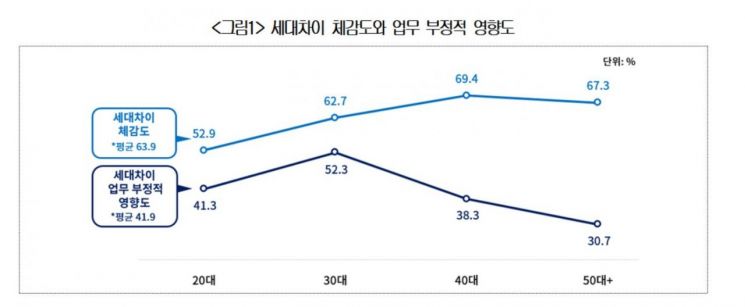
In the survey, 63.9% of office workers responded that they feel generational differences. By age group, the perception rates were 52.9% and 62.7% for those in their 20s and 30s respectively, while those in their 40s and 50s felt the differences more strongly at 69.4% and 67.3%, indicating that the older generations felt generational gaps more acutely.
Conversely, regarding whether generational differences negatively affect work, 41.3% and 52.3% of those in their 20s and 30s answered ‘yes,’ whereas only 38.3% and 30.7% of those in their 40s and 50s agreed, showing that the younger generations felt more difficulties due to generational differences.
A KCCI official pointed out, “Due to the top-down vertical work style and communication practices, the difficulties caused by generational differences tend to fall on lower ranks. What the older generation may consider a simple generational difference can be perceived as serious generational conflict by the younger generation.”
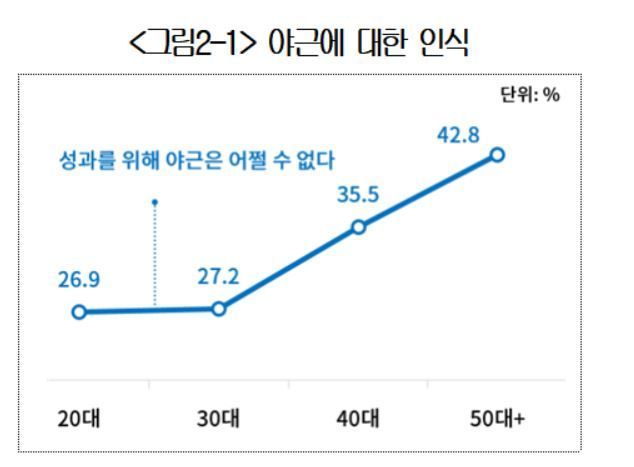
Regarding the statement ‘Overtime work is inevitable for performance,’ 35.5% and 42.8% of those in their 40s and 50s responded positively, while only 26.9% and 27.2% of those in their 20s and 30s agreed, showing a significant gap.
This is analyzed as the older generation, who think in terms of ‘duty,’ prioritizing assigned tasks, while the younger generation, who think in terms of ‘rights,’ emphasize working hours as stipulated in labor contracts.
In the in-depth interviews by generation, the younger generation viewed the older generation’s emphasis on being ‘diligent’ and ‘hardworking’ as irrational, whereas the older generation evaluated the younger generation’s attitude as “lacking responsibility as organizational members.”
◆Work Instructions: “Figure it out yourself” vs. “Need to understand the reason and method of the work”= In the survey, all generations gave low positive evaluations regarding the rationality and clarity of work instructions. Although those in their 50s had relatively higher positive response rates on whether ‘work practices are rational’ and ‘leaders’ instructions are clear,’ those in their 20s, 30s, and 40s did not exceed half in positive responses.
In the in-depth interviews, the older generation was described as the ‘map generation’ who learned work vaguely and accepted it as a practice, while the younger generation was characterized as the ‘navigation generation’ who desire clear instructions.
Regarding company dinners, the older generation said in the interviews, “Company dinners are like formal greetings, not fun but a necessary ‘gyeoreuk’ (a metaphor for something reluctantly accepted) for communication.” In contrast, the younger generation responded, “How can communication happen through company dinners, which are a series of formalities? Communication during work hours is sufficient.”
A KCCI official said, “Contrary to popular belief, the older generation also finds company dinners unenjoyable,” adding, “Rather than focusing on the shell of company dinners (회식, hoeshik) as ‘a meal and a drink for communication,’ it is time to consider new meeting methods (회동, hoedong) that satisfy everyone.”
The report identified generational change as the superficial cause of workplace generational conflicts. Since the 1980s, the millennial generation has entered society, forming the current 20s and 30s generation, which has weakened collectivist tendencies and increased individualistic tendencies.
In fact, in this survey, the 20s and 30s generation showed significantly lower agreement than the 40s and 50s generation on statements such as ‘I exist because the organization grows’ or ‘I can sacrifice myself for the organization.’
Due to these generational differences in tendencies, the older generation views the 20s and 30s as ‘yojeum aedeul’ (these days’ kids), while the younger generation sees the 40s and 50s as ‘kkondae,’ leading to interpersonal conflicts.
◆Fundamental Cause: ‘Unchanging Organization’ That Fails to Reflect ‘Changed Members’= The KCCI’s organizational structure diagnosis analyzing factors influencing generational conflicts found that the fundamental cause lies in low organizational competitiveness.
In this survey, office workers rated their organization’s competitiveness low across all detailed areas: rationality (44 points), dynamism (44 points), fairness (24 points), openness (20 points), and autonomy (39 points). The generational differences in these ratings were also minimal.
Ambiguity in work roles and processes causes interpersonal conflicts, and lack of innovation and learning results in leaders falling behind environmental changes.
Irrational evaluations and rewards lead to complacency among the younger generation, and lack of autonomy and delegation causes conflicts with the older generation, while a rigid corporate culture that does not respect diversity raises barriers between generations.
The KCCI report suggested that to overcome generational conflicts, superficial leadership training is insufficient; instead, the organizational culture should be improved from a ‘family-like company’ to a ‘pro team-like company.’ This means adopting the principle of pro team operation: ‘When players play for the team, the team gives players what they want.’
As a way to introduce a ‘pro team’ corporate culture, the report proposed the ‘5Rs’: ▲Re-establish (valuable dedication), ▲Respect (mutual respect), ▲Result (performance and outcomes), ▲Reward (compensation and recognition), and ▲Reboot (training and growth) as core corporate culture elements.
Park Joon, head of the KCCI Corporate Culture Team, emphasized, “If the organization’s orientation is like a ‘pro team,’ leaders will strive to have the capabilities of a ‘pro team coach,’ and followers will contribute to the team like ‘pro players’ to be recognized. Ultimately, a good organization is one that is both a good place to work and competitive.”
© The Asia Business Daily(www.asiae.co.kr). All rights reserved.
![Clutching a Stolen Dior Bag, Saying "I Hate Being Poor but Real"... The Grotesque Con of a "Human Knockoff" [Slate]](https://cwcontent.asiae.co.kr/asiaresize/183/2026021902243444107_1771435474.jpg)

















