"Emergency Operation System Level 2, to be Closely Coordinated with Related Agencies"
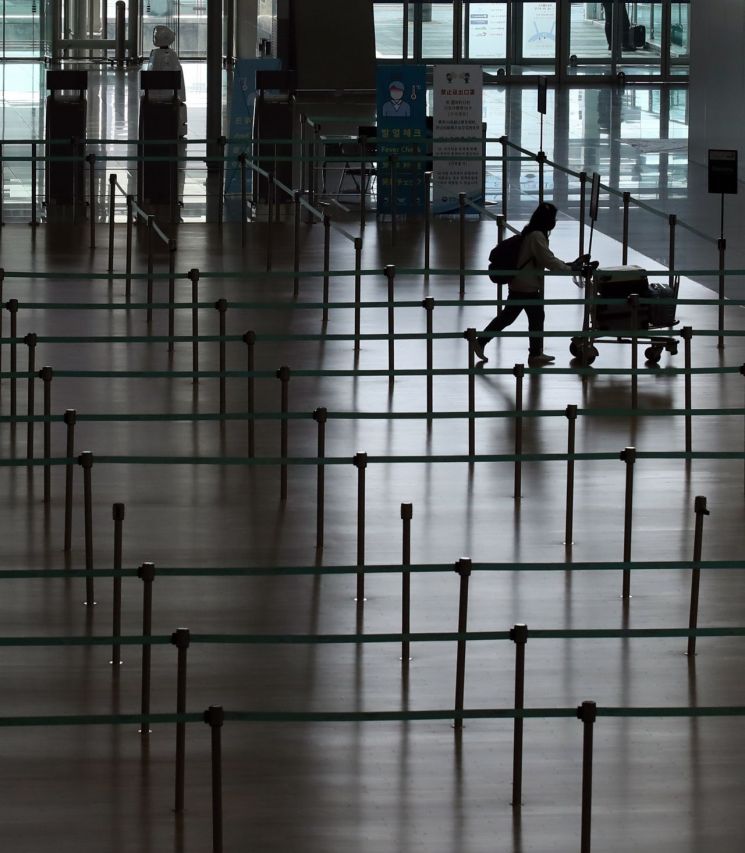
[Asia Economy Reporter Yu Je-hoon] Due to the COVID-19 pandemic, the daily passenger count at Incheon International Airport has fallen below 5,000. In response, Incheon Airport has begun full-scale measures, including partial reduction of airport functions such as departure halls and aprons.
On the 7th, according to Incheon International Airport Corporation, President Koo Bon-hwan held the 2nd Emergency Management Meeting the day before to discuss the implementation status of the first-stage emergency operation system at Incheon Airport and support plans for the airport industry ecosystem.
This measure was taken in response to the sharp decline in passengers at Incheon Airport due to the impact of COVID-19. In fact, the number of passengers using Incheon Airport the previous day was 4,581, breaking the 5,000 mark for the first time since its opening in 2001. Additionally, the average daily passenger count from the 1st to the 6th was only around 6,869.
Accordingly, the corporation began implementing the first-stage emergency operation system from the previous day. The corporation had previously established plans for ▲Emergency Operation Stage 1 (airport function reduction when daily passengers range from 7,000 to 12,000 for one week) ▲Emergency Operation Stage 2 (expanded airport function reduction when daily passengers range from 3,000 to 7,000 for one week) ▲Emergency Operation Stage 3 (minimal airport function maintenance when daily passengers fall below 3,000 for one week).
Under the current Stage 1 application, Incheon Airport has partially operated major facilities such as departure halls, check-in counters, aprons, baggage handling facilities, and shuttle trains. The number of departure halls was reduced from six to two (based on Terminal 1), and manned check-in counters were reduced to within 30% of the previous number. The aircraft parking aprons were cut from 107 to 40, and the shuttle train tracks were reduced from two to one.
The corporation is also preparing for the possibility of applying Stage 2 emergency response in the future. A corporation official stated, "There are many aspects that need to be discussed with the government and authorities regarding the initiation of Stage 2 or higher emergency operations," adding, "We will carefully review the situation."
Meanwhile, at the emergency meeting, the corporation also prepared a support plan for the airport industry worth 181 billion KRW. To this end, the corporation decided to raise a total of 1.1988 trillion KRW in borrowings through bond issuance and other means. This amount is about 220 billion KRW higher than the 975.1 billion KRW borrowing considered during the first meeting in March.
President Koo said, "The decision to initiate Stage 2 emergency operations will be made cautiously based on a comprehensive analysis of passenger trends at Incheon Airport, the ripple effects of airport function reductions on passengers, and cases from overseas airports, in close consultation with related agencies such as the Ministry of Land, Infrastructure and Transport." He added, "By proactively implementing an all-out support plan worth a record 181 billion KRW, the corporation aims to help the airport industry ecosystem overcome the current crisis early and create a foundation for mutual coexistence."
© The Asia Business Daily(www.asiae.co.kr). All rights reserved.
![Clutching a Stolen Dior Bag, Saying "I Hate Being Poor but Real"... The Grotesque Con of a "Human Knockoff" [Slate]](https://cwcontent.asiae.co.kr/asiaresize/183/2026021902243444107_1771435474.jpg)
















