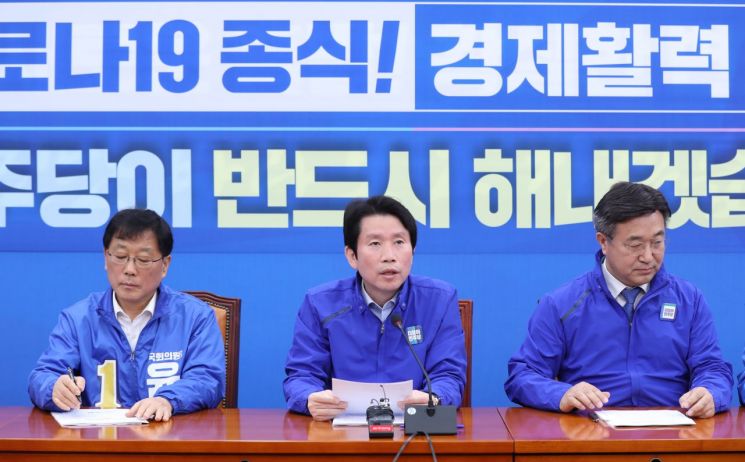
[Asia Economy reporters Kang Nahum, Son Sunhee, Jang Sehee] The Democratic Party of Korea has proposed an urgent meeting between ruling and opposition floor leaders to swiftly allocate the emergency disaster relief fund budget, accelerating efforts. However, discord among the party, government, and Blue House is expected to cause considerable difficulties before the related budget is actually allocated.
On the morning of the 7th, at a current affairs inspection meeting held at the National Assembly, Lee In-young, floor leader of the Democratic Party, said regarding the allocation of the emergency disaster relief fund budget, "I propose an urgent meeting with the United Future Party's floor leaders," adding, "If the opposition agrees, we will actively consider recommending the issuance of an emergency financial order." This reaffirmed the policy of expanding support payments nationwide announced earlier by party leader Lee Hae-chan, while also indicating a willingness to accept United Future Party leader Hwang Kyo-ahn's proposal to provide 500,000 won per person.
Lee said, "United Future Party's Kim Jong-in, the election committee chairman, and leader Hwang Kyo-ahn both unanimously advocated for the issuance of an emergency financial order," adding, "The Democratic Party has refrained from requesting issuance due to some legal reviews stating conditions were not met, to avoid political conflict, but since the opposition's election committee chairman and leader agree, there is absolutely no reason to hesitate in requesting the president to issue the emergency financial order."
He continued, "The emergency disaster relief fund is not a vote-buying cash handout but a timely support fund for all citizens struggling due to COVID-19," and said, "We plan to convene an extraordinary session immediately after the general election to process the supplementary budget starting from the 16th. If possible, we will speed up to complete payments within April."
The previous day, party leader Lee announced plans to provide an emergency disaster relief fund of 1 million won per four-person household to all citizens regardless of income or region. This maintains the originally proposed payment amount of 1 million won per four-person household but expands the eligible recipients. The expanded support is estimated to require a total of 13 trillion won, which is 3.9 trillion won more than the government's proposal of 9.1 trillion won. The initially expected size of the second supplementary budget (7.1 trillion won) will also increase accordingly.
Leader Hwang also proposed on the 5th to provide 500,000 won per person as an emergency disaster relief fund. He urged the president to invoke the 'emergency financial and economic order' for swift execution and called for securing the necessary 25 trillion won by restructuring the 2020 budget of 512 trillion won.
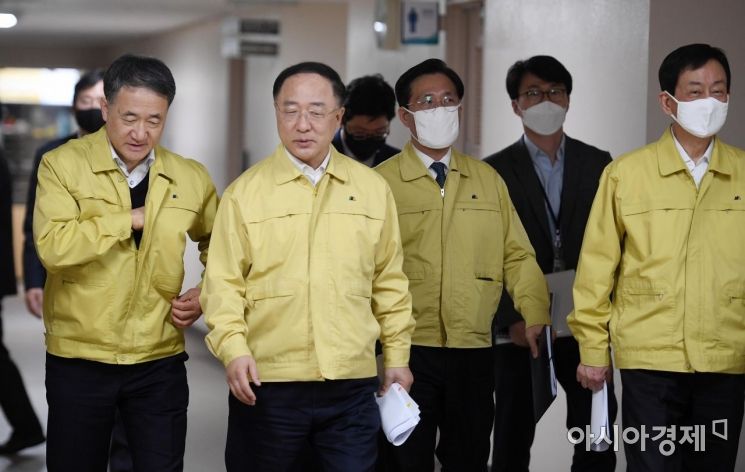 Hong Nam-ki, Deputy Prime Minister and Minister of Economy and Finance (second from left), is leaving the briefing room with related ministers after concluding the joint briefing of relevant ministries on the results of the 3rd Emergency Economic Meeting held at the Government Seoul Office in Jongno-gu, Seoul on the 30th. From the left, Park Neung-hoo, Minister of Health and Welfare; Deputy Prime Minister Hong; Sung Yun-mo, Minister of Trade, Industry and Energy; Jin Young, Minister of the Interior and Safety. Photo by Kim Hyun-min kimhyun81@
Although each party has different approaches, if the gap in payment amounts narrows, bipartisan agreement is expected to be easily reached. The problem lies in the differences between the party and government. It is known that the Democratic Party did not consult with the government before deciding to expand the emergency disaster relief fund to all citizens. A government official said in a phone call on the 6th that the nationwide payment plan was "not considered at all," adding, "The payment to the lower 70% was decided less than a week ago; how could we have discussed expanding it nationwide?"
In particular, the government's burden regarding securing funds is expected to be a source of conflict in future party-government negotiations. Earlier, Deputy Prime Minister and Minister of Economy and Finance Hong Nam-ki stated regarding securing funds for the second supplementary budget for the emergency disaster relief fund, "We plan to cover it as much as possible through restructuring existing expenditure projects." This means identifying projects expected to be delayed due to the COVID-19 situation, projects with reduced needs due to falling oil prices and interest rates, and other projects where expenditure cuts are possible. If the supplementary budget increases by more than 3 trillion won as proposed by the Democratic Party, it may be difficult to secure funds solely through such expenditure restructuring, implying that issuing deficit bonds may be inevitable.
The Blue House is carefully monitoring the situation without immediately taking a stance on the emergency disaster relief fund. Officially, the plan is to swiftly prepare and submit the second supplementary budget to the National Assembly as decided by President Moon Jae-in at the third emergency economic meeting on the 30th of last month. At that time, President Moon said, "To reserve fiscal capacity and ensure swift bipartisan agreement, most of the funds will be secured through painful government budget expenditure restructuring." The government is proceeding with supplementary budget preparations based on this policy through expenditure restructuring.
However, internally, there is a sense of concern. Despite the party, government, and Blue House having already made a decision after long discussions and consultations, considering urgency, fairness, and fiscal capacity comprehensively, claims overturning this decision have emerged even before the supplementary budget was submitted. Ultimately, since the supplementary budget review will take place in the National Assembly, the final decision is expected to depend on bipartisan negotiations.
© The Asia Business Daily(www.asiae.co.kr). All rights reserved.
![A Woman Who Jumps Holding a Stolen Dior Bag... The Mind-Shaking, Bizarre Con of a "Human Knockoff" [Slate]](https://cwcontent.asiae.co.kr/asiaresize/183/2026021902243444107_1771435474.jpg)

















