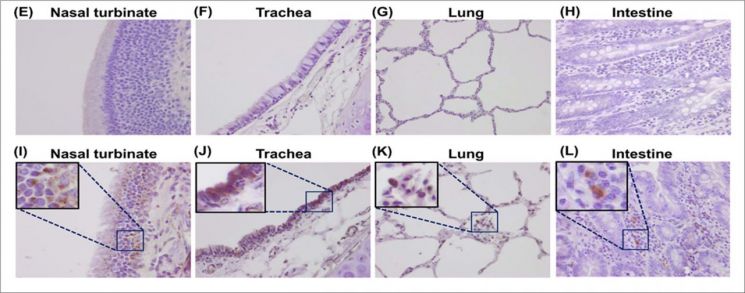
 Observation of tissue infection through immunohistochemical staining of ferrets infected with the COVID-19 virus. (E)~(H) are tissues from uninfected ferrets, (I)~(L) are tissues from ferrets infected with the COVID-19 virus (NMC-nCoV02 isolate), showing enlarged dark brown areas. These were observed in the nasal turbinate, trachea, lung, and intestine.
 [Asia Economy Reporter Choi Dae-yeol] The National Medical Center announced on the 6th that it confirmed asymptomatic transmission during the incubation period of COVID-19 through animal experiments.
The Public Health Medical Research Institute at the National Medical Center and Professor Choi Young-gi from the Department of Microbiology at Chungbuk National University School of Medicine formed a joint COVID-19 research team to verify the pathogenesis and transmission patterns of the coronavirus using animal models. This study, titled "Study on Infection and Rapid Transmission of COVID-19 Virus in Ferrets," was published online on the 31st of last month in "Cell Host & Microbe," a sister journal of "Cell Press."
The research team injected the COVID-19 virus (NMC-nCoV02), isolated from respiratory specimens of domestic COVID-19 patients in early February, into ferrets, experimental animals with lung structures similar to those of humans. Subsequently, they confirmed the spread of the virus to various internal tissues such as the respiratory and digestive systems through immunohistochemical staining.
As a result of the experiment, the COVID-19 virus injected into the ferrets was detected and spread from the second day of infection in nasal secretions (inside the nostrils and between the uvula), blood, and other bodily fluid secretions. From the fourth day, clinical symptoms such as high fever, coughing, and reduced activity, which appear in human infections, were observed. The research team stated, "We demonstrated that infection began in six other ferrets living in the same space from the second day, when the infected ferret had not yet shown full clinical symptoms," adding, "We reproduced the transmission speed and incubation period infection using an experimental animal model."
The animal experiment model can be used to verify the effectiveness of COVID-19 vaccines once developed. Additionally, the medical center expects it will help confirm the efficacy of therapeutic drugs to be released in the future.
© The Asia Business Daily(www.asiae.co.kr). All rights reserved.
![Clutching a Stolen Dior Bag, Saying "I Hate Being Poor but Real"... The Grotesque Con of a "Human Knockoff" [Slate]](https://cwcontent.asiae.co.kr/asiaresize/183/2026021902243444107_1771435474.jpg)











