Seller's Advantage Lasted 6 Months
Seoul Sales Supply-Demand Index at 100 Last Month
Demand and Supply Balanced, Causing 'Fluctuations'
Housing Demand Sharply Contracted Due to Increased Uncertainty from COVID-19 Impact
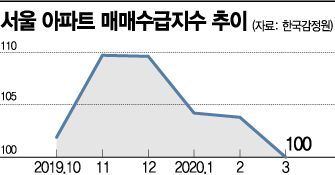
[Asia Economy Reporter Choi Dong-hyun] Following a decline in Seoul apartment prices for the first time in nine months, the 'seller's market' that had persisted for six months in the transaction market is also showing signs of weakening. A seller's market means that there are more buyers than sellers, so the market is led by sellers. This is interpreted as a result of shrinking housing demand due to expanded uncertainties in the domestic and international economy caused by the impact of the novel coronavirus infection (COVID-19), along with loan regulations and expanded investigations into the sources of home purchase funds.
According to the Korea Real Estate Board on the 6th, as of the 30th of last month, the Seoul apartment sales supply-demand index recorded 100. This index is a score that quantifies the balance of demand and supply by analyzing surveys from real estate agencies and the number of online listings. The closer the score is to '0', the more it indicates a buyer's market with supply exceeding demand, and the closer it is to '200', the more it indicates a seller's market with demand exceeding supply. A score of 100 means that demand and supply are balanced. The Seoul apartment sales supply-demand index had steadily risen above 100 since October 14 last year but reversed to a decline after the December 16 real estate measures. The Korea Real Estate Board expects that the 100-point level will break down within this month if the current trend continues.
The most recent period when the Seoul apartment market was a buyer's market was about 11 months from November 12, 2018, to October 7, 2019. Looking at the index trend, it sharply declined after the September 13, 2018 measures and then sharply rose from March last year, forming a 'V'-shaped graph. During the period when the sales supply-demand index was falling, Seoul apartment prices also followed the same trend, dropping by 1.57%.
In the recent market trend, as demand decreased relative to supply, urgent sale listings have appeared mainly in the Gangnam 3 districts (Seocho, Gangnam, Songpa), continuing the price decline. According to the KB Housing Market Trends data released on the 3rd, apartment prices in the Gangnam 3 districts fell for two consecutive weeks recently. For example, an 85㎡ apartment in Jamsil Els, Jamsil-dong, Songpa-gu, was sold for 1.94 billion KRW (5th floor) on December 11 last year but dropped by about 100 million KRW to 1.853 billion KRW on the 7th of last month. Similarly, an 85㎡ apartment in Dogok Rexle, Dogok-dong, Gangnam-gu, was traded for 2.39 billion KRW (9th floor) on the 8th, which is 100 million KRW lower than the 2.49 billion KRW (3rd floor) sale on December 11 last year. Due to these effects, as of the end of last month, Seoul apartment prices turned to a decline after 39 weeks.
In a buyer's market, there is a high possibility that demanders will continue to hesitate due to expectations of further price drops. In fact, real estate agencies around Gangnam-gu and Yongsan-gu have been accumulating listings little by little. The representative of real estate agency A in Daechi-dong, Gangnam-gu, said, "At the beginning of the year, urgent sale listings mainly from multi-homeowners who have held properties for over 10 years appeared, and recently, due to the impact of COVID-19, more people want to sell their homes. However, transactions are not going well, so prices are being lowered by 20 million KRW per week." The representative of real estate agency B in Yongsan-gu also said, "Although urgent sale listings have not yet accumulated significantly, asking prices are gradually decreasing."
Experts predict that the COVID-19 situation threatens the domestic real economy and that the end of this situation is uncertain worldwide, so the decline in demand is expected to continue for the time being. Professor Kwon Dae-jung of Myongji University Graduate School of Real Estate said, "Real estate lags behind economic conditions by about six months to a year," and added, "By June, the impact of the COVID-19 situation on the real estate market will become more apparent."
However, concerns have been raised that the implementation of the private land price ceiling system may shrink the supply of redevelopment and reconstruction, which are major housing supply sources in Seoul, and that the preference for new apartments remains, so a sharp drop in housing prices is unlikely. Ham Young-jin, head of the Zigbang Big Data Lab, forecasted, "Although a contraction in apartment demand seems inevitable, demand flowing into the subscription market remains, so a rapid price decline is unlikely."
© The Asia Business Daily(www.asiae.co.kr). All rights reserved.
![Clutching a Stolen Dior Bag, Saying "I Hate Being Poor but Real"... The Grotesque Con of a "Human Knockoff" [Slate]](https://cwcontent.asiae.co.kr/asiaresize/183/2026021902243444107_1771435474.jpg)
















