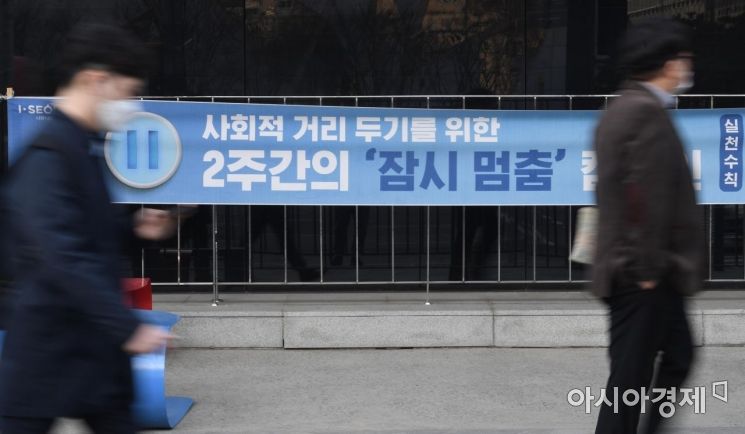
 As the period of intensified social distancing to prevent the spread of the novel coronavirus infection (COVID-19) has been extended for two weeks, commuters are hurrying near Seoul City Hall on the morning of the 6th. Photo by Hyunmin Kim kimhyun81@
[Asia Economy Reporters Choi Dae-yeol, Kim Heung-soon, Jo Hyun-ui] The number of new cases of the novel coronavirus infection (COVID-19) has fallen below 50 for the first time in a month and a half, drawing attention to whether the situation is entering a clear stabilization phase. Although the quarantine authorities emphasized that it is still based on daily figures and that the trend needs to be monitored, they believe that the high-intensity social distancing measures extended are beginning to show visible results one by one. As the impact of COVID-19 continues across society, including school openings, telecommuting by workplaces, and restrictions on the use of crowded facilities, social discussions about the timing of transitioning to daily life quarantine are expected to emerge.
Below 50 for the First Time in a Month and a Half
The 47 new COVID-19 cases confirmed on the 6th are the lowest since February 20, when 36 cases were reported (based on 9 AM the previous day to 9 AM that day). At that time, after a cluster infection was confirmed at the Shincheonji Church of Jesus in Daegu, the number of patients surged by dozens to hundreds per day. Subsequently, cluster infections presumed to be related to Shincheonji occurred nationwide, including at the Daenam Hospital in Cheongdo, Gyeongbuk, as well as sporadic cluster infections such as the call center in Guro-gu, Seoul, causing a steady increase in cases.
Previously, the number of cases increased by about one per day, but suddenly surged, resulting in significant casualties. The steady emergence of deaths mainly in the Daegu and Gyeongbuk regions is largely due to the inability to provide timely hospitalization and treatment during the initial surge in patients. COVID-19 patients require isolation and special treatment, but the rapid increase in cases over a short period prevented proper management.
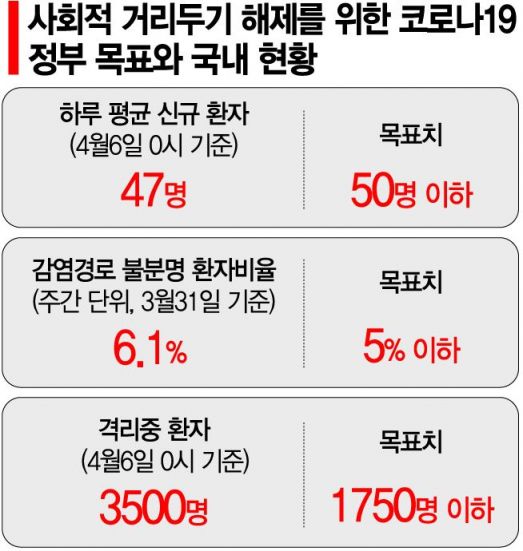
New Cases Below 50 and Unidentified Infection Routes Under 5%
The government decided to extend the 'enhanced social distancing' for two weeks from this day until the 19th and presented three goals for further easing: ▲daily new cases below 50 ▲cases with unknown infection routes under 5% ▲and a reduction of patients under isolation treatment to less than half. Yoon Tae-ho, head of the COVID-19 Central Disaster and Safety Countermeasures Headquarters' quarantine team, explained, "Currently, 97 large hospitals capable of treating severe COVID-19 patients have about 100 to 110 negative pressure intensive care units. If the daily new confirmed cases fall below 50, estimating 10% of them as severe cases (5 patients) and assuming an average treatment period of 21 days, the healthcare system can sufficiently handle the load."
The number of new confirmed cases entered the government's target range for the time being. However, it is too early to evaluate based on a single day's data. Yoon said, "We will not switch the policy based on one day's situation; we will judge whether the target is maintained for a considerable period and then decide on additional measures." The number of patients under isolation treatment, currently 3,500, must also fall below half, 1,750, and the proportion of confirmed cases with unknown infection routes, which was 6.1% as of the 31st of last month, must be lowered to under 5% daily.
The government and quarantine authorities are also considering small cluster infections occurring recently in high-risk facilities such as medium and large hospitals, nursing homes, and psychiatric hospitals as important evaluation criteria. Son Young-rae, head of the Central Disaster and Safety Countermeasures Headquarters' strategic planning team, said, "We will look at both the number and scale of cluster infections." From the 12th to the 21st of last month, there were a total of 11 cluster infections, and during the first week after the implementation of enhanced social distancing from the 22nd, the number decreased to 4, which the government interprets as evidence of the effectiveness of the guidelines.
© The Asia Business Daily(www.asiae.co.kr). All rights reserved.


















