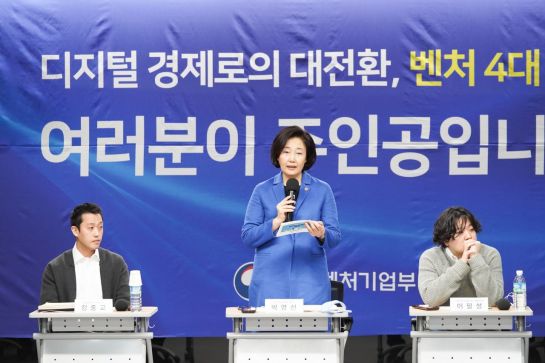
 Park Young-sun, Minister of SMEs and Startups (center), is announcing the new employment achievements of companies that received investments from venture capitalists at the briefing on the "Job Creation Effect of Venture Investment" held on the 6th at Tipstown in Yeoksam-dong, Seoul.
[Asia Economy Reporter Kim Daeseop] Venture investment has been found to significantly contribute to job creation in companies. It has achieved not only quantitative growth in the scale of venture investment but also qualitative outcomes in terms of job creation effects.
Park Young-sun, Minister of SMEs and Startups, stated at the briefing on the "Job Creation Effect of Venture Investment" held at Tipstown in Yeoksam-dong, Seoul, on the 6th, "Although the Ministry of SMEs and Startups faced the unexpected challenge of the novel coronavirus infection (COVID-19), we will focus our policy capabilities here to continue the enthusiasm for venture investment."
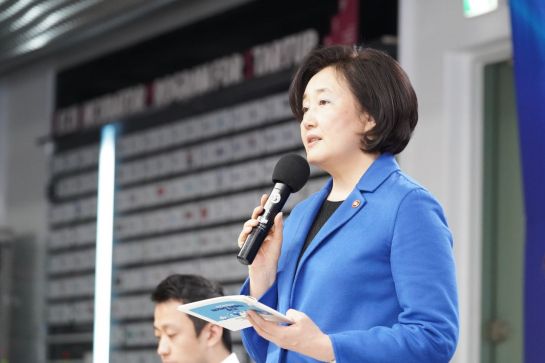
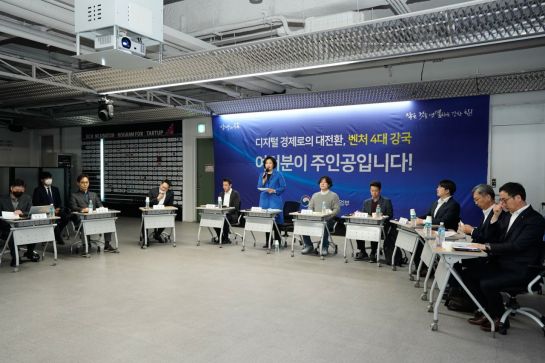
About ten stakeholders, including Minister Park, venture capital representatives, and startup leaders, attended the briefing. They presented and shared the effects and cases of job creation through venture investment. Minister Park emphasized, "There is a tendency for the investment market to contract due to COVID-19, but we plan to prepare additional measures so that it can stretch out again."
According to the Ministry of SMEs and Startups, employment in 3,339 companies that received investments from venture capital over the past five years increased by 59.4% (48,025 people), from 80,790 at the end of the year before the investment to 128,815 at the end of last year. The average number of employees per company rose from 24.2 to 38.6, indicating that each company newly hired 14.4 employees on average. The total amount invested in these companies by venture capital was 11.3956 trillion KRW, and it was calculated that 4.2 new employees were hired per 1 billion KRW invested.
Fresh Easy, a home meal replacement (HMR) meal kit manufacturer established in 2016, successfully attracted a total of 31.7 billion KRW in venture capital investment from 2018 to 2019. Through this, employment increased nearly elevenfold from 27 employees at the end of 2017, the year before the investment, to 293 employees at the end of 2019.
Jung Joong-kyo, CEO of Fresh Easy, said, "We started the company with the goal of delivering the freshness of home-cooked meals with the convenience of instant noodles. The growth of meal kits goes hand in hand with the growth of e-commerce." CEO Jung explained, "We are experiencing an average annual growth rate of 400%. This was possible thanks to investments and support from various venture capitalists."
Yanolja, a leisure platform company, also received a total of 37.3 billion KRW from venture capitalists between 2015 and 2018, leading to continued job creation. Employment increased by 667, from 119 at the end of 2014, the year before the investment, to 786 at the end of 2019. Yanolja continued to grow and was listed as a unicorn company (a non-listed startup valued at over 1 trillion KRW) in June 2019.
This analysis of job creation effects was conducted on 3,339 companies out of 4,613 companies that received investments in the recent five years from 2015 to 2019, for which employment information was available from the Korea Employment Information Service. Employment at the end of the year before the investment was compared with employment at the end of last year.
The Ministry of SMEs and Startups has been analyzing the job creation effects of venture investment since 2018. This year marks the third analysis, and the effect has shown an increasing trend every year. New hires per 1 billion KRW invested increased from 3.8 in 2018, to 4.0 last year, and 4.2 this year. New hires per company also increased annually from 10.6 in 2018, to 12.4 last year, and 14.4 this year.
Looking at the annual job trends of 718 companies that received investments in 2015, employment per company increased from 29.5 to 38.5 in the first year after investment. The growth rate was highest at 30.5%. Thereafter, employment steadily increased by an average of 9% annually, reaching 44.0 in the second year, 47.7 in the third year, 51.9 in the fourth year, and 54.4 in the fifth year.
Among the Fourth Industrial Revolution sectors, 'cloud' companies hired 8.7 new employees per 1 billion KRW invested. They were followed by 'intelligent semiconductors (8.6)' and 'blockchain (7.6)'. By industry, 'game' companies hired the most, with 5.8 new employees per 1 billion KRW invested. According to the Ministry of SMEs and Startups, the annual scale of venture investment has been increasing every year: 2.3803 trillion KRW in 2017, 3.4249 trillion KRW in 2018, and 4.2777 trillion KRW last year.
Jung Sung-in, Chairman of the Korea Venture Capital Association, emphasized, "I hope the recent economic crisis caused by COVID-19 will be overcome quickly. Although there are concerns in the venture industry, new technologies are always emerging, so venture investment will not shrink." Chairman Jung reiterated, "There is no need to worry about investment contraction."
Minister Park said, "Venture investment has not only grown quantitatively but also greatly contributed to job creation, showing qualitative achievements as well. This year, we will supply 1.3 trillion KRW from the Korea Fund of Funds to the investment market, and we will speed up the preparation of subordinate legislation for the Venture Investment Promotion Act scheduled for implementation in August, as well as the K-Unicorn Project, to continue the enthusiasm for venture investment."
© The Asia Business Daily(www.asiae.co.kr). All rights reserved.
!["The Woman Who Threw Herself into the Water Clutching a Stolen Dior Bag"...A Grotesque Success Story That Shakes the Korean Psyche [Slate]](https://cwcontent.asiae.co.kr/asiaresize/183/2026021902243444107_1771435474.jpg)


















