[Asia Economy Reporter Seulgina Jo] Marking the first anniversary of commercialization, the domestic 5G mobile communication industry is accelerating the deployment of In-Building equipment that delivers 5G signals inside buildings where radio waves do not reach starting this year. By the end of the year, it is expected that 5G In-Building services will be available in 2,000 to 2,500 locations, more than four times the number from last year. This move comes in response to criticism of 'dead zones' after the 5G In-Building deployment in the first year of commercialization reached only half of the initial target. However, difficulties are also anticipated as the recent spread of COVID-19 has caused delays in 5G network installations.
◆ Last year's In-Building installation target missed = According to the industry on the 6th, SK Telecom plans to install 5G In-Building equipment in about 2,000 locations this year, including airports, department stores, large shopping malls, and small to medium-sized buildings. In-Building service refers to transmitting wireless repeater signals inside buildings to subscribers located where radio waves do not reach. SK Telecom's 5G In-Building deployment in 2019, the first year of commercialization, reached only about 500 locations, half of the original target.
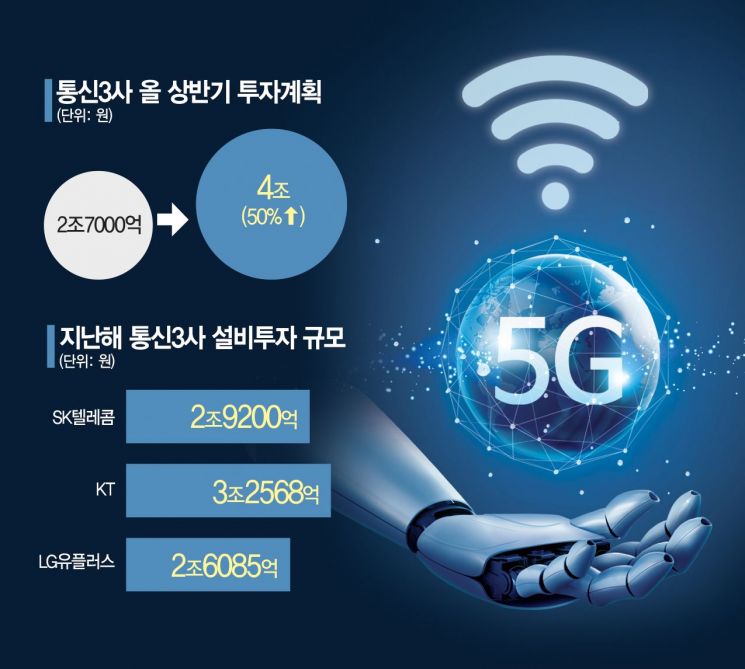
In the case of KT, 5G In-Building services are currently available in about 500 buildings, including KTX Seoul Station and airports. KT also failed to achieve its goal of deploying in 1,000 locations within the year. Although KT has not disclosed its target for this year, it is reported that coverage will expand to a level similar to SK Telecom. LG Uplus also plans to make investments in the 5G sector at a level similar to last year to secure a denser service network.
For the three telecom companies to shed the stigma of '5G that works worse than LTE (4G),' 5G In-Building investment is urgently needed above all else. Although these companies invested over 8 trillion won in capital expenditures (CAPEX) last year, the focus was on building outdoor base stations in major cities nationwide rather than In-Building deployments. An industry insider said, "All three companies competitively invested in 5G networks, but the In-Building deployment took more time than expected, falling short of last year's targets. It can now be seen as the beginning of the full-scale phase."
Especially from this year, when the first 5G quality evaluation is conducted, the quality of 5G in large buildings in downtown areas where many people gather is expected to be a key factor in the popularization of 5G. Currently, unlike outdoor base stations, a significant portion of 5G In-Building deployment is being carried out jointly through cooperation among the three companies. Considering this, it is estimated that by the end of this year, 5G In-Building services in Korea will expand to a total of 2,000 to 2,500 locations, more than four times the previous year.
◆ 5G investment scale increased by 50% = However, the problem lies in the impact of COVID-19. The three telecom companies increased their planned 5G investment for the first half of this year (4 trillion won) by 50%. This measure was taken to bring forward investments scheduled for the second half of the year in line with the government's policy to stimulate the economy. However, there are many concerns that private investments outside large corporations will not continue easily amid the sluggish economy.
Moreover, the prolonged 'high-intensity social distancing' due to COVID-19 has slowed the pace of 5G network construction. An SK Telecom official explained, "There is definitely a tendency for delays in recent In-Building infrastructure construction as residents are reluctant to allow outside visitors." Access to buildings is essential for 5G In-Building deployment. This atmosphere is similarly confirmed in business-to-business (B2B) sectors, such as smart factories and smart buildings, which the industry expects to be the real battleground for 5G competition.
An industry insider said, "It is difficult to estimate the future scale of 5G In-Building investment," adding, "Additional support measures are urgently needed to expand private investment." Previously, the Ministry of Science and ICT proposed expanding tax credits for 5G In-Building under the 'Restriction of Special Taxation Act' amendment, which the government promoted as part of economic stimulus, but this was not included in the final bill.
© The Asia Business Daily(www.asiae.co.kr). All rights reserved.
![Clutching a Stolen Dior Bag, Saying "I Hate Being Poor but Real"... The Grotesque Con of a "Human Knockoff" [Slate]](https://cwcontent.asiae.co.kr/asiaresize/183/2026021902243444107_1771435474.jpg)
















