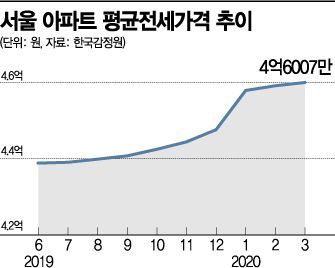
[Asia Economy Reporter Yuri Kim] The average jeonse price for apartments in Seoul has continued to rise since July last year, surpassing 460 million won. This increase is attributed to the government's December 16 measures last year that restricted mortgage loans for high-priced housing, as well as a rise in prospective buyers waiting for pre-sale applications targeting the private land price ceiling system, which has led to increased jeonse demand. Concerns over the expansion of uncertainty in the real estate market due to the COVID-19 pandemic have also contributed to the growing jeonse demand.
According to the Korea Real Estate Board on the 6th, the average jeonse price for apartments in Seoul recorded 460.07 million won last month. It steadily increased from 438.88 million won in June last year to 439.08 million won in July, surpassing the 460 million won mark. In the KB Kookmin Bank Live On monthly housing price trends, the median jeonse price for Seoul apartments also exceeded 450 million won for the first time since the statistics began, reaching 450.61 million won last month.
According to the Real Estate Board statistics, Seoul apartment prices fell last month for the first time in nine months. However, jeonse prices continue to rise. The sale price of a 61㎡ unit in Gaepo Jugong 5 Complex, Gaepo-dong, Gangnam-gu, Seoul, rose to 1.77 billion won in early February but dropped to 1.7 billion won on February 29, after the COVID-19 outbreak intensified. In contrast, jeonse prices for lower floors were traded at 450 million won on February 28 (4th floor) and 31 (2nd floor) last month. Considering that the 12th floor was traded at the same price on December 31 last year, the peak jeonse season, this effectively represents an increase.
However, the conversion from jeonse to monthly rent with a deposit due to increased property tax burdens has not yet been active. Based on confirmed jeonse and monthly rent dates up to the previous day, the proportion of jeonse contracts in Seoul increased from 70.6% in December to 71.5% in January and February, and 74.6% in March. Conversely, the proportion of monthly rent, semi-monthly rent, and semi-jeonse contracts decreased relatively. The proportion of semi-jeonse (ban-jeonse), where the deposit exceeds 240 months of monthly rent, was 13.8% in December, 11.1% in January, 11.9% in February, and 10.0% in March.
The jeonse-to-monthly rent conversion rate has also been declining since mid-last year, according to both the Real Estate Board and KB statistics. This rate refers to the ratio applied when converting a jeonse deposit into monthly rent. A decline in this rate means landlords’ monthly rent income decreases. Although the supply of monthly rent and semi-jeonse units is increasing, jeonse demand remains high. The market expects that the jeonse price, which suffers from a supply shortage, will continue its upward trend for the time being.
© The Asia Business Daily(www.asiae.co.kr). All rights reserved.
![Clutching a Stolen Dior Bag, Saying "I Hate Being Poor but Real"... The Grotesque Con of a "Human Knockoff" [Slate]](https://cwcontent.asiae.co.kr/asiaresize/183/2026021902243444107_1771435474.jpg)
















