Government: "If Small Business Owners and Self-Employed Provide Income Documentation, It Will Be Reflected Later"
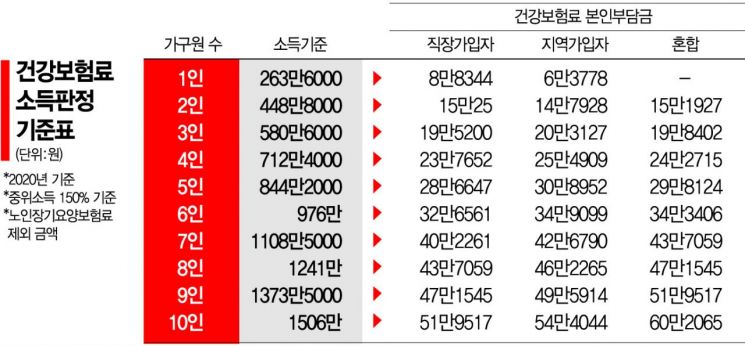
[Asia Economy Reporter Jang Sehee] The government announced that it will provide emergency disaster relief funds to households in the bottom 70% income bracket based on health insurance premiums as of March this year. However, there are several difficult tasks ahead, such as establishing criteria for high-net-worth individuals and negotiating the resource-sharing ratio between the government and local governments.
According to the emergency disaster relief fund payment criteria presented by the government on the 5th, whether a household is included as a recipient in the bottom 70% income bracket is determined by the total health insurance premiums paid by household members. For a four-person household, the bottom 70% income threshold is a health insurance premium personal contribution of 237,652 KRW for workplace subscribers, 254,909 KRW for regional subscribers, and 242,715 KRW for households with both workplace and regional subscribers (mixed).
① Establishing criteria for high-net-worth individuals to be determined later = The government has not yet announced specific exclusion criteria for high-net-worth individuals. According to government departments, various methods are being considered, such as excluding those subject to comprehensive real estate tax (종부세) from the recipients. Even if they fall within the bottom 70% income bracket, high-net-worth individuals will be excluded from the recipients. On the 3rd, Yoon Jong-in, Vice Minister of the Ministry of the Interior and Safety, stated, "The recipients of the emergency disaster relief fund will be determined using the personal health insurance premiums, specifically the total health insurance premiums imposed on the applying household members as of March 2020," adding, "Even if they qualify, we are considering excluding high-net-worth individuals from the selection of emergency disaster relief fund recipients."
② Negotiation of resource-sharing ratio between government and local governments = The emergency disaster relief fund will be funded 80% by the government and 20% by local governments. However, some regions are facing financial difficulties and may vary the payment levels, which could trigger an emergency to secure additional funds. Vice Minister Yoon said, "It is not easy for local governments to bear the costs related to the emergency disaster relief fund to expand the scope, but it is not impossible. We will continue to negotiate with local governments." There was no detailed plan on how to negotiate with local governments or any contingency plans if negotiations fail. In fact, Lee Jae-myung, Governor of Gyeonggi Province, said, "We will pay the already decided disaster basic income (100,000 KRW per resident) as is, and will not allocate additional matching budgets from Gyeonggi Province, paying only the government’s share of the emergency disaster relief fund."
③ Small business owners and self-employed must provide income documentation = Another issue is that the health insurance premiums used as the standard are based on income from the previous or the year before last. For regional subscribers, many of whom are small business owners or self-employed, the health insurance premiums are calculated based on 2018 income. The government plans to reflect the current income situation by requiring income documentation only from small business owners and self-employed individuals whose income has sharply declined, but since there are many such individuals, it is expected to take considerable time.
© The Asia Business Daily(www.asiae.co.kr). All rights reserved.
![Clutching a Stolen Dior Bag, Saying "I Hate Being Poor but Real"... The Grotesque Con of a "Human Knockoff" [Slate]](https://cwcontent.asiae.co.kr/asiaresize/183/2026021902243444107_1771435474.jpg)











