"Online Shopping Infrastructure and Industry Concentrated in the Seoul Metropolitan Area... Negative Impact on Regional Retail Sales"
[Asia Economy Reporter Eunbyeol Kim] Although the online shopping industry is growing due to the spread of the novel coronavirus infection (COVID-19), it has been found that as online sales increase, the growth rate of retail sales in non-metropolitan areas declines more sharply compared to metropolitan areas. While increased online consumption is offsetting the decrease in overall consumption caused by COVID-19, retail sales in local regions are actually declining further.
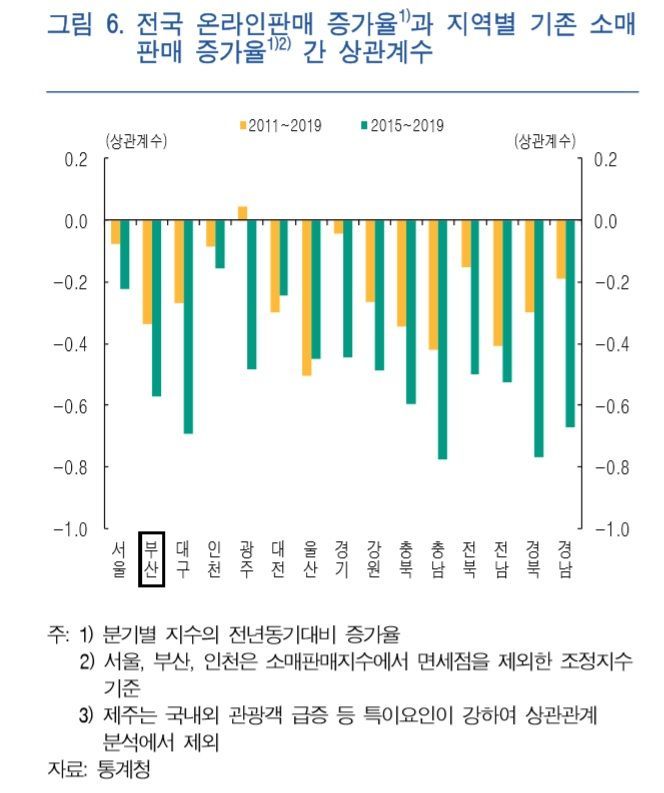
On the 4th, Jeong Minsu and Song Hyojin, managers at the Busan Regional Headquarters of the Bank of Korea, analyzed the impact of the online shopping industry on regional retail sales. They found that the correlation coefficient between the nationwide online sales growth rate and the growth rate of existing retail sales by region was negative in most areas. For example, when the nationwide online sales growth rate rises by 1 percentage point, the growth rate of existing retail sales (excluding online sales) by region is estimated to decrease by an average of 0.1 percentage points. In particular, the decline in non-metropolitan areas (-0.12 percentage points) was more pronounced than in metropolitan areas (-0.05 percentage points).
This phenomenon has been worsening recently. When limiting the estimation period to after 2015, the decline in the growth rate of existing retail sales in non-metropolitan areas was estimated at 0.3 percentage points, about three times larger than the decline during 2011?2019.
The reasons for the differing impacts of online shopping industry growth by region include ▲existing retail productivity ▲proportion of large retail stores ▲income levels ▲proportion of industries related to online shopping ▲internet usage rates.
First, in non-metropolitan areas, retail productivity is 170 million KRW (sales per employee), which is lower than the 250 million KRW in metropolitan areas. Because retail productivity itself is lower than in metropolitan areas, the damage caused by online shopping can be greater. The proportion of large retail stores (14.2%) is also lower than in metropolitan areas (17.8%), reducing the mitigating effect of large stores on the erosion of existing retail industries by online shopping. Typically, when large retail stores exist, people reduce online shopping and purchase directly.
Lower income levels also had an impact. Manager Jeong stated, "When income levels are high, there is a strong tendency to see and purchase luxury goods directly, and the price elasticity of demand is low, which may mitigate the effect of online shopping growth eroding existing retail sales."
Another issue in non-metropolitan areas is the low proportion of telecommunication sales and information service industries related to online shopping. Because related industries are scarce, even if online shopping grows, these areas tend to suffer rather than experience concurrent growth.
When the online shopping industry grows, employment in metropolitan areas increases significantly, whereas employment in existing retail sectors in non-metropolitan areas decreases sharply. Improvements in employment quality are also concentrated only in metropolitan areas. Manager Jeong said, "Since wages for telecommunication sales workers are higher than those for existing retail workers and telecommunication sales are concentrated in metropolitan areas, as the online shopping industry grows, the wage gap between regions in the overall retail sector may widen."
However, this regional disparity is not decreasing, raising concerns that the negative impacts of the online shopping industry may become more differentiated by region in the future. Accordingly, Manager Jeong pointed out the need for policy efforts to establish infrastructure related to the online shopping industry within local communities.
He emphasized, "Innovative conditions should be created so that the online shopping industry and related industries such as transportation warehousing and information services can develop together within regions, and support should be provided to enable workers who have left existing retail sectors to smoothly transition to other fields like the online shopping industry or to regain competitiveness and re-challenge."
© The Asia Business Daily(www.asiae.co.kr). All rights reserved.

















