Unmute Button Off, Hear Noise from Other Participants
But Microphone Not Working, Can't Answer Attendance
Attending Class Only via Smartphone Has Limits
Another Alternative Needed if Prolonged
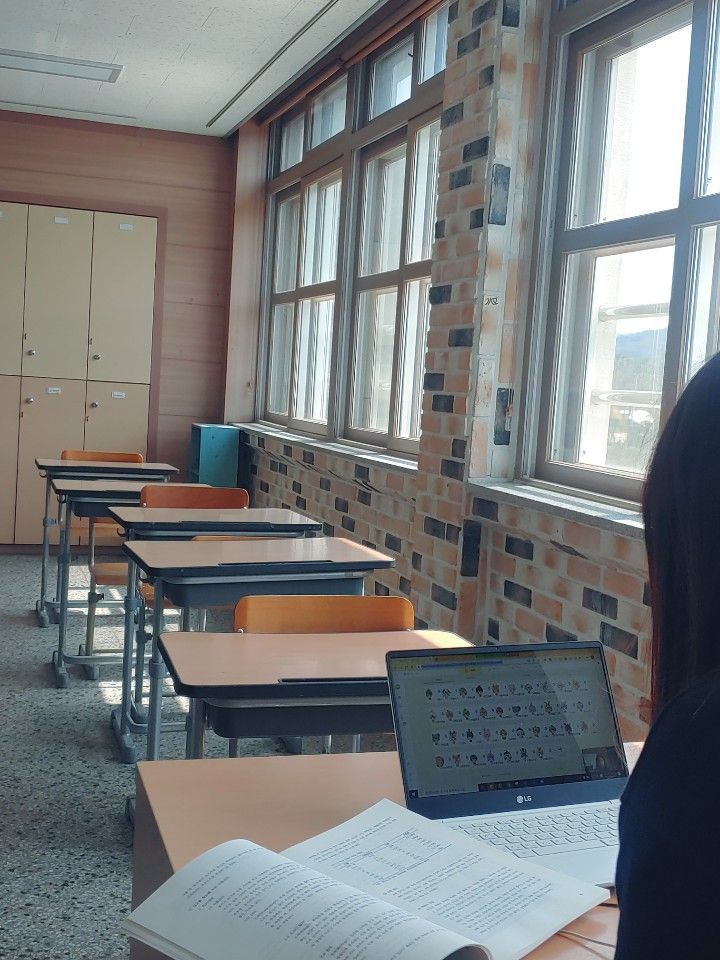 On the 2nd, a high school conducted a mock remote lecture attended by reporters accredited to the Ministry of Education. The teacher conducting the class is calling the attendance. (Provided by the Ministry of Education)
[Asia Economy Reporter Hyunju Lee] "From now on, I will call attendance just like a real class. Asia Economy reporter Hyunju Lee, are you here? Reporter Hyunju Lee? (...) You are not here. Marked absent."
On the 2nd, the Ministry of Education arranged an opportunity for reporters to directly experience remote high school classes. It was the first time for interactive remote classes. First, I looked for earphones with a microphone. After checking the performance, I connected them to my smartphone and entered an open chat room via the KakaoTalk PC version using the pre-notified address. Then, I downloaded the video chat application 'Zoom' on my smartphone and entered the link, which allowed me to join the remote class. The plan was to listen to the class on the smartphone like a video chat and use a laptop for taking notes.
At first, I was startled because no sound came through, but after unmuting the overall mute button, I could hear the teacher's voice. Unexpectedly, I also had to listen to the noise from other participants, but it did not greatly interfere with following the class. However, for some reason, only my voice was not heard. Attendance was called, but I could not respond. It seemed I was not the only reporter who could not answer. In a hurry, I typed in the Zoom chat room, "Asia Economy Hyunju Lee is present."
I intended to use both the smartphone and laptop, but it was overambitious. I was unfamiliar with the usage, which made things chaotic, and I soon felt fatigued. Even though I was wearing earphones with a microphone connected, I still do not know why only my voice was not coming through. I thought the microphone might be broken, but recording worked fine. Some reporters tried all the sound-related buttons during the class, but they said they could not even hear the teacher's voice.
No way to know if students are distracted
Random 'drawing' used to select students to answer
Concerns about learning loss if prolonged
Difficult for lower elementary and special school students to participate
The Ministry of Education stated that those who can use smartphones are, in principle, not eligible for smart device loans, but it was difficult to attend classes with only a smartphone. Staring at the smartphone screen for a long time seemed likely to cause significant eye strain. During the remote class, I missed about five minutes of the lesson due to a sudden call from a source.
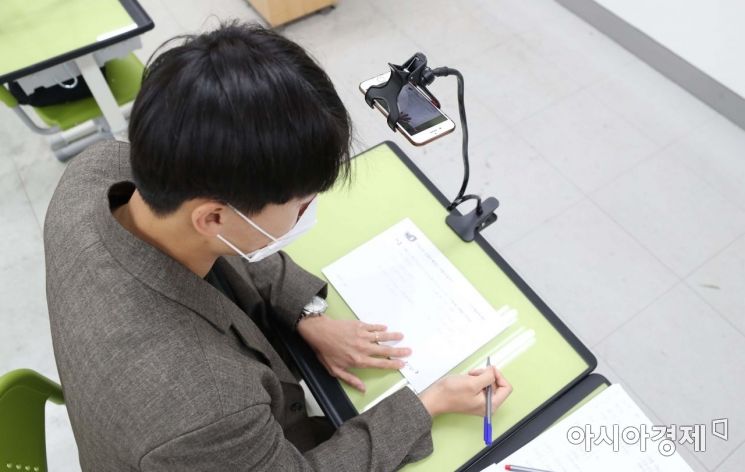 On the 30th of last month, a teacher at Hwibong High School in Dongdaemun-gu, Seoul, designated as a remote education pilot school, is recording a class video. Photo by Mun Ho-nam munonam@
Although it was an interactive class, the teacher had no way of knowing if students were watching YouTube or playing games. While there may be students who get distracted even in classroom lessons, it is clear that controlling this is difficult. To maintain tension, the teacher conducting the class used the 'drawing' feature to randomly select students to answer during the lesson. The teacher also asked students to take pictures of their notes and upload them to the open chat room, and after class, assigned a quiz using 'Microsoft Forms.'
Participating in the remote class firsthand, I felt it was obvious that learning loss would occur if online schooling is prolonged. It was difficult to concentrate in the chaotic online environment, and listening to lectures on a smartphone for several hours a day seemed challenging. The textbooks provided by the teacher were also hard to look at for long periods on a smartphone. Especially students in lower elementary grades or attending special schools seemed unlikely to be able to participate in remote classes alone no matter how you think about it. Middle and high school students will likely end up relying on private education that allows small group classes.
A parent in Israel, where online school started, became a hot topic on Instagram by saying, "If I don't die from COVID-19, I'll die from online classes." They lamented, "Teachers live in a fantasy, expecting children to be sitting in front of the computer at 8 a.m., but at that time, my daughter is just turning over in bed." Even in South Korea, which boasts itself as an IT powerhouse, this time it seems no different.
© The Asia Business Daily(www.asiae.co.kr). All rights reserved.


















