[Asia Economy Reporter Naju-seok] It has been found that fine particles of the novel coronavirus (COVID-19) can remain suspended in enclosed spaces for a considerable period. Most secretions and bodily fluids expelled from the body through coughing or sneezing fall to the ground, but some particles remain airborne in the form of fine particles.
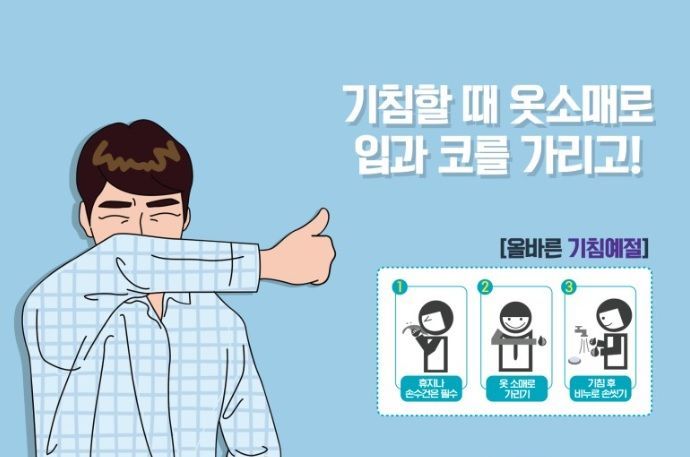
On the 3rd, Japan's Asahi Shimbun introduced research by Professor Masashi Yamakawa of Kyoto Institute of Technology, reporting these findings. According to the study, relatively large droplets up to 2 mm in size expelled by coughing fall to the ground within one minute, but fine particles measuring 0.004 to 0.008 mm are predicted to remain suspended in the air without falling even after 20 minutes.
In other words, in places with poor ventilation, if a COVID-19 positive individual has been present, the virus can remain airborne in the form of fine particles, posing a risk of transmission to others.
Professor Kenichi Azuma of Kinki University also stated, "Large droplets expelled by sneezing fall to the ground quickly, but fine particles can remain suspended in the air for some time."
At a Japanese expert meeting, it was also recommended that when ventilating, both windows on opposite sides should be opened if possible, rather than opening only one side.
This recommendation considers that replacing the indoor air with fresh air can help prevent infection.
© The Asia Business Daily(www.asiae.co.kr). All rights reserved.

















