Selection Method for Payment Recipients Confirmed
Criteria Selection for Rapid Payment
Application Based on Household Members as of March 29
Spouses and Children Registered as Dependents
Considered Same Household Even if Addresses Differ
When Health Insurance Subscriber is Regional
Targeting 4-Person Households with Monthly Premiums Below 254,909 KRW
Controversy Over Using Last Year's Income as Basis
[Sejong=Asia Economy Reporters Kim Hyunjung, Joo Sangdon, Jang Sehee] On the 3rd, the government’s decision to use 'health insurance premium payments as of March this year' as the criterion to determine recipients of the emergency disaster relief fund is interpreted as an unavoidable choice for rapid disbursement. Utilizing health insurance premium payment data allows the identification of the bottom 70% income group without additional manpower or time consumption. However, since over 70% of all health insurance subscribers are workplace subscribers whose premiums are mostly based on last year's income, there is a high possibility that current income is not reflected. Furthermore, workplace subscribers who have low income but own or rent high-value real estate may also receive the relief fund, so the government plans to consider excluding those subject to comprehensive real estate tax payments or asset owners above a certain wealth threshold.
◆Households Based on Resident Registration Records= For workplace subscribers (36.99 million as of the end of 2018), health insurance premium payments are calculated based solely on income from wages, business, interest, pensions, etc., since income is clear. In contrast, regional subscribers (14.082 million) have premiums calculated based on income plus assets such as land, housing, buildings, rental deposits, and passenger cars' income conversion values. The criteria used to determine premium payments differ. However, unifying these is practically difficult. The National Health Insurance Service only secures income data for workplace subscribers, making it hard to add assets, and excluding assets for regional subscribers would take considerable time. Ultimately, for rapid execution, the existing system using health insurance premium payments is used to select the bottom 70% income group.
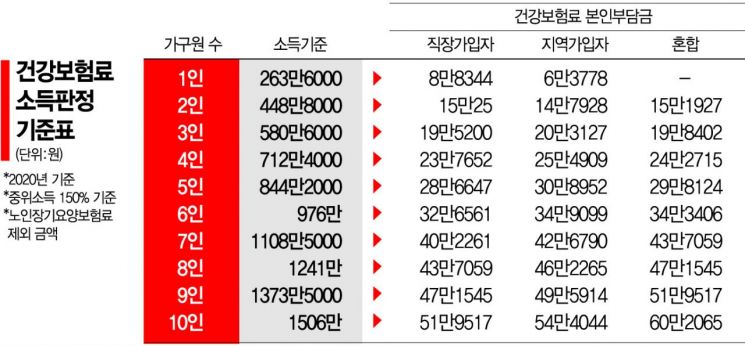
Specifically, the government presented the 'Emergency Disaster Relief Fund Selection Criteria Table' based on the 'Social Service Project Income Assessment Standard Table,' which calculates health insurance premium payments corresponding to each income level. According to this, for workplace subscribers, a 4-person household with a monthly health insurance premium payment of 237,652 KRW or less qualifies. The figures are ▲3-person household 195,200 KRW ▲2-person household 150,025 KRW ▲1-person household 88,344 KRW. For regional subscribers, the amounts differ: ▲4-person household 254,909 KRW ▲3-person household 203,127 KRW ▲2-person household 147,928 KRW ▲1-person household 63,778 KRW.
The emergency disaster relief fund is paid on a household basis, with households defined by the resident registration records as of the 29th of last month. Those registered together on the resident registration for each household under the Resident Registration Act are considered the same household. However, spouses and children registered as dependents of health insurance subscribers are considered the same household even if their addresses differ.
For example, if both the subscriber and spouse work at workplaces and their combined workplace insurance premiums total 190,000 KRW, they qualify for support. But if the subscriber’s workplace insurance premium is 100,000 KRW and the self-employed spouse’s regional insurance premium is 200,000 KRW, their combined mixed insurance premium is 300,000 KRW, excluding them from support. A subscriber living in City A and working, with a spouse and child living in City B, are considered a 3-person household of the subscriber in City A; if the subscriber’s workplace insurance premium is 170,000 KRW, they qualify for support.
◆Inevitable Controversy Over High-Value Asset Owner Criteria and Payment Timing= The problem with using health insurance premium payments to determine the bottom 70% income group is that high-value homeowners, tenants of rental properties, and owners of luxury passenger cars?whose income is not reflected?may become eligible for the relief fund. The government plans to establish exclusion criteria through additional review of related official data.
Excluding those subject to comprehensive real estate tax or asset owners above a certain scale is a likely measure. Those subject to comprehensive real estate tax are individuals whose combined official property prices of owned houses or land as of June 1 annually exceed ▲9 billion KRW for houses (apartments, multi-family, detached, etc.; 600 million KRW for multiple homeowners) ▲500 million KRW for comprehensive combined land ▲8 billion KRW for separately combined land (commercial or office annex land). Last year, 595,000 people were subject to comprehensive real estate tax based on notifications.
Another issue is timing. Although the government said it would use March health insurance premium payments to calculate the bottom 70% income group, premiums are based on last year's income. Those who recently lost jobs or took unpaid leave due to the COVID-19 pandemic and whose income has significantly decreased may be excluded from the relief fund. A National Health Insurance Service official said, "The timing is not fixed, but workplace subscribers’ income is usually reported to the NHIS by their workplaces around May to June. Unless the workplace files a revised income report, the March premium is based on last year's income."
For small business owners and self-employed individuals, recent income is also difficult to reflect. Therefore, the government plans to prepare various supplementary measures allowing local governments to consider the income situation at the time of application and make final decisions on support for small business and self-employed households whose income has sharply decreased but is not reflected in health insurance premiums.
© The Asia Business Daily(www.asiae.co.kr). All rights reserved.

















