Foreign Exchange Reserves Decrease by $9 Billion in March
Largest Decline Since the Financial Crisis
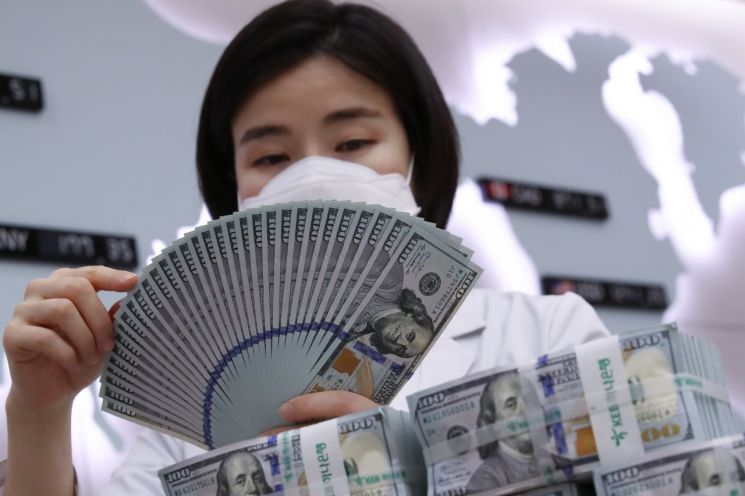
[Asia Economy Reporter Kim Eun-byeol] Last month, South Korea's foreign exchange reserves decreased by as much as $8.96 billion in just one month. This is the largest decline since the global financial crisis, causing the foreign exchange reserves to plummet to levels seen two years ago.
According to the Bank of Korea on the 3rd, South Korea's foreign exchange reserves at the end of March stood at $400.21 billion, down $8.96 billion from the previous month ($409.17 billion). This is the largest monthly decline since November 2008 (-$11.75 billion) during the financial crisis. The balance-based foreign exchange reserves are at their lowest level since May 2018. Until January, foreign exchange reserves had been hitting record highs, but they turned to a declining trend in February after six months and continued to decrease for two consecutive months.
◆ Bank of Korea: "Foreign exchange reserves exceed IMF standards" = The sharp drop in South Korea's foreign exchange reserves in March is related to the global "dollar shortage." Due to increased uncertainty caused by the COVID-19 pandemic, investors flocked to the dollar, and as dollars rapidly flowed out and the won-dollar exchange rate surged, the foreign exchange authorities released their dollar holdings to control exchange rate fluctuations. Although the Bank of Korea emphasizes that there is no need for concern, some in the market argue that additional safety measures are necessary.
A Bank of Korea official stated, "The decrease in foreign exchange reserves last month was the result of market stabilization measures," adding, "Currently, South Korea's foreign exchange reserves exceed the appropriate holding size calculated by the International Monetary Fund (IMF), so there is no need for major concern."
The IMF calculates appropriate foreign exchange reserve sizes reflecting each country's degree of openness. If a country's trade dependence and securities market openness are high, the risk of foreign capital outflow increases, so these factors are considered when suggesting appropriate foreign exchange reserves. South Korea is known to hold reserves exceeding the IMF's calculated standards despite its higher openness compared to other countries. However, South Korea's current foreign exchange reserves fall short of the more conservative Bank for International Settlements (BIS) standards. According to BIS standards, South Korea's appropriate foreign exchange reserves range between $600 billion and $800 billion.
Short-term external debt that South Korean companies and banks must repay within one year is also currently not at a dangerous level. According to the Bank of Korea, the short-term external debt ratio at the end of last year was 32.9%, up 1.8 percentage points from the previous year. This ratio, which compares short-term external debt to reserve assets (foreign exchange reserves), indicates whether external payment capacity is sufficient. The proportion of short-term external debt, which reflects external debt soundness, improved slightly to 28.8% compared to the previous year. This is still low compared to about 50% at the end of 2009, right after the global financial crisis.
◆ Possibility of second tranche of Korea-US currency swap funds next week = The Bank of Korea expects that if a dollar liquidity problem arises, it can resolve it by releasing funds from the Korea-US currency swap. The Bank of Korea plans to supply the second tranche of Korea-US currency swap funds to the market as early as next week. Although there are concerns that dollar demand may have eased after $8.72 billion out of $12 billion in the first tranche was awarded through competitive bidding on the 31st of last month, it is expected that the Bank of Korea will continue to release funds, sending a message to the market that "dollars will be supplied abundantly."
While there may be concerns about artificial intervention by foreign exchange authorities in the money market, the entire world is in a "wartime situation" releasing funds, and the U.S. Federal Reserve (Fed) has also announced unlimited dollar printing, so worries about this are minimal.
In particular, recent market interventions by foreign exchange authorities have been aimed at lowering the exchange rate, not raising it to create a favorable situation for exports.
Meanwhile, demands for a Korea-Japan currency swap continue in the market. Prime Minister Chung Sye-kyun said on the 27th of last month, "It is appropriate to have a currency swap with Japan as well." Since the yen is a key currency, a currency swap is always welcomed as a safety measure. However, it is reported that the yen is not currently in an urgent situation in the domestic foreign exchange market.
© The Asia Business Daily(www.asiae.co.kr). All rights reserved.
![Clutching a Stolen Dior Bag, Saying "I Hate Being Poor but Real"... The Grotesque Con of a "Human Knockoff" [Slate]](https://cwcontent.asiae.co.kr/asiaresize/183/2026021902243444107_1771435474.jpg)
















