March Cosmetics Export Value Hits Record High... Recovery in Chinese Consumption Leads
Cosmetics Companies Focus More on Online Than Offline Duty-Free Shops and Department Stores... Strategy Revision
[Asia Economy Reporter Lee Seon-ae] Cosmetic exports in March reached an all-time high. Although domestic exports in March turned negative due to sluggishness in semiconductors, petrochemicals, and petroleum products amid the COVID-19 pandemic, cosmetics performed well, solidifying their status as a new export growth engine. However, since the impact of COVID-19 in March was considered limited, domestic cosmetic companies have revised their business strategies to sustain the rebound.
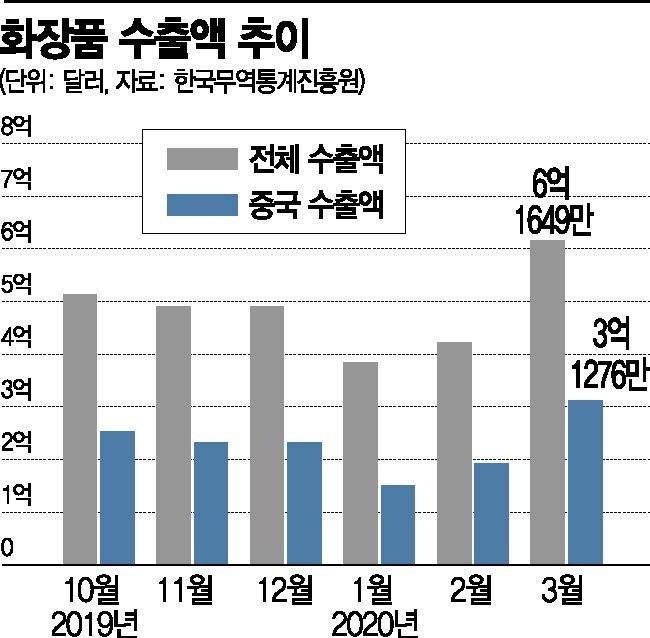
◆ China is the only reliable market, leading domestic cosmetic exports = According to the Korea Trade Statistics Promotion Institute on the 6th, cosmetic exports in March amounted to $616.49 million, a 30% increase compared to the same period last year, preliminarily reported. This is the highest monthly export value ever recorded. March had two more business days than last year, and even when adjusted for the same number of business days, exports increased by 18% year-on-year. Exports to China and Hong Kong increased by 40% compared to the same period last year, driving the export growth. Exports to Japan also stood out among major regions, increasing by 62% year-on-year.
Cosmetic exports to China reached $312.76 million, up 49% year-on-year and 63% month-on-month. It is analyzed that cosmetics consumption in China, especially through online malls, increased significantly in March as COVID-19 peaked in February. Exports to Hong Kong amounted to $94.56 million, up 15% year-on-year and 112% month-on-month.
Excluding China and Hong Kong, Japan showed strong performance. Exports to regions excluding China and Hong Kong in March were $210 million, up 15% year-on-year and 13% month-on-month. Exports to Japan were $48.92 million, up 62% year-on-year and 47% month-on-month.
Mi-jin Cho, a researcher at NH Investment & Securities, said, "Although overall Chinese consumption in the first quarter was expected to shrink compared to last year due to the COVID-19 situation, it recovered quickly, and demand recovery appeared due to the characteristics of cosmetics," adding, "It is judged that demand for domestic cosmetics remains high due to the recovery of Chinese consumption."
Jeong Park, a researcher at Yuanta Securities, also said, "The surge in exports to China enabled domestic cosmetic exports to achieve an all-time high in March," and added, "China is gradually stabilizing, and it is expected that consumption stimulation will continue as stimulus measures are introduced in the future."
◆ Overcoming the 'economic recession hurdle'... Strengthening online channels = Domestic cosmetic companies are busy. To maintain good export momentum in the second quarter, they are devising business strategies to minimize the impact of COVID-19.
Amorepacific made a sharp pivot. Although Amorepacific had set its channel strategy toward online, the proportion was not large, and it had focused on offline channels such as duty-free shops, department stores, and door-to-door sales. However, after experiencing the COVID-19 situation, it revised its channel strategy to focus more on online. Since offline channels (duty-free shops, department stores, etc.) have been hit hard by social distancing consumption patterns this year, it judged that recovery must come from online channels. In particular, it plans to strengthen its local online business in China. It also plans to design various content targeting first-, second-, third-, and fourth-tier cities. In the U.S. market, although Sulwhasoo was sold mainly through department stores, it will now actively utilize Sephora.com and others.
An Amorepacific official said, "We plan to focus on e-commerce both domestically and internationally, and will also focus on online channels for global new market entry," adding, "Domestically, we will strengthen Amore’s official mall, direct shopping malls, and e-commerce, and overseas, we will collaborate with Alibaba Tmall in China to sell products targeted specifically at the Chinese market."
LG Household & Health Care will also increase the online proportion and strengthen local customized marketing. Since there are no offline stores in China, it plans to sell mid-priced brands online. Luxury brands such as Su:m37 and Whoo will continue VIP marketing while being showcased in department stores and duty-free shops. For Physiogel (Asia and North America business rights), acquired earlier this year, sales channels include Watsons in China, home shopping in Japan, and Sephora and New Avon in the U.S. The goal is to develop Physiogel into a global representative derma brand by leveraging global networks.
An industry insider said, "Not only the big two domestic cosmetic companies (Amorepacific and LG Household & Health Care) but also all companies such as Aekyung Industrial and Tony Moly are focusing on strengthening overseas online channels," adding, "Although the economic recession impact due to the COVID-19 pandemic is inevitable, the impact on online consumption is expected to be mild, so partnerships with e-commerce companies are likely to become more active."
© The Asia Business Daily(www.asiae.co.kr). All rights reserved.

















