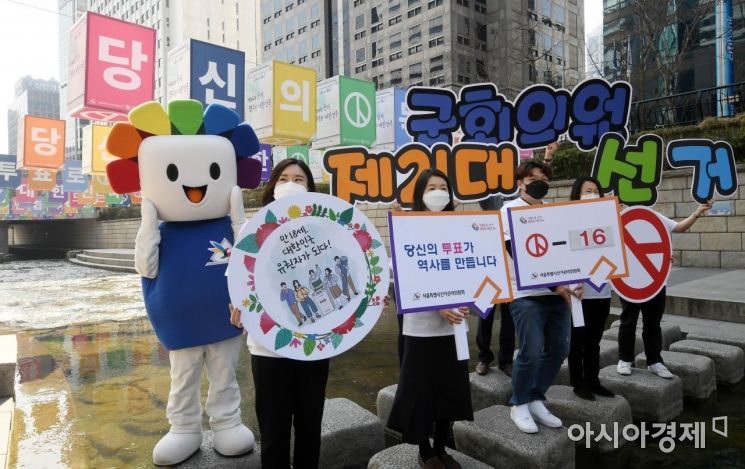
 Officials from the Seoul Metropolitan Election Commission are performing a voting encouragement event in front of the 'Beautiful Election Sculpture' installed at Cheonggyecheon, Seoul, ahead of the 21st National Assembly election on the 30th. Photo by Hyunmin Kim kimhyun81@
[Asia Economy Reporter Park Cheol-eung] According to the official voter awareness survey conducted by the National Election Commission, 72% of respondents expressed their intention to actively vote in the 21st general election. This public sentiment contrasts with predictions that the voter turnout for the 21st general election would decline due to the novel coronavirus disease (COVID-19). It is interpreted as a trend arising from the simultaneous rise in public opinion favoring regime stability during a crisis and calls for regime judgment.
According to the Election Commission on the 2nd, a first voter awareness survey was conducted at the end of last month through Korea Gallup by telephone interviews with 1,500 people, showing that about 72% responded that they would "definitely vote." This is about 8 percentage points higher than the 63.9% recorded in the first survey conducted ahead of the 20th general election four years ago. The voter turnout for the 20th general election was 58%.
Among respondents who said they would not vote, common reasons such as "I don't think anything will change even if I vote" or "I am not interested" were prevalent, while responses citing COVID-19 as a reason were minimal.
The Election Commission's survey has a larger sample size compared to media polls and is conducted solely through interviews rather than ARS (Automated Response System). Additionally, since it is known as the "official survey of the Election Commission," it has been regarded as relatively the most reliable.
Even considering that actual voter turnout tends to be lower than the awareness survey results, this shows an unusually high willingness to vote. Looking at historical general election turnout rates, since the 15th general election in 1996 recorded 63.9%, the rates fluctuated with 57.2% in the 16th, 60.6% in the 17th, dropped to a record low of 46.1% in the 18th general election, then rose to 54.2% in the 19th, and showed an increasing trend in the 20th general election.
Although there are many predictions that anxiety caused by COVID-19 will negatively affect voter turnout, the initial results are positive. An Election Commission official said, "The willingness to vote came out higher than we had feared," adding, "We need to analyze further, but it seems that the expansion of issues due to the introduction of the semi-proportional representation election system, lowering of the voting age, election law amendments, and the emergence of proportional parties has had some influence."
The biggest variable in recent voter turnout is the youth in their 20s and 30s. If the youth vote more actively, it generally leads to results favorable to progressive parties. This time, the direction of public sentiment amid COVID-19 is the biggest concern. While there is public opinion that the regime should be stabilized in times of uncertainty, the regime judgment sentiment in the Yeongnam region, which has been hit hard, may also play a role. An Il-won Ahn, CEO of Research View, said, "There is strong public opinion that the regime should be protected against vested interests symbolized by prosecutorial reform and that stability is needed in times of crisis," adding, "On the other hand, among groups strongly demanding regime judgment, COVID-19 may further increase voter turnout."
Meanwhile, with the official election campaign starting today, the Democratic Party will hold a joint launch event titled "Protecting the People" in the National Assembly in the afternoon together with the Together Citizens' Party. The main message is the "COVID-19 Worker Theory." Kim Jong-in, the general election campaign committee chairman of the United Future Party, visited Dongdaemun Market and Eulji Police Substation in Jung-gu, Seoul, from midnight to check on livelihood sites. The United Future Party is emphasizing the "Economic COVID Judgment Theory."
© The Asia Business Daily(www.asiae.co.kr). All rights reserved.

















