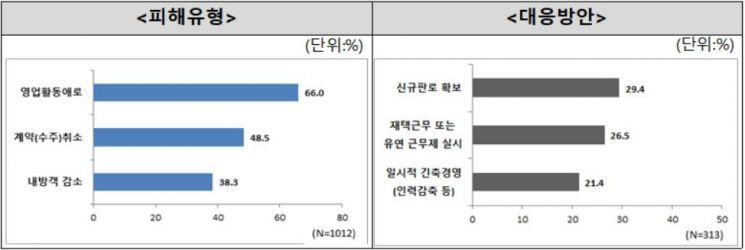
 Types of Damage to Women-Owned Businesses Related to COVID-19 and Countermeasures. Source: Women’s Enterprise Comprehensive Support Center
[Asia Economy Reporter Moon Hyewon] It has been revealed that 9 out of 10 women-owned businesses have suffered damage due to the novel coronavirus infection (COVID-19).
On the 1st, the Women’s Economic Research Institute conducted a survey on the 'Status of Damage and Difficulties Faced by Women-Owned Businesses Related to COVID-19' targeting a sample of 1,072 companies issued with women-owned business certificates. The results showed that 94.4% of the companies responded that they had suffered damage, and among them, 92.0% said the extent of the damage was 'significant.'
When asked about the types of damage, the most common response was 'difficulties in business activities' at 66.0%. This was followed by 'contract cancellations' (48.5%), 'decrease in visitors' (38.3%), and 'cancellations of reservations and exhibitions' (37.3%).
Regarding the expected duration of the damage, responses were in the order of '6 months to less than 1 year' (40.8%), '3 to less than 6 months' (32.2%), and 'more than 1 year' (17.2%). More than half of the respondents believed that the COVID-19 damage would continue for more than 6 months.
As for the self-response measures of women-owned businesses related to COVID-19, 'securing new sales channels (29.4%)' was the most common. This was followed by 'implementing telecommuting or flexible work systems (26.5%)' and 'temporary austerity management (such as workforce reduction) (21.4%).'
Regarding difficulties related to COVID-19, 32.9% reported that they had applied for support but did not receive sufficient assistance due to existing loans or other reasons. Additionally, 30.3% said that although they had applied for support, the decision was delayed, and they remained in a waiting state.
Furthermore, 14.2% of respondents received government support related to COVID-19, but among them, 78.3% generally felt that the support was insufficient.
The main reasons for feeling the support was insufficient were 'not receiving adequate support due to existing loans or other reasons' (32.9%) and 'delays in support decisions after application, resulting in prolonged waiting' (30.3%).
The proportion of respondents who said additional government support was necessary was also 81.3%.
© The Asia Business Daily(www.asiae.co.kr). All rights reserved.

















