[Asia Economy Reporter Kim Daeseop] The 'Small and Medium Enterprise (SME) Regulatory Impact Assessment Inspection Committee' has been launched to improve laws related to government department regulations that burden or disadvantage SMEs before the laws are finalized. This move comes from the judgment that active measures are needed as newly established or strengthened regulations that burden SMEs are increasing annually through amendments by various departments.
According to the Ministry of SMEs and Startups on the 1st, the number of SME regulatory impact assessments has significantly increased from 211 cases in 2016, 359 in 2017, 649 in 2018, to 1,161 in 2019. It has increased more than fivefold in three years. When the Office for Government Policy Coordination requests a regulatory impact assessment from the Ministry of SMEs and Startups, the ministry reviews the analysis report from the SME Regulatory Impact Assessment Center and collects field opinions before sending review comments to the Office and the relevant departments.
Last year, the Ministry reviewed 1,161 regulations across 584 SME-related laws and submitted modification opinions on 34 cases. Among these, 21 were reflected, resulting in a reduction of annual regulatory costs by 254.4 billion KRW for 60,191 SMEs. The SME regulatory impact assessment system has been in place since 2009, benchmarking the U.S. Regulatory Flexibility Act.
To systematically and professionally conduct over 1,000 regulatory impact assessments annually, the Ministry launched and began operating the Regulatory Impact Assessment Self-Inspection Committee from this day. Unlike large corporations, SMEs often find it difficult to even recognize unfavorable regulations being created, let alone voice their concerns, making them a 'silent majority.' Therefore, the ministry explained that they have preemptively formed an expert group that can continuously monitor such regulations and provide professional opinions.
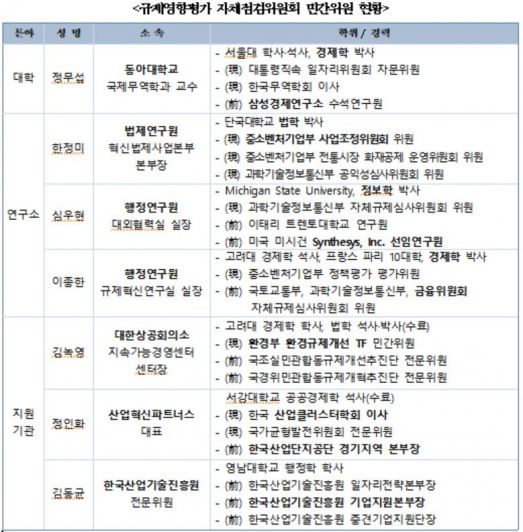
Seven private members were appointed to the Regulatory Impact Assessment Self-Inspection Committee: Professor Jeong Museop of Dong-A University’s Department of International Trade, Han Jeongmi, Head of the Innovation Legislation Division at the Korea Legislation Research Institute, Shim Woo-hyun, Director of External Cooperation at the Korea Institute of Public Administration, Lee Jonghan, Director of the Regulatory Innovation Research Division at the Korea Institute of Public Administration, Kim Nokyoung, Head of the Sustainable Management Center at the Korea Chamber of Commerce and Industry, Jeong Inhwa, CEO of Industrial Innovation Partners, and Kim Donggyun, Specialist at the Korea Institute for Advancement of Technology. Their term is two years.
During their term, the appointed members will review whether to provide opinions on over 1,000 newly established or strengthened SME-related regulations annually. Their main duties include contributing to enhancing SMEs’ industrial competitiveness by preventing new regulations by government departments, resolving excessive regulations compared to advanced foreign competitors, and proposing alternatives to regulations that are impossible with existing technology.
Lee Byungkwon, Policy Planning Officer at the Ministry of SMEs and Startups, said, "SMEs that feel burdened by frequently amended enforcement decrees, enforcement rules, and notifications from various departments can submit their opinions to the Self-Inspection Committee at any time." He added, "To quickly overcome the COVID-19 crisis, the Ministry will actively cooperate with related agencies to improve laws and regulations that companies perceive as regulatory burdens."
© The Asia Business Daily(www.asiae.co.kr). All rights reserved.

















