Online School Opening for All Elementary, Middle, and High Schools Nationwide from Next Month 9th, Excluding Kindergartens
"Preparing for School Attendance by Combining Online and In-Person Classes"
Rolling Student Record Submission Deadline September 16
CSAT Postponed by 2 Weeks to December 3
Regular Admission Application Deadline Extended to December 14
Device Ownership Survey Underway for All Schools Nationwide
67% Response Rate...170,000 Students Report No Devices
[Asia Economy Reporter Hyunju Lee] Except for kindergartens nationwide, elementary, middle, high schools, and special schools will conduct an unprecedented online school opening.
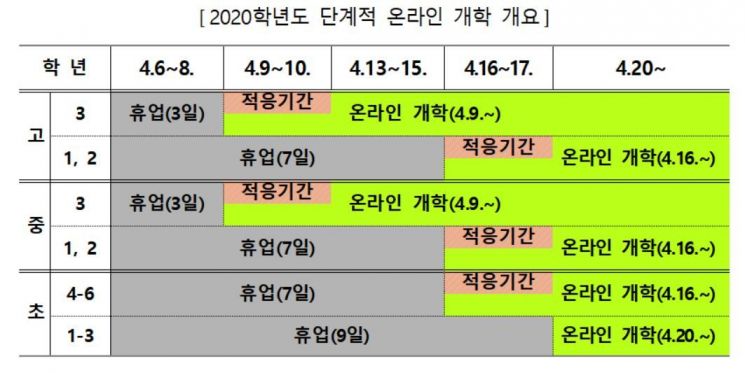
Online school opening will begin on April 9 for 3rd-year middle school and 3rd-year high school students, and on April 16 for 1st and 2nd-year high school and middle school students. Upper-grade elementary students will also start on the 16th, while lower-grade elementary students will have their online school opening last, on May 20.
The Ministry of Education announced this at a briefing held at the Government Complex Sejong on the 31st. Deputy Prime Minister and Minister of Education Yoo Eun-hye said, "An unprecedented situation continues where schools have not opened throughout March," adding, "Currently, schools in 165 countries worldwide are closed, and 1.5 billion students are unable to attend school." Deputy Prime Minister Yoo explained, "Rather than simply extending school closures by one or two weeks, it was deemed more appropriate to prepare for stable school attendance by combining online classes with in-person attendance."
In relation to this, more detailed information has been organized in a Q&A format.
=How will the 2021 university entrance exam schedule change?
▲Considering the difficulties faced by examinees and the education field, the College Scholastic Ability Test (CSAT) will be postponed by two weeks from the original schedule and held on December 3 this year. The deadline for submitting early admission student records will be extended from August 31 to September 16. Accordingly, the deadline for regular admission student records will also be postponed from November 30 to December 14. As a result, the early admission period is expected to be shortened by about three days, and the regular and additional admission periods by about eleven days. The revised university entrance exam schedule reflecting the changed CSAT date will be announced in April.

=How will the legally mandated number of school days change?
▲Until the first and second closure orders, summer and winter vacations were adjusted to secure school days first, but during the closure order from March 23 to April 3, the number of school days will be reduced. The reduction will vary depending on the sequential end dates of closures, but additional reductions will occur.
=What is the adaptation period after the online school opening?
▲Two days after the opening day for each grade will be set as an adaptation period for remote classes, during which students will experience the use of class content and platforms to prepare for full-scale remote learning. During the adaptation period, an online opening ceremony (principal’s greeting) and remote class orientation will be held to provide guidance on learning methods and attendance evaluation.
=Is the IT infrastructure fully prepared for the online school opening?
▲Plans are being made by city and provincial offices to provide smart devices and internet support for students from households with income below 50% of the median (education benefit recipients). Currently, about 290,000 students fall under this category. Among them, approximately 130,000 have already received smart devices and internet communication fee support. A survey on smart device ownership is being conducted for all students nationwide and will be completed by tomorrow. So far, 67% of responses have been received, with about 170,000 students reporting no smart devices. The plan is to lend devices held by schools and city/provincial education offices.
Lower-grade elementary students linked with EBS TV channels
Considering home visits or mailing learning materials
App development under review for multicultural families
=What are the contingency plans if remote connections are interrupted or unstable?
▲We will start with two-way communication methods, and if necessary, confirm via social network services (SNS) or phone calls. Since 6 million people will start simultaneously, a review will be conducted within a week.
=Remote education seems difficult for lower-grade elementary students, how will this be addressed?
▲It is challenging for 1st and 2nd graders to learn using PCs or smart pads. We are considering linking with EBS channels and plan to include a balanced mix of music, art, and physical education. Methods such as teachers visiting homes or mailing learning materials and then collecting and checking them are also being considered. For multicultural families, development of a simple learning application is under review.
 Eun-Hye Yoo, Deputy Prime Minister for Social Affairs and Minister of Education / Photo by Jinhyung Kang aymsdream@
=How will vocational high schools and arts and physical education schools respond?
▲For vocational high schools, which have many practical classes, a concentrated completion system will be used first. Theoretical classes will be conducted through remote learning, and practical classes will be completed intensively when conditions allow. Approximately 17,000 major subject and employment-related contents will be provided in consultation with related vocational education institutions.
=What about students with disabilities?
▲For students with visual and hearing impairments, remote classes will provide subtitles, sign language, and Braille. For students with developmental disabilities, various forms of remote classes and itinerant (visiting) education will be provided considering the type and degree of disability. Additionally, to support special education teachers’ remote classes, the National Institute of Special Education will operate an online learning room for students with disabilities starting from the 6th of next month.
=Will kindergarten openings be postponed indefinitely?
▲Kindergartens will extend closures after reviewing children’s developmental stages, play-centered curricula, and infection control possibilities. Fees other than tuition, such as transportation and specialized activity fees, will not be collected.
© The Asia Business Daily(www.asiae.co.kr). All rights reserved.



















