Large-scale unsold units in Ilsan complex sold in 2009
Sharp decline since then... continuous operating loss
Financial condition worsens, sale unlikely to be easy
Doosan Heavy Industries considers selling only 'prime' assets
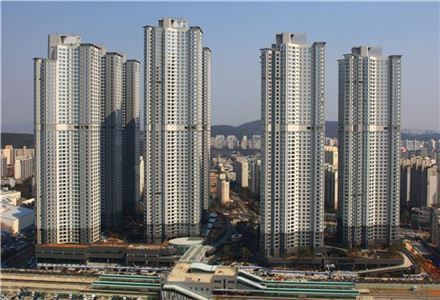 Ilsan Doosan We've the Zenith Panorama
[Asia Economy Reporter Moon Jiwon] 'The curse of Ilsan has ultimately held them back.'
This is the industry's assessment of Doosan Heavy Industries & Construction's decision the previous day to sell its subsidiary, Doosan Construction. Doosan Construction pursued a large-scale residential-commercial complex project called 'Ilsan Doosan We've the Zenith' in Tanhyeon-dong, Goyang-si, near Ilsan New Town in Gyeonggi Province, shortly after the global financial crisis in 2009. However, a large-scale unsold and unoccupied housing crisis occurred, and after a liquidity crunch, management has not normalized for over 10 years, leading to the search for a new owner.
Considering the large scale of Doosan's insolvency and the current construction market situation, the industry expects that there will be no suitable buyers willing to step forward easily, making the sale process difficult.
According to the industry on the 31st, the sale of Doosan Construction has been regarded as a foregone conclusion despite the group's denial since the decision to delist from the KOSPI was made at the Doosan Heavy Industries & Construction board meeting in December last year. This is because Doosan Heavy Industries & Construction, which has been experiencing the government's nuclear phase-out policy, continuous poor performance of subsidiaries, and a liquidity crisis due to massive borrowings, is expected to no longer be able to bear Doosan Construction's insolvency.
The decisive cause of Doosan Construction's staggering for over 10 years is the Ilsan Doosan We've the Zenith project. This large-scale residential-commercial complex with 2,700 households caused a massive unsold housing crisis due to aggressive pricing and a design focused on large units with shallow demand segments, amid the housing market downturn that began in earnest after the financial crisis.
Even after move-in, the unsold housing crisis continued, pushing the company into a liquidity crunch. Although group affiliates including Doosan Heavy Industries & Construction provided nearly 2 trillion KRW in funding support, the business contraction and interest burden made it difficult to escape losses. Especially after the failure of the Ilsan project, business shrank, leading to a vicious cycle of insufficient orders and poor performance.
In fact, Doosan Construction recorded net losses every year since 2011. At one point, borrowings reached as high as 1.5 trillion KRW, and due to heavy debt, the company was unable to even pay interest with its earnings. Although borrowings were reduced through capital increases, as of the end of last year, separate basis borrowings still amounted to 725.7 billion KRW. In particular, short-term borrowings maturing within one year reportedly reached 585.1 billion KRW. Korea Credit Rating downgraded Doosan Construction's 94th unsecured convertible bonds (BW) credit rating from 'BB- (Stable)' to 'BB- (Watchlist Downward Review)' the day before.
The industry also expects the sale process to be challenging. While Doosan Construction's apartment brand 'We've' and civil engineering capabilities are strengths, its financial condition has deteriorated due to years of poor performance. However, it is known that Doosan Heavy Industries & Construction is considering selling only the prime assets while leaving behind bad assets, so there is a possibility that the sale may accelerate.
© The Asia Business Daily(www.asiae.co.kr). All rights reserved.
















