From April 1, Small Business Owners in Daegu and Gyeongbuk Special Disaster Areas Receive 50% Electricity Bill Reduction
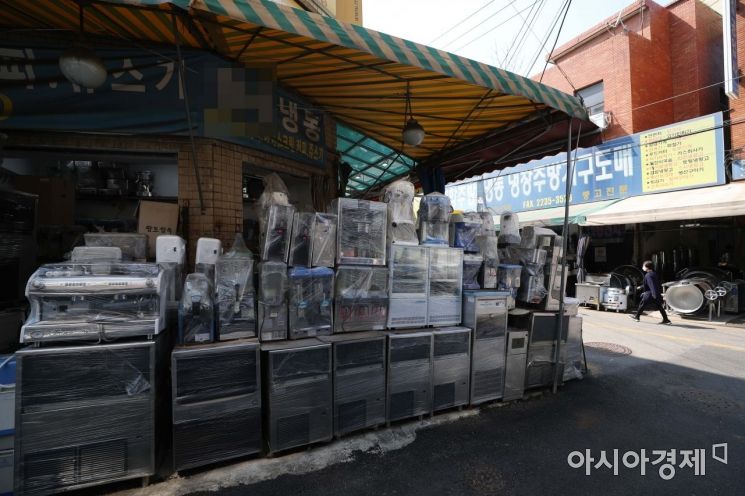 The wrinkles of small business owners and self-employed individuals are deepening due to the impact of COVID-19. Photo by Mun Ho-nam munonam@
[Asia Economy Reporter Moon Chaeseok] The government considered a plan to reduce part of the electricity bill but ended up only postponing the payment deadline by three months for 4,772,000 households of small business owners and low-income groups due to Korea Electric Power Corporation's (KEPCO) management crisis. The electricity bill reduction for small business owners in special disaster areas such as Gyeongsan City, Bonghwa County, and Cheongdo County in Daegu and Gyeongsangbuk-do will be implemented starting from the 1st.
On the 31st, the Ministry of Trade, Industry and Energy announced that it will implement measures to reduce the electricity bill burden to overcome the novel coronavirus infection (COVID-19) in cooperation with KEPCO and others. According to the 'Electricity Bill Burden Relief Plan' confirmed at the 3rd Emergency Economic Meeting the day before and announced by the government, the government and KEPCO decided to extend the monthly electricity bill payment deadline by three months starting from the bills issued on the 18th of next month for vulnerable groups. Even after the three-month extension period ends, payments can be made in installments until the end of this year. The Ministry of Trade, Industry and Energy explained that the extension effect can last up to seven months.
Payment deferrals will be provided for 3.2 million small business households and 1.572 million low-income households. Small business owners are defined as businesses with fewer than five regular employees (ten for manufacturing and mining industries). The low-income group includes basic livelihood security recipients, near-poverty income earners, persons with disabilities, and independent or distinguished veterans. Households receiving welfare discounts for residential use and small business owners who receive KEPCO bills and pay directly to KEPCO can apply for payment deferral through KEPCO's cyber branch or call center. However, small business owners must prepare their customer number and business registration number.
The government estimates a total effect of 1.2576 trillion KRW from the payment deferral. This is based on the assumption that the average monthly electricity bill is 125,000 KRW for small business owners and 20,000 KRW for low-income groups. All financial costs arising from the payment deferral will be borne by KEPCO. A Ministry of Trade, Industry and Energy official said, "Through this electricity bill payment deferral measure, the payment deadlines for bills issued from April to June will be extended by three months each," adding, "During this period, there will be no obligation to pay electricity bills or late fees of 1.5%, which will help alleviate the electricity bill burden on small business owners and vulnerable groups struggling due to COVID-19."
In the power industry, it is said that if KEPCO had maintained a normal financial status, it could have provided electricity bill reductions to all citizens and companies. The government and KEPCO temporarily reduced residential and industrial electricity rates in 2015 when MERS (Middle East Respiratory Syndrome) spread. KEPCO's operating profit recorded 12.0016 trillion KRW in 2016 but plunged into losses for two consecutive years starting in 2018. KEPCO's performance decline began when the government's nuclear phase-out (energy transition) policy was fully implemented. Last year's operating loss was 1.3566 trillion KRW, the largest loss in 11 years since the global financial crisis in 2008. The debt ratio also rose from 143.4% in 2016 to 186.8% last year.
As a follow-up measure to the 'Special Disaster Area Small Business Electricity Bill Support Project' passed by the National Assembly on the 17th, electricity bills for small business owners in special disaster areas will be reduced. The eligible small business owners are those using residential (limited to non-residential), industrial, or general electricity with fewer than five or ten regular employees depending on the industry. Fifty percent of the bills for six months (April to September) will be supported. The maximum support is up to 600,000 KRW per month. The support will be provided by reducing 50% of the electricity bill on the current month's bill. The Ministry of Trade, Industry and Energy expects an average reduction effect of 62,500 KRW per month per small business owner who applies for the electricity bill reduction. Over six months, this amounts to a saving of 375,000 KRW.
© The Asia Business Daily(www.asiae.co.kr). All rights reserved.
![Clutching a Stolen Dior Bag, Saying "I Hate Being Poor but Real"... The Grotesque Con of a "Human Knockoff" [Slate]](https://cwcontent.asiae.co.kr/asiaresize/183/2026021902243444107_1771435474.jpg)
















