Hong Nam-ki, Deputy Prime Minister and Minister of Economy and Finance
"Fiscal policy is the last bastion protecting the economy... I will do my best as the minister guarding the treasury"
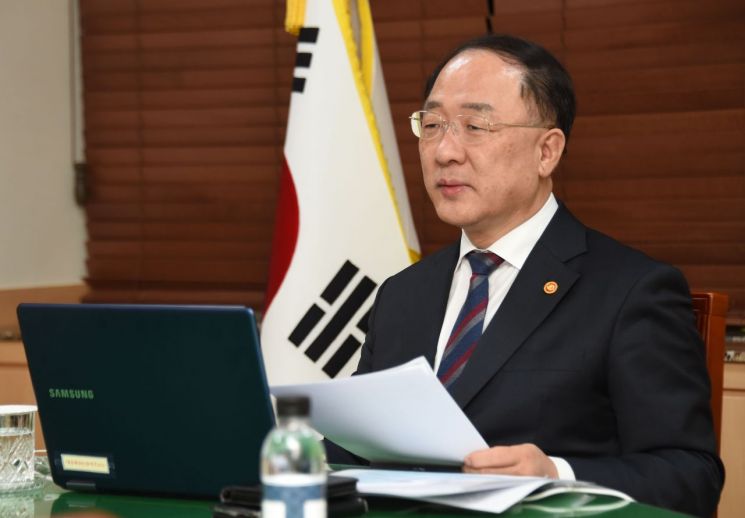
[Sejong=Asia Economy Reporter Kim Hyunjung] Hong Nam-ki, Deputy Prime Minister and Minister of Economy and Finance, stated regarding the funding for the emergency disaster relief fund in response to the novel coronavirus infection (COVID-19), "As the responsible minister, I will manage it through maximum expenditure restructuring."
Deputy Prime Minister Hong appeared on KBS 9 o'clock news on the 30th and said, "The required funds of more than 7 trillion won for the emergency disaster relief fund will be secured through painful restructuring." Earlier, the government announced that a total of 9.1 trillion won in disaster relief funds would be provided to 14 million households in the bottom 70% income bracket affected by COVID-19. Among this, the central government will bear about 7.1 trillion won, and local governments about 2 trillion won. The 7.1 trillion won funding will be secured as much as possible through restructuring of this year's main budget of 512 trillion won rather than issuing deficit bonds.
He reiterated, "If insufficient, deficit bonds may be issued again, but as the responsible minister, I will secure funds through maximum expenditure restructuring." He explained, "For example, with interest rates falling, the budget for interest payments will decrease, and with oil prices halving, there will be budget savings related to oil. Also, among the unused budgets of investment projects stalled due to the COVID-19 situation, there are budgets that can be mobilized without damaging their original purposes."
Regarding additional large-scale tax cut measures, he expressed a negative stance, saying, "We are not considering it separately." Deputy Prime Minister Hong said, "Through the first supplementary budget, we implemented tailored tax relief measures such as reductions in corporate tax, income tax, and value-added tax for small business owners," adding, "Large-scale tax cut policies are controversial in terms of effectiveness and inevitably affect tax revenues." He added, "We will provide tailored tax relief so that those in need can receive it."
Regarding gift certificates and electronic money provided according to government policy, he said, "We will ensure through supplementary measures that they are connected to consumption as quickly as possible," adding, "Usage periods can be set to three months, etc., and may vary by local government."
Furthermore, Deputy Prime Minister Hong explained the decision to set the support target at the bottom 70% income bracket, saying, "Initially, the Ministry of Economy and Finance judged that about the bottom 50% income bracket was appropriate, but due to the large damage to the people, it was decided to expand the support range based on the majority opinion." He also emphasized, "Fiscal policy is the last bastion to protect the economy, and as the minister responsible for managing the treasury, it is difficult to gauge the extent of the economic ripple effects. Regarding fiscal capacity, I firmly oppose distributing funds to the entire population, but I believe it is the government's duty to make efforts to supplement income for vulnerable groups."
© The Asia Business Daily(www.asiae.co.kr). All rights reserved.

















