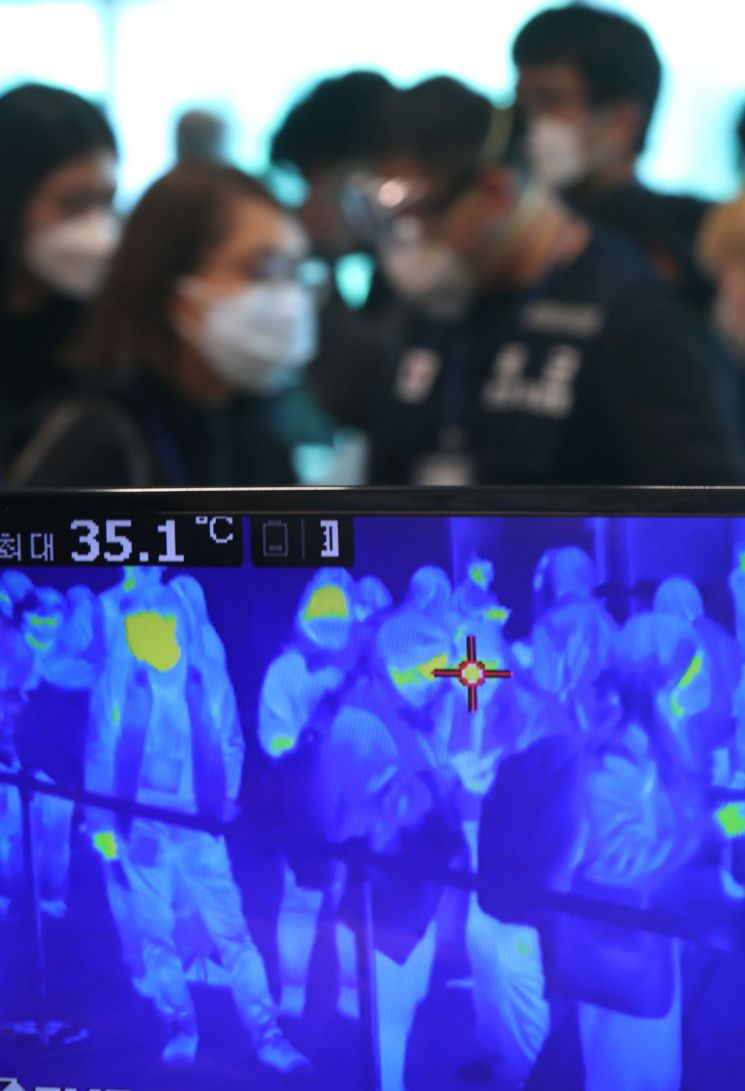
 Passengers arriving on a flight from Paris at Terminal 2 of Incheon International Airport are undergoing special entry procedures such as quarantine and contact information verification. [Image source=Yonhap News]
[Asia Economy reporters Choi Dae-yeol, Kim Heung-soon, Jo Hyun-ui] Starting from the 1st of next month, a two-week quarantine will be mandatory for all domestic and foreign nationals entering Korea, which is expected to significantly reduce the number of foreigners visiting Korea for short-term stays such as tourism. However, since a considerable portion of the confirmed COVID-19 cases imported from overseas during the quarantine process are Korean nationals, the possibility of a short-term decrease in new cases is low. For foreigners without domestic accommodation, facilities near the airport, where European arrivals have been waiting for COVID-19 testing, are being considered as places to stay.
Imported cases account for 5% of total patients
Mandatory for foreigners without accommodation
Accommodation and meal costs of about 1.4 million KRW borne by individuals
According to the Central Disaster and Safety Countermeasure Headquarters on the 30th, the average daily number of domestic and foreign nationals entering Korea recently is around 8,000. Although this is a significant decrease from the approximately 130,000 before the COVID-19 outbreak, the return of students and others to Korea continues. The government has decided to expand the two-week self-quarantine, previously applied to arrivals from Europe and the United States, to all arrivals starting from the 1st of next month. Those entering for diplomatic or official purposes or for contracts and investments must obtain prior approval from Korean embassies to be exempt from the two-week quarantine guidelines.
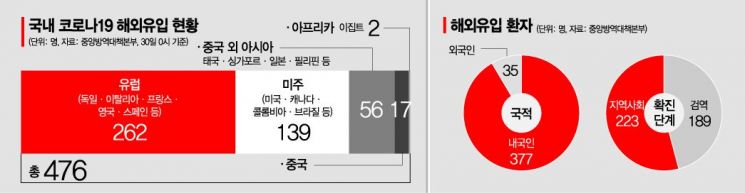
With arrivals who were previously only under active monitoring without quarantine now included in the quarantine target, securing adequate facilities to accommodate them is crucial. According to the Disease Control Headquarters, 202 people have been confirmed positive during the quarantine process, including 13 confirmed cases yesterday. Including those who were not detected during quarantine but later tested positive after returning to local communities, the total number of imported cases is estimated at 476 as of this date, accounting for about 5% of all domestic cases.
The government has not yet disclosed where arrivals without accommodation will stay. However, it is reported that they are considering using facilities where arrivals have previously waited for diagnostic testing during quarantine. For European arrivals, since the 22nd, they have stayed for about half a day at training centers or hotels and resorts near the airport while undergoing testing. The government had secured about eight facilities near the airport, including the SK Muui Training Center, with a capacity of approximately 1,175 people for waiting for test results. Yoon Tae-ho, head of the quarantine task force, said in a briefing yesterday, "Previously, arrivals from Europe and the U.S. stayed at facilities while waiting for test results, but going forward, most will have to undergo 14 days of self- or facility quarantine, so such cases will disappear."
Accommodation and meal costs for facility use must be borne by the arrivals themselves. They will have to pay about 1.4 million KRW in total for two weeks, at roughly 100,000 KRW per day. Assuming that 10% of daily arrivals are foreigners and about half of them have unclear accommodation, the number is expected to be around 400 to 500 people. Park Neung-hoo, the first deputy head of the Central Disaster and Safety Countermeasure Headquarters, said, "Depending on how much the number of arrivals increases, it may vary, but we have secured sufficient facilities within a predictable range." A hotel official near Incheon International Airport said, "Reservations for next month are possible, but we cannot disclose in principle whether there are self-quarantined guests."
Central Disaster Headquarters: "Facilities secured within scope"
Rapid increase in confirmed cases from Asia and Middle East beyond US and Europe
With foreigners visiting Korea for travel also included in the quarantine target, concerns have been raised that the administrative burden on public health centers managing self-quarantine may increase. Choi Bok-su, head of the Disaster Cooperation Office at the Ministry of the Interior and Safety, said, "The burden has already grown to the point where public health centers alone cannot cope, so practically all local government personnel have been cooperating from early on," adding, "We have discussed strengthening self-quarantine measures extensively, and with the installation of safety protection applications, information is shared quickly, reducing management tasks."
The decision to mandate two weeks of quarantine for virtually all arrivals is due to the rapid increase in COVID-19 cases worldwide. Around the time the World Health Organization declared the COVID-19 pandemic, cases surged mainly in Europe, including Italy and Spain, followed by a rapid increase in the United States. Recently, dozens of countries have been reporting hundreds of new cases daily.
According to data from the statistics site Worldometer, Korea ranks around 12th in total cumulative confirmed cases but is outside the top 40 in terms of daily new cases. The number of cases has been sharply increasing recently in Latin American countries such as Peru and Mexico, which have limited travel exchanges with Korea, as well as in countries like the United Arab Emirates (UAE) and Saudi Arabia, which had previously been considered relatively well-controlled. According to WHO, COVID-19 has now been reported in 174 countries.
Meanwhile, as of midnight today, 78 new COVID-19 cases were reported, bringing the total domestic cumulative cases to 9,661. The number of recovered patients increased by 195 to a total of 5,228 who have been released from isolation. Deaths increased by 7 to a total of 159, while the number of patients currently in isolation and treatment decreased to 4,275. The regions with the highest number of new cases are Seoul (16), Gyeonggi (15), and Daegu (14), in that order.
© The Asia Business Daily(www.asiae.co.kr). All rights reserved.


















