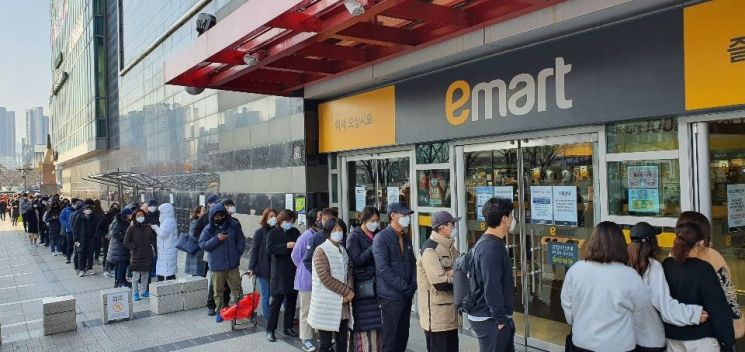
[Asia Economy Reporter Eunmo Koo] Amid the ongoing consumption contraction caused by the novel coronavirus disease (COVID-19), retail stocks leveraging diverse channel competitiveness are gaining attention.
According to the Korea Exchange on the 30th, Emart's stock price fell by only 0.9% as of the closing price on the 27th of this month. Considering that the KOSPI dropped by 13.6% during the same period and most stocks experienced a sharp decline due to COVID-19, this is a relatively strong performance.
With increased demand for daily necessities such as groceries due to the impact of COVID-19, both online and offline consumption have risen, highlighting these stocks as relatively defensive even in a challenging market environment. Orin Ah, a researcher at Ebest Investment & Securities, explained, "Initially, it was expected that only online sales would increase strongly due to the preference for 'untact' consumption, meaning contactless, but consumer panic buying and the advantage of immediate purchase have also led to increased offline traffic."
First-quarter earnings this year are also expected to improve compared to the previous quarter. According to financial information provider FnGuide, Emart is estimated to have recorded an operating profit of 72.7 billion KRW in the first quarter, turning profitable from an operating loss of 10 billion KRW in the fourth quarter of last year. Sales during the same period are also expected to grow by 2.6% to 4.9603 trillion KRW.
The COVID-19 crisis is expected to further strengthen the online daily necessities market. Although online shopping for major consumer items has already become routine, the online purchase ratio in the food and beverage market is relatively low, indicating high growth potential. Na Eunchae, a researcher at Korea Investment & Securities, analyzed, "In a situation where high growth of the online food and beverage market is expected, large marts with significant logistics investments and competitiveness in fresh food can increase channel loyalty." It is also noteworthy that middle-aged and older consumers, who were not accustomed to online shopping, have experienced it voluntarily or involuntarily due to the pandemic.
Convenience store companies are also expected to see relatively stable performance within the retail industry as local purchases expand due to COVID-19. GS Retail, the leading convenience store stock, is estimated to have an operating profit of 26.5 billion KRW in the first quarter of this year, a 23.8% increase compared to the same period last year. During the same period, BGF Retail is also expected to grow by 8.6% with an operating profit of 28.6 billion KRW.
© The Asia Business Daily(www.asiae.co.kr). All rights reserved.